Love addressed questions regarding Title IX, how it’s applied and what his office is working on in regards to advocacy and awareness.



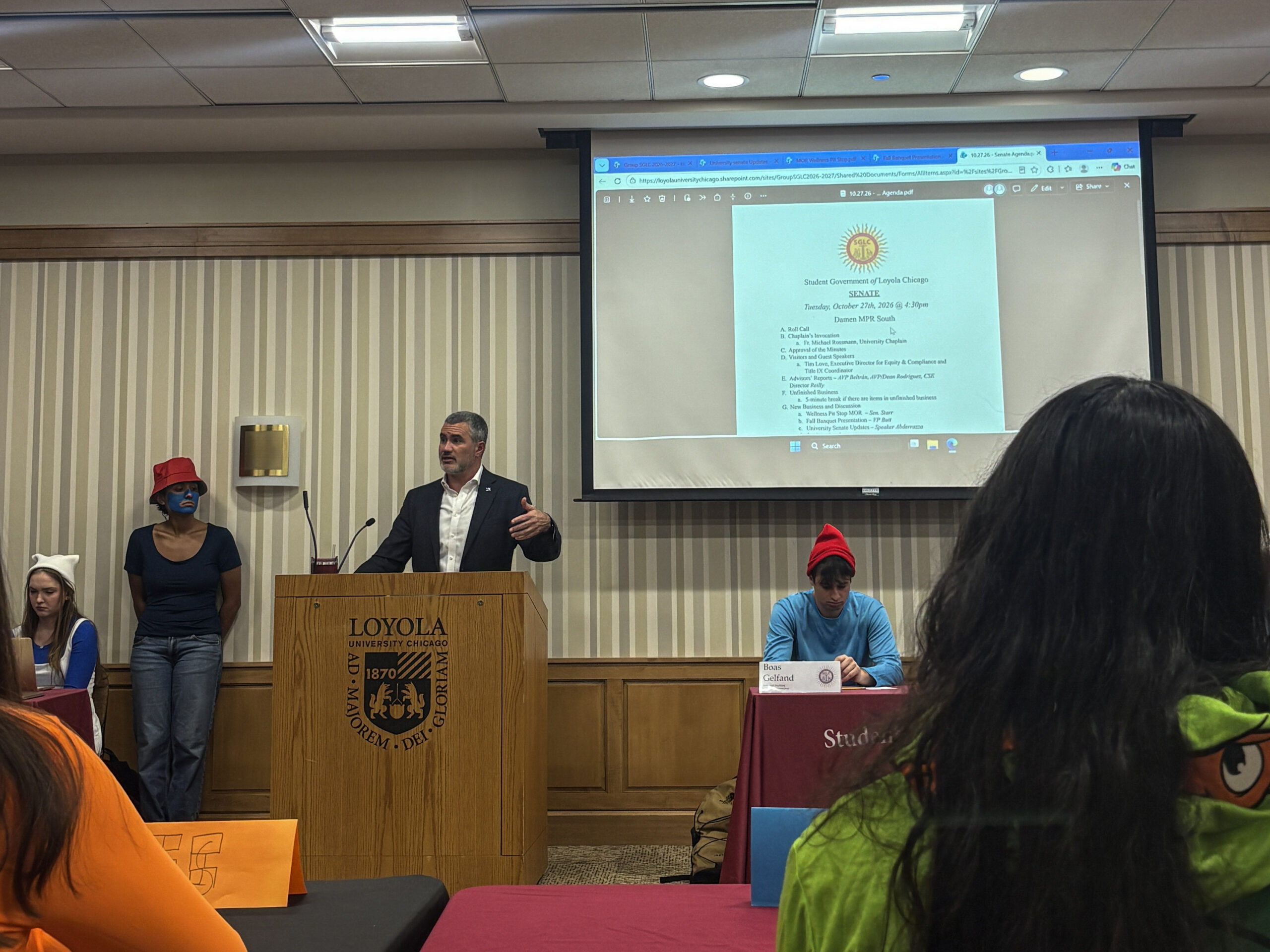
Student Government of Loyola Chicago (SGLC) held a Senate Oct. 27 featuring guest speaker, Title IX Coordinator Tim Love.
In light of recent events — the Cornell gang rape allegations, the civil lawsuit brought against Loyola for the mishandling of sexual assault and on-campus protests — Love spoke to SGLC in an open forum. He addressed questions regarding Title IX, how it’s applied and what his office is working on in regards to advocacy and awareness.
While Love said he’d take questions, he wouldn’t respond to any questions about any specific cases — past or current — out of a “commitment to honoring the privacy of students who interact with our office, whether it was a long time ago or it was recently.” He said it’s important to the Title IX office that a person’s case is not subject to public discussion.
“There are processes if people feel like they’ve experienced something dissatisfying,” Love said. “Lawsuits and court cases — those are all rights that people have. We don’t want to interfere with those processes or diminish and dismiss concerns. We are not going to touch cases, period. That’s my rule for myself, for my office and also consistent with our legal obligations.”
Title IX is currently doing outreach to Sorority and Fraternity Life given their “unique connection to some events in the news,” Love said.
SGLC President Boas Gelfand said of the six committees of SGLC, the justice committee is the primary leader on addressing the allegations of Loyola’s mishandling of sexual assault reports and the protests. He said they worked to post on Instagram an acknowledgement of the alleged Cornell gang rape, which included phone numbers and other resources students could turn to.
Additionally, they’re working on hosting more Q&As with Campus Safety the student body can attend. Part of their outreach to Campus Safety and Love offers them the opportunity to conduct research on sexual assault prevention, and establish a “baseline” by which they can best serve students, Gelfand said.
“Our ultimate goal is to make sure that we’re listening to students and letting them know we understand their concerns, we have the same concerns, and using our position to advocate for them based off of what we’re hearing and what’s available to us,” Gelfand said.
Love said their office has seen a “trend of unkindness” this year, more so than in past years. He pointed to how people engage with one another online, along with bullying and harassment, which are often seen as taking place “under the guise of advocacy,” Love said.
Every year, the Title IX office reviews and updates their community standards, whether due to legal updates or suggestions from students and staff. This year’s changes were largely technical, incorporating some pieces of proposed legislation from House Bill 4I990, an amendment to the Illinois Preventing Sexual Violence and Higher Education act.
This amendment would “adjust definitions, offer additional resources and support to survivors, et cetera,” Love said. For instance, the definition of sexual harassment in terms of AI is being changed, now, altering photos of people to make them sexually explicit is a form of sexual harassment. The passing of this amendment is something the office is watching very closely, according to Love.
Love emphasized opportunities for student involvement in the Office of Equity and Compliance (OEC) — an office designed to promote a culture of inclusion, safety and accessibility — such as open meetings held with community coalitions and the RISE Council, a committee for students to both receive information and offer opinions what’s on student’s minds.
The OEC team consists of Love, three full-time investigators and a paralegal, whose jobs are solely to respond to reports. The team receives both reports and complaints. A report is filing a case of misconduct while a complaint occurs when someone who’s been harmed by misconduct asks the university to launch a full investigation into the case.
“Loyola responds to each and every report that we receive,” Love said. “We investigate fully every complaint we receive. Every report we get is responded to with care, offers, outreach, resources and support. We will bend over backwards to help people through whatever it is they are going through.”
Love and the OEC staff wanted more resources to be able to partake in prevention support. While the OEC offers some support sources through the Wellness Center, Love said they have limited staff and resources to create more prevention education.
As a way to further promote awareness on campus, the OEC offers task forces and committee structures to spread awareness and advocacy while also listening to student suggestions. They also implemented a climate survey specific to gender-based violence, which is sent out to students every two years. The survey, last sent spring 2025, gathers anonymous data to grant insight to campus culture which can be reviewed with the task force.
The OEC is trying to proactively use data as a way to see where giving informational talks and hosting Q&A’s will garner the most interest. Any students interested in research, outreach and advocacy within the Title IX office can reach out to Love or Deputy Title IX Coordinator Nika Arzumanian.
The standard of evidence is the amount of evidence needed to prove someone responsible. The standard Loyola uses for Title IX is a preponderance of the evidence which is the lowest tier of evidence required, commonly described as “50% and a feather,” according to Love. He said the preponderance scale is most protective of survivors who are coming forward while also balancing the rights of respondents.
Even if governmental organizations encourage changing the standard of evidence, Loyola will only comply with changing the standard if it becomes mandatory through Title IX. Loyola’s main goal is to ensure they’re intentional in maintaining a fair and balanced scale when listening to evidence and filing reports, according to Love.
Title IX holds the university accountable for two things — being a generally responsible university meaning sustaining policies, having a reporting system and maintaining the structure to responsibly attend to sexual or gender-based misconduct when it happens and actually responding to incidents after they’ve been brought to the attention of the school, according to Love.
No university could be legally responsible for preventing all instances of gender-based violence — all universities and Title IX can do is let people know what the standards are and how they apply and deal with situations as they arise, according to Love.
“When harm happens, and it’s reported to us, that’s when our obligation kicks in,” Love said. “We have to not be indifferent or put our heads in the sand or look the other way or brush it under the rug, but rather address it directly and in a way that stops it, prevents it from happening again and tries to remedy the harm.”
Love said he urges survivors of sexual assault or harrasment to find resources if they’re uninterested or incapable of talking to the Title IX office. Students can also refer to Wellness Center counselors and advocates who aren’t Loyola-affiliated and thus not mandated to report what they hear.
Jane Wagle, the chair of the Justice Committee for SGLC and a second-year studying political science and global studies, said the committee is brainstorming various ideas for informing and advocating for the student body.
“I have been throwing around the idea of hosting another Q&A with Tim Love that is specifically catered to being open to the student body,” Wagle said. “My committee has also been in contact with Campus Safety after we noticed they offer a sexual assault prevention and saftey talk and are wanting to know if we could host one.”
Wagle said her statements are her own and not on behalf of the SGLC.
Love said he wants people to feel safe and comfortable on campus and not be afraid to speak up due to events happening at other universities.
“We are a diverse community at this school with people from all different kinds of backgrounds and priorities,” Love said. “We owe it to each other to try and work through those differences towards our common goal of safety, inclusivity and feeling like we all deserve to belong here, because we do.”