Learning the classic languages have far more to offer students than just historical insight.



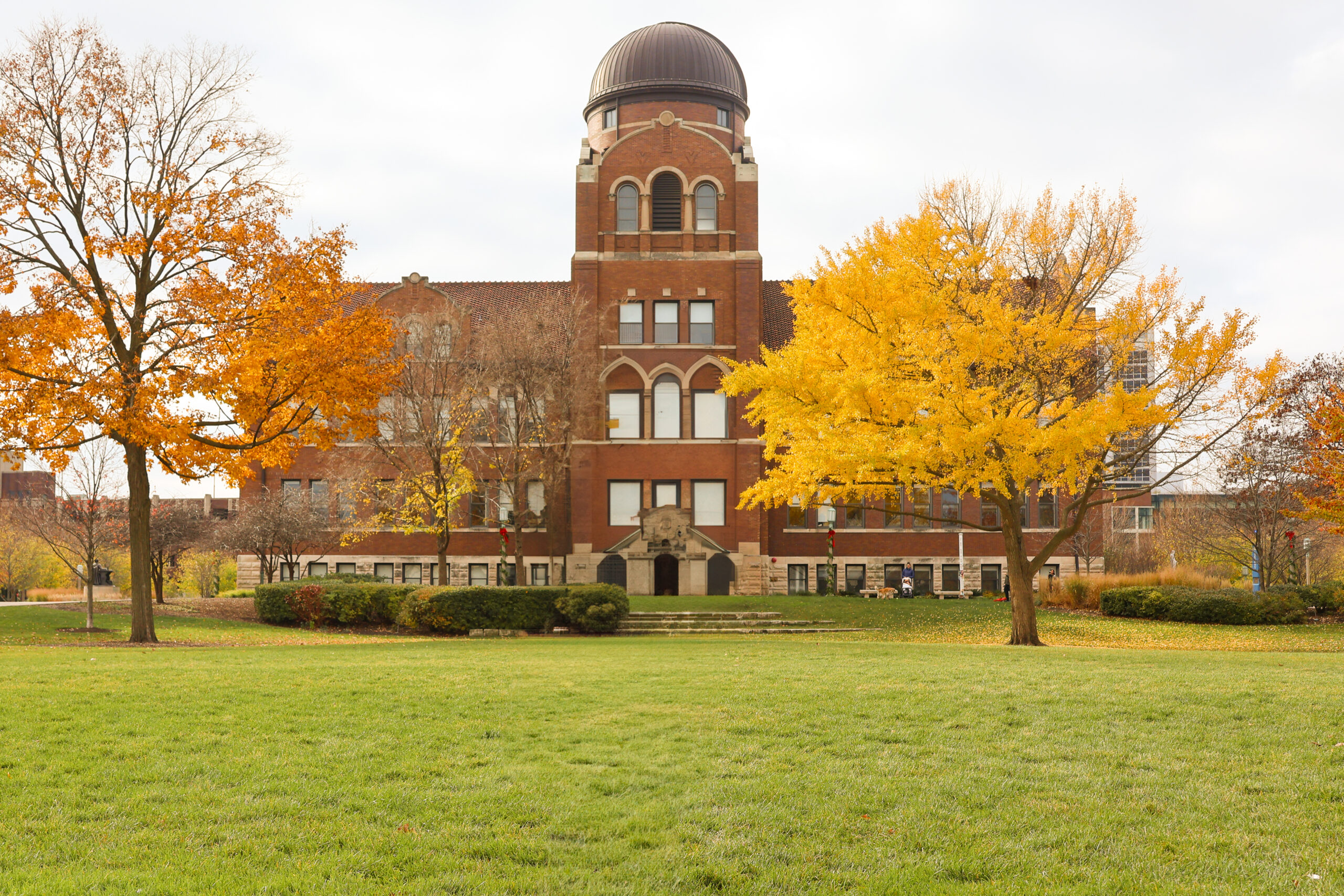
Bronze leaves fall lazily from the trees in front of Dumbach Hall. Clouds loom heavily over Lake Michigan as seen through the stained glass windows of its halls illuminating the myriads of passing students.
Nothing feels more quintessentially dark academia than the mezzanine’s statue of St. Michael, the dark-stained wooden doors and a professor greeting students with an ancient salutation: “Salvete discipuli et discipulae.”
And all the students in a harmonious response: “Salve, magister.”
It’s an interaction familiar to any student enrolled in LATN 101 through Loyola’s Department of Classical Studies. Offered every fall, elementary Latin or Greek is an introduction not just to the languages who conquered the Mediterranean, but to the culture and modern contingencies which resulted from them.
But these languages have far more to offer students than just historical insights: learning them can be a practical way to stand out in both academic and professional settings.
“Being able to understand these ancient texts in the original language is relevant to a lot of fields,” Laura Gawlinski, professor and undergraduate program director for the Classical Studies Department, said.
“We get a lot of students — English majors who want to know medieval Latin,” Gawlinski said. “Even science students — there is a history of scientific thought you can get at by understanding these past texts.”
Learning Latin is certainly no easy feat — like any language, it requires dedication and support from those most familiar with its intricacies. Loyola’s Classical Studies Department, one of the few left alongside Northwestern University and the University of Chicago’s, is especially equipped when it comes to preparing students to decipher tongues so far removed from modern learners.
“Here, you have an opportunity, even in Latin 101, to learn from an expert at the top of their field who’s got a Ph.D., has written books and is actively doing [scholarly] things,” Gawlinski said.
Latin serves students not just by fulfilling the College of Arts and Science’s two-semester foreign language requirement, but by opening up doors in Academia and the job market.
For pre-med students especially, a significant amount of anatomical vocabulary and medical terminology derive from Greek and Latin terms. Diagnoses like presbyopia (Greek: old man’s eyes), cardiopathy (Greek: disease or suffering of the heart) or cerebellum (Latin: little brain) all derive from common Greek and Latin words.
“If you’re going to be a doctor, you’re going to need to pay attention to people’s symptoms and be a good observer,” Gawlinski said. “Attention to detail, being able to memorize — these are absolutely transferable skills.”
What students learn in the classroom now is not independent of, but rather in continuous dialogue with, modern medicine’s relationship to Western classical languages.
For communications majors, learning Latin means adopting a new way of thinking which can revolutionize one’s reading and writing. Latin’s status as a highly inflected language means it has a natural proclivity towards what Keller and Russel — Loyola’s first-year textbook authors — call rules of “emphasis, balance and economy.”
Learning to recognize these features of Latin can help students with their reading comprehension skills, analyzing text with greater attention and reading between the lines.
“It really teaches you close reading and careful attention to details, especially by the time you get to the intermediate level,” Gawlinski said. “You have to look closely at every single world and try to figure out what it means.”
Although historically privileged to a minute class, classical studies have also seen a recent broadening of scholarship to include marginalized communities.
Gawlinski recommended the works of Chinese-born American poet Sally Wen Mao, who draws on Sappho, or Chicano playwright Luis Alfaro, who transposes Oedipus into a young Latino and his encounters with gang culture.
“Communities who have not always had their voices heard — they’re producing some of the most interesting receptions of classical scholarship,” Gawlinski said.
For students who want something to show for their hard work and advance their career and professional goals through learning the classics, Loyola offers a special BA classics distinction — a vestige of when all Loyola students enrolled in classical languages — on top of one’s major.
This special merit, available to all students who enroll in four Latin or Greek above the 100 level and show elementary competence in a third language, gives students beginning their journey in classical languages a distinction worth working forward to.
“College is the chance to do things that you may not have a chance to again,” Gawlinski said.
“You are probably never going to have an opportunity to be able to take a Latin and Greek class and find out what it’s like. This is your moment.”