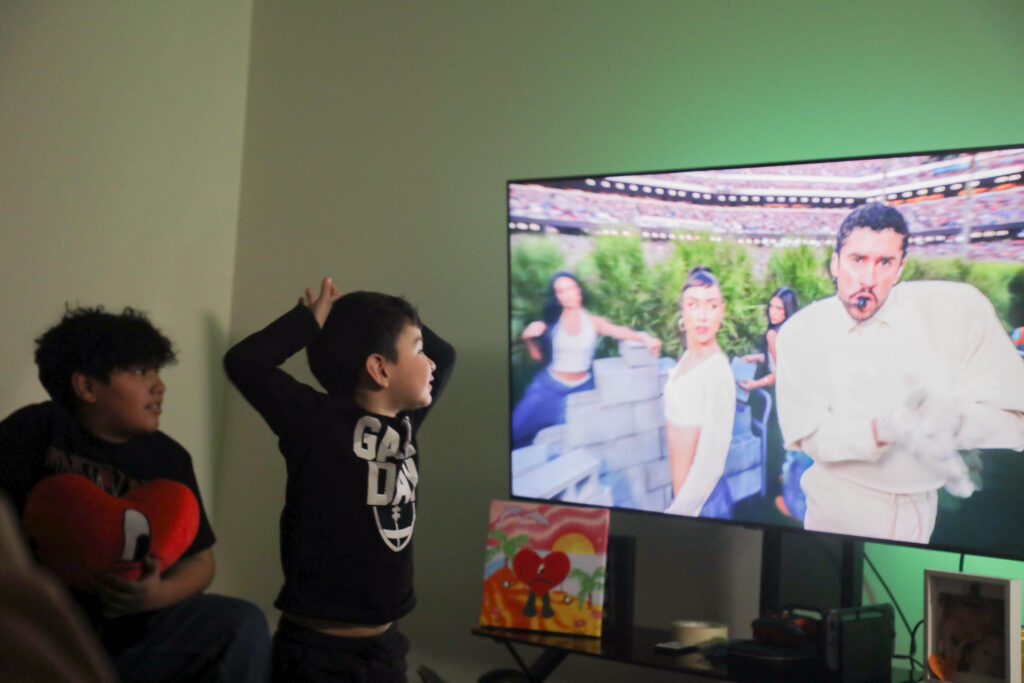
Puerto Rican artist Bad Bunny filled Levi’s Stadium with rhythm, salsa, and a live orchestra for Super Bowl LX.




The 2026 Super Bowl halftime show was always going to overshadow the actual football game and redefine what a performance means on a nationally televised stage. Bad Bunny’s performance wasn’t likely to be just a show to watch from the stands or at home passively, and this was the case well before he stepped onto the field at Levi’s Stadium in Santa Clara, Calif.
The Puerto Rican superstar being named the artist for Super Bowl LX had already become a polarizing social and political event riddled with backlash, high expectations and the weight of representation on a national stage that’s rarely made room for Latin artists like him.
The Super Bowl opened with an agreeable and safe performance by Green Day, who put on a set of familiar hits like “American Idiot,” “Holiday” and “Boulevard of Broken Dreams,” songs that once carried a striking political bite but felt noticeably restrained this time around as the set was completely washed of any commentary from the usually outspoken rock band.
Famously changing “America Idiot” lyrics to say “I’m not a part of the MAGA agenda” and chanting “No Trump, no KKK, no fascist USA” in past performances, Green Day’s clean Super Bowl showing was a great contrast from the previous actions of the band — including that from the events they play leading up to the weekend. It set the tone for an evening that seemed like it was being carefully managed, as if any controversy had preemptively been nipped in the bud.
Still, Bad Bunny didn’t enter the halftime on neutral ground. His announcement as the performer was met with immediate backlash from conservative commentators who criticised his Spanish music, scrutinized his “Americanness” and continued tired arguments about who gets to belong on one of the most-watched stages in the country.
A year ago, Kendrick Lamar faced similar scrutiny by conservatives — consisting of his music being too political. What sets this Super Bowl apart is the creation of an alternate halftime show branded as “All-American” by conservative organization Turning Point USA. Performing artists included Kid Rock, Gabby Barrett, Brantley Gilbert and Lee Brice.
The opening shot of the Apple Music halftime performance introduced Bad Bunny not by his stage name, but as Benito Antonio Martínez Ocasio, followed by Spanish subtitles reading “El espectáculo de medio tiempo del Super Tazón,” or “The Super Bowl halftime show.” From the very beginning, language — which was such a point of contention for most — was not translated or softened. It was true to nature.
What followed wasn’t a barrage of spectacles and excess, but a carefully curated world built from the everyday scenes of Latino life — a piragua cart, a game of doble seis, women doing nails, a barbershop, a Villa’s taco stand, a compra oro y plata case that turned into a proposal, a traditional Puerto Rican Casita and dancers dressed in cream beige workwear who moved through tall grass, sugar cane fields and narrow pathways of the maze-like set.
Bad Bunny’s set list pulled from across his career, weaving together reggaeton, dembow, salsa, mambo and live orchestral elements. Songs like “Tití Me Preguntó,” “Yo Perreo SOla” and “MONACO” flowed into one another, with the brief sampling of earlier influences like Daddy Yankee’s “Gasolina,” a clear nod to the genre’s predecessors and roots.
Rather than promoting only his latest album, Bad Bunny treated the halftime show retrospectively, honoring the lineage of Latin music that paved the way for his career and success. Additional cameos by Latino figures such as Cardi B, Karol G, Jessica Alba, Young Miko, Pedro Pascal and Ronald Acuña Jr. reinforced who exactly was at the center of this event.
One of the night’s most memorable moments occurred when Bad Bunny handed his Grammy to a young boy watching his acceptance speech from a vintage television on the couch with his parents. There was some speculation as to whether it was Liam Conejo Ramos, the 5-year-old boy detained by ICE agents, however this was later confirmed to be untrue.
Still, the moment resonated deeply, whether intentional or not. The image of walking up to a reflection of your younger self and giving them a tangible testament of all your hard work and dedication delivers a universal sentiment: You made it.
The political undertones became more explicit during “Lo Que Le Pasó a Hawaii,” opened by Ricky Martin, who notably performed from a plastic chair heavily reminiscent of Latin parties.
“Quieren quitar me el rio y tambien la playa / quieren al barrio mio y que abuelita se vaya / no, no suelte’ la bandera ni olvide’ le lelolai/ que no quiero que hagan contigo lo que le paso a Hawaii,” Martin sang, translating to “They want to take the river and the beach from me / They want my neighborhood and for grandma to leave / don’t, don’t let go of the flag nor forget the lelolai / I don’t want what happened to Hawaii to happen to you.”
These lyrics express displacement, loss of land and cultural erasure, the song existing as a token of resilience, of not wanting Puerto Rico to undergo the kind of erasure that’s devastated Hawaii.
During “El Apagón,” dancers worked atop electrical poles — a striking reference to Puerto Rico’s ongoing power outages. Bad Bunny later emerged waving the Puerto Rican flag, standing alone while others labored around him.
This particular segment was much more isolated in terms of sound and visuals, the moment dialed in and singular — almost feeling quiet, however not entirely devoid of artistry. Much of the performance was similarly riddled with visual easter eggs that told a story without words.
As Bad Bunny took viewers on a trip throughout his maze-like set, the audience was tuned into Latin culture. The tall grass and stalks the dancers appeared to be working on at the beginning of the performance were sugarcane, a nod to Puerto Rico’s colonial history and heavily exploited plantation workers. Other notable inclusions were the Pavas worn by laborers and Toñita, a woman who runs the Caribbean Social Club in Brooklyn, New York.
Compared to his Grammy acceptance speech at the beginning of the month, in which he declared “ICE Out” and reminded viewers “the only thing more powerful than hate is love,” the halftime show felt restrained and, at times, rushed. It left the sense that perhaps there was more he wanted to say or do but couldn’t.
However, when Bad Bunny cradled a worn football inscribed with “Together, We Are America,” listing American countries aloud as flags filled the frame all around, his message was unmistakable. This wasn’t an attempt to assimilate or translate himself for the convenience and comfort of others. It was a declaration of presence and unity.
The show closed not with a jaw-dropping finale, but with joy as “Debí Tirar Más Fotos” played and dancers flooded the field in colorful, mismatched outfits. The uniformity broke, and community and celebration took over. It felt less like an ending and more like an invitation to the afterparty, making viewers want to follow them out of the arena and forget all about the football game.
Bad Bunny’s Super Bowl halftime show may not have been world-defining, but it was history-making. In a time when immigrant and Latino communities are increasingly targeted, erased, or pushed to the margins even more so than before, his presence alone carried weight.
This was not just a performance. It was a moment of recognition, a moment to remember the family, communities, language, places and art that cultivated who you are.
Maybe that’s why it left so many viewers wanting more — not because it was underwhelming, but because Latinos rarely get to see themselves reflected on a stage like that. For a few minutes, the game faded into the background, and what remained was culture, connection, memories and a feeling that, at least for one night, the Latin community was part of the conversation.