Superfan Jerry Bjurman, a men’s basketball season ticket holder and Loyola class of 1973 alumnus, has watched Loyola for decades.




Superfan Jerry Bjurman, a men’s basketball season ticket holder and Loyola class of 1973 alumnus, has been watching Loyola men’s basketball for a long time.
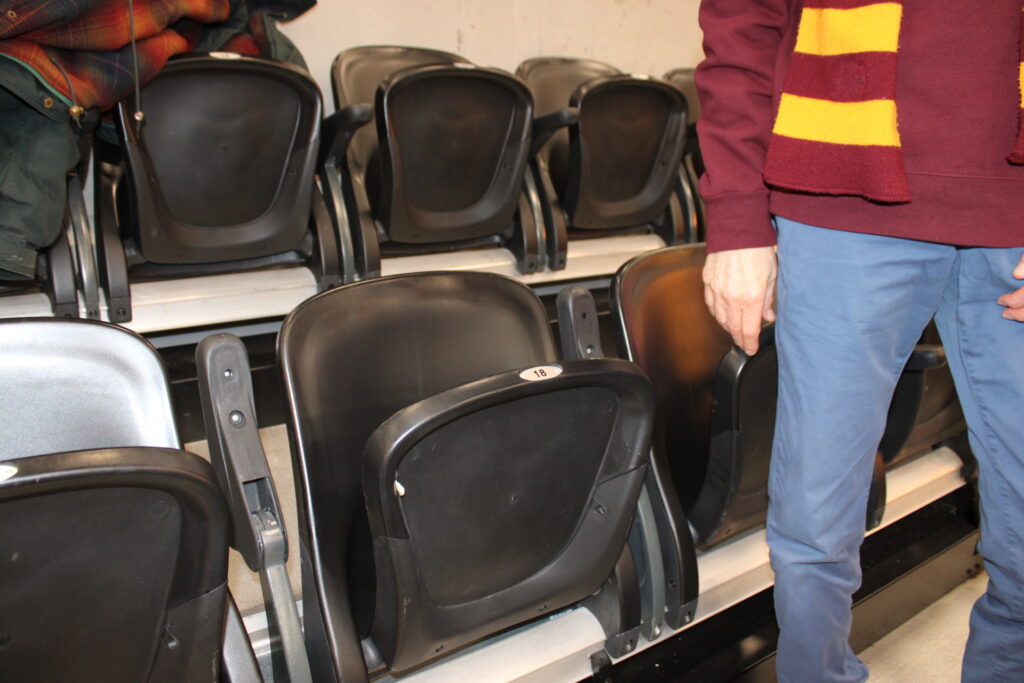
In seat number 18 at Gentile Arena, dressed in the unmistakable Loyola scarf and a collection of Rambler pins, Bjurman said the culture of Loyola basketball has persisted through many different eras of the sport.
This includes pre-Title IX years, the Ramblers’ time in the Midwest City Conference, a stint in the Missouri Valley Conference, the legendary 2018 Final Four run and now the teams’ tenure in the Atlantic 10 (A10).
“It’s kind of a microcosm of life,” Bjurman said, explaining how basketball has come to be a metaphor for the fluidity and spirituality of life — all encapsulated in the execution and ease of athleticism the game provides, each play and pass connecting and showcasing a togetherness.
Bjurman compared the coordination and team cohesiveness needed in basketball to a ballet or orchestra performance. He said he’s watched decades of Loyola teams find this balance and togetherness with each other.
Bjurman said he related to Danny Rojas from Apple TV show “Ted Lasso” because, like Rojas — who infamously told his team, “Football is life” — Bjurman thinks basketball is life too.
When Bjurman arrived at Loyola as undergraduate political science student in 1969, the men’s basketball team was coming off the high of their 1963 NCAA championship win, and the team was led by head coach George Ireland, often known to Ramblers as “The Man.”
“Basketball was changing dramatically then,” Bjurman said. “A lot more recruiting. Not just recruiting in your area, but recruiting nationwide. They were starting to televise basketball games on TV.”
In Bjurman’s years at Loyola, the Ramblers played in Alumni Gym, the teams’ home arena before moving to Gentile in 2011. Alumni Gym was a small, old-school style court with a nostalgic feel that Bjurman said he still tries to seek out when traveling for other games.
Bjurman remembers a time when Sister Jean Dolores Schmidt, BVM, who died Oct. 9, was up, bustling around before she transitioned into the wheelchair. He recalled the energy Schmidt brought to the court and what her presence meant to the teams who were lucky enough to work with her.
One of Bjurman’s most memorable Loyola basketball games was when the Ramblers beat Larry Bird’s Indiana State team 79-76 on Jan. 30, 1978 in Alumni Gym. Bjurman compared the game to watching the Ramblers defeat the University of Miami with a logo three-pointer in the NCAA Sweet Sixteen in 2018.
“When [Donte Ingram] shot that ball, he had a really high arc on his shot,” Bjurman said. “It was almost like slow motion.”
He remembered thinking to himself the shot was either going to go in to win the game, or it was going to hit the backboard and fly way up. Luckily, Bjurman’s original hypothesis was right, and Ingram made one of the most memorable baskets in recent Loyola history with only seconds left in the game.
Athletic Director Steve Watson, who’s been at Loyola for 11 years, said he feels historic moments like Ingram’s game winning shot can be even more gratifying for fans like Bjurman who have been through so much with the team.
“At a place like Loyola, you get a chance to know your season ticket holders, your supporters,” Watson said. “So someone like [Bjurman], I’ve known since I got here.”
Watson recalled how welcoming long-time fans, including Bjurman, were to him when he first arrived. He said he was touched by the “genuinely nice people” who love Loyola and continue to support the team.
Bjurman said he gets energy from the students who fill the stands for games, especially seeing ex-Loyola players, like class of 2024 point guard Braden Norris and forward Tom Welch, come back to support the team.
“For the longest time, it was truly just us old guys that graduated in the ‘70s and maybe the early, mid ‘80s,” Bjurman said. “We’re getting much better student turnout.”
Watson said he thinks students and other Loyola students have something to learn from the friendships Bjurman has maintained through his time as a Loyola fan. He hopes coming to together to watch some basketball at Gentile can be a starting point for relationships and friendships for students, just like it’s been for himself and Bjurman
While his main love is basketball, Bjurman tries to attend a few other Loyola athletic events throughout the year if he can squeeze it into his schedule.
Originally from Kenosha, Wis., Bjurman has been living in Chicago’s North Side since he graduated. After obtaining his undergraduate degree from Loyola in 1973, Bjurman stayed at Loyola and got his master’s in industrial relations in 1975. Ten years later, he returned to school to get his law degree, taking night classes.
“I ended up with a fantastic education, with life long friends,” Bjurman said.
The academic focus and Jesuit values are what separates Loyola’s basketball program from other schools, according to Bjurman. This year, Loyola reported that student athletes had all-time record GPA with an average of 3.61. The men’s basketball recorded a GPA of 3.31.
For Bjurman, players like class of 2025 guard Sheldon Edwards Jr. exemplify Loyola’s culture of togetherness and constant improvement. Bjurman said he had a soft spot for him because Edwards didn’t start out a star player, but he grew into one of the most decisive members of the squad by his last year.
In the age of NIL, many players choose to transfer to bigger name schools, and Bjurman said he hopes the Ramblers realize how special staying in one place can be and how impactful it can be for a player’s game and legacy.
“Don’t play for yourself,” Bjurman warned. “Play for each other. Play for the team.”