Over the summer, third-year Annabelle Mueller felt inspired to try something new after a friend of hers gave her a tarot card reading that encouraged her to download a dating app. Mueller, a double major in psychology and criminal justice, said she hated dating apps, and firmly believed they were “stupid.” “They gave me a …
About 20% of Loyola students are currently on a dating app of some kind. (Bella Adams | The Phoenix)
Over the summer, third-year Annabelle Mueller felt inspired to try something new after a friend of hers gave her a tarot card reading that encouraged her to download a dating app.
Mueller, a double major in psychology and criminal justice, said she hated dating apps, and firmly believed they were “stupid.”
“They gave me a tarot reading, and they were like, ‘You know, the tarot cards are saying you need to loosen up,’” Mueller said. “‘You need to do something for yourself. You need to get your head out of your ass. You need to download a dating app.’”
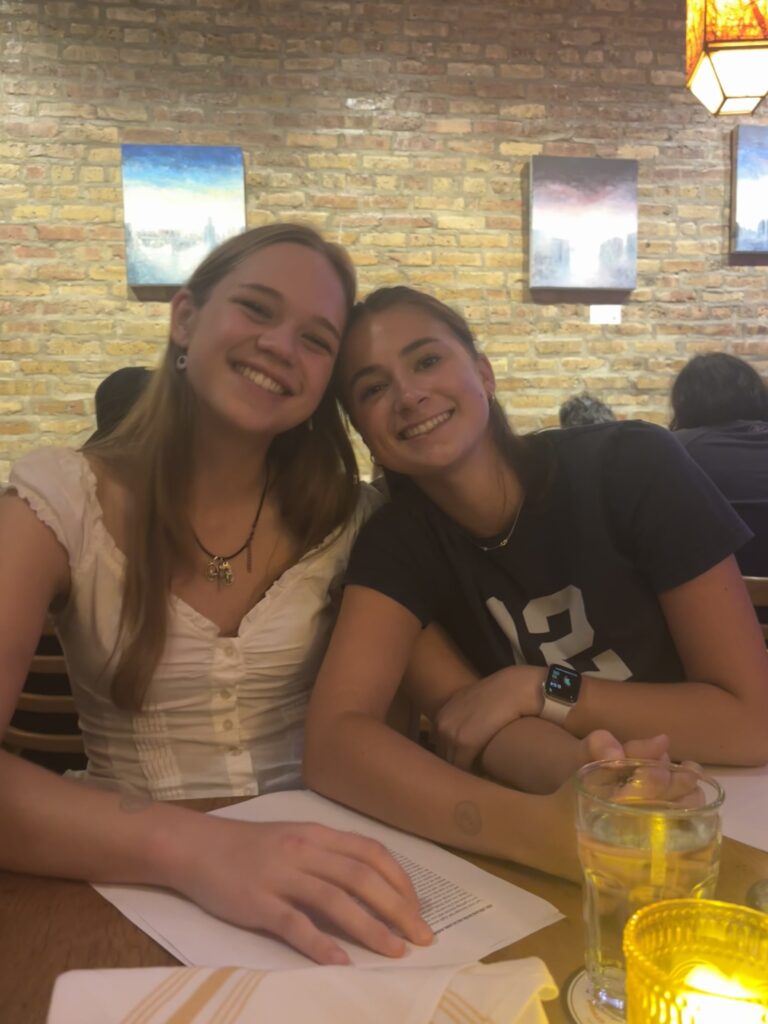
Although resistant at first, Mueller ultimately gave in. Lucky for her, Mueller met her now-girlfriend, third-year Villanova University student Sofia Marino — whose profile featured photos of her hiking all over the world — on the first Hinge-date she went on.
In downloading Hinge, Mueller joined thousands of other Generation Z individuals who use dating apps as a way of meeting new people.
About 20% of Loyola students are currently on a dating app of some kind, according to data collected by The Phoenix. Nationally, approximately 37% of Gen Z actively use a dating app, according to a report from Statista.
Marino sparked a conversation by responding to Mueller’s Hinge prompt.
“My cry-in-the-car song is…” the prompt read. Mueller finished the sentence with, “my way from the hit movie musical Sing.”
“Oh hell yeah,” Marino said in response. The rest is history.
Annabelle Mueller, left, with her girlfriend, Sofia Marino. (Photo Courtesy of Annabelle Mueller)
Seven months later, the pair is still together. Although long distance, they find any chance they can to talk about each other. They aren’t the first couple to meet online, matched through an algorithm curated by various dating platforms over the last two decades.
In the weeks leading up to and following Valentine’s Day each year, dating apps see an increased level of use. Gen Z users spent additional time on the app and made updates to their profile right before Feb. 14, Bumble Chief Product Officer Michael Affronti told CBS News. Hinge saw a 28% increase in likes and a 17% increase in both matches and likes in the first weeks of February 2024, according to the article.
Of the surveyed students, 9% of Rambler men and 24% of Rambler women currently have a dating profile on apps including Tinder, Hinge and Grindr — an app designed specifically for LGBTQ+ community members, according to their website.
As technology around dating continues to become more complex, there’s a rise in “situationships” — a relationship between individuals who have either have no intent about committing to something serious or who aren’t on the same page about committing, according to an article from Florida State University News.
Dating apps simulate a feeling of endless options, leading to Gen Z users hoping to avoid commitment, the article reported.
Both Marino and Mueller said, as lesbians, they think dating apps are helpful for members of the LGBTQ+ community because they eliminate the fear of approaching someone without knowing their sexuality.
“There’s always, between women, kind of an implication of friendship instead of a relationship, so I feel like from my perspective a dating app is helpful in understanding that everyone who is on that dating app is looking for a relationship, they’re not looking for a friendship,” Mueller said. “If I went up to someone in person, there’s a chance that they’re not, but on a dating app I know for certain that they would be at least willing to try.”
Third-year advertising and public relations major Lucy Machiniak said she currently has both Tinder and Hinge downloaded. She said she doesn’t have a favorite, although she has had Hinge for longer.
“They both kind of suck,” Machiniak said. “But sometimes it’s fun. I don’t use them that seriously — I’ll just ‘play’ Tinder, or I’ll ‘play’ Hinge.”
Neither Tinder, Hinge, Bumble nor Grindr responded to The Phoenix’s request for comment at the time of publication.
Machiniak said she will only take something seriously if she’s talking to someone she really likes, which she’s found to be rare. She said many of her friends view the apps the same way, and they will sometimes trade phones to scroll on each other’s profiles.
When she’s swiping, Machiniak said she looks for a “personality pic.” She said she’s drawn to people who include a funny photo or prompt in their profile.
“Usually it’s a personality thing,” Machiniak said. “Yes, obviously looks, but I like a personality photo. I like to know that you’re not just some boring person.”
Mueller said when she was swiping, she was looking for people who had a good sense of humour and interesting personality.
“I saw this phrase, ‘Love should feel like a conversation that never ends,’” Mueller said. “Just one long conversation, your whole life. I felt like that was always something I was looking for. Someone I could be my whole self with, someone who’s super funny and kind and caring.”
Second-year marketing student Payton Cherra said she hasn’t ever had a dating app and doesn’t plan to download one in the future. She said she avoids them because of the negative experiences she’s heard about from her friends who are active on romantic social platforms.
Overall, Cherra said she thinks dating apps can be a good thing when used for the right reasons.
“I feel like a lot of people meet on them — a lot of success stories,” Cherra said. “I do think though at our age group, they are not productive. I think that they work best for people of older ages because I think that they’re more inclined to have further results from that.”
Mueller said if people want to find success on dating apps, they need to know what they are looking for and be intentional about expressing those wants.
“I think you definitely have to know yourself really well and know what you’re looking for pretty strongly,” Mueller said. “Be super confident in being yourself authentically… I think being picky is a really good thing. I think I kind of, maybe, have a negative perspective but going on lots of dates with people who really are just not your vibe or aren’t your speed at all, I think it’s kind of an energy suck. It’s nice to prioritize.”
Cherra said she thinks the culture of Gen Z revolves around non-serious relationships, which has in part been shaped by the use of dating apps.
First-year social and behavioural science major Jaylen Bell said he’s never had any interest in downloading dating apps before due to distrust.
“It seems like you are more likely to get catfished on the dating apps,” Bell said. “Anyone can make a profile, you can use anyone’s photos, you can say or do whatever on them, so it’s kind of hard to know who is who and if they are telling the truth.”
Bell said he thinks the overall impact of dating apps on Gen Z is bad and said he has no plans of downloading any dating apps in the future. He said he thinks people are drawn to them because they have less to lose by asking someone out online than if you are risking rejection by asking someone out in person.
Of all Americans who have used a dating app, 66% have reported going on a date with someone they matched with and 23% have reported entering a serious relationship or marriage as a result, according to a study by the Pew Research Center.
Of the students surveyed, some said they have had dating apps in the past, but no longer have them downloaded.
Cherra said she thinks dating apps have made it less common for individuals to approach each other romantically in person.
“We’re the first main generation — and millennials — to actually have [dating apps] as an opportunity as opposed to meeting people just day-to-day,” Cherra said. “I do think that that existing in the culture of dating has turned people away from meeting people in the wild.”
Machiniak said she has similar sentiments and doesn’t think people interact as much in person now that they know they can rely on swiping left or right as a way of meeting new people.
“It takes away the meeting in person and the connection of it all,” Machiniak said.
Editor’s note: Deputy opinion editor Carlos Soto-Angulo contributed reporting.
Lilli Malone, a senior, is the Editor-in-Chief of The Phoenix and has written for the paper since the first week of her freshman year. She is studying journalism, criminal justice and political science. She was previously on the news team of The Phoenix and has contributed to local newspapers such as The Daily Herald and Block Club Chicago. Originally from Columbus, Ohio, Malone enjoys staring longingly out over Lake Michigan and pigeon-watching with her roommates.
The Loyola Phoenix is the official student newspaper of Loyola University Chicago. Since 1969, we've been dedicated to reporting on university happenings, the Rogers Park and Edgewater neighborhoods, Chicago, and important national and international events. Your donation helps us continue delivering quality independent journalism to the Loyola community.