Since the start of the spring semester, the Halas Rock Wall has experienced an increase in climbers.



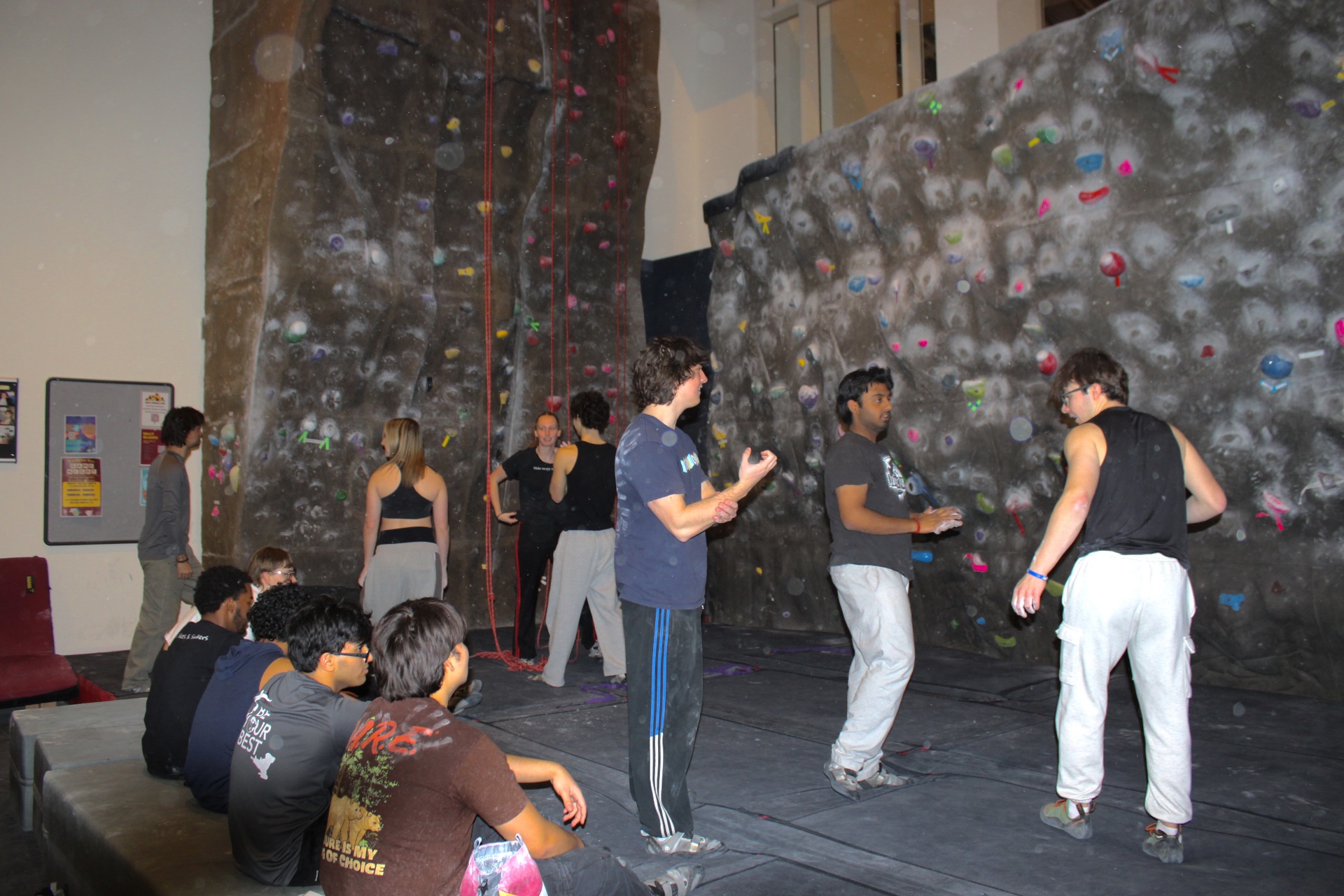
Underneath Halas Recreation Center’s chatty front desk in Damen Student Center, a miniature world of grit and adventure is tucked into the side of the weight room, where students sit in bean bags offering advice while their friends swing from colored hold to colored hold, bouldering with chalk-covered hands and aiming to flash the newest routes.
The Halas Rock Wall seems like Loyola’s best-kept secret, but based on the growing number of climbers who come in each day to share the space with friends and strangers alike, the wall might not be a secret at all. It’s actually a meaningful recreational community.
With about 30 to 45 Loyola students climbing each day, the wall has seen an increase of participants since the start of the spring semester in January — lately teetering closer to an average of 40 climbers per day, according to rock wall Program Coordinator Luke Schmidt.
“I think students are just trying to find more on campus than before,” Schmidt said. “Something I’ve noticed over the past seven years of being here is I just think we’re doing a better job at getting students to stay on campus.”
He said he also thinks Alex Honnold, who free soloed Taipei 101 in January, may have brought climbing to the mainstream and influenced students to come to Halas’ wall.
Dilann Zuniga, a first-year physics major who started climbing about a month ago, said he was encouraged to check out the wall by a friend he usually lifted weights with.
“We lifted together, and he’s like ‘I think you’d be good at it,’” Zuniga said. “Now, I’m addicted.”
For Zuniga, the addiction stems from the ability to constantly see progress in himself. He said at first, he was struggling to accomplish anything, but soon enough he was able to flash — rock climber speak for getting a route on the first try — the project he was working on the day before.
The wall usually has about 25 to 30 bouldering routes at any given time, ranging from V0, the easiest climbs, to V7, the hardest climbs. Rock wall staff, like third-year computer science student Jackson Horgan and third-year advocacy and social change major Nathalie Jensen, reset the routes and rotate in about six to eight new ones each weekend.
“Setting’s super fun,” Jensen said. “It’s like the same thing as like a puzzle you are putting together, except you get to make the puzzle.”
Horgan said he can be a bit biased and enjoys climbing the routes he sets, but to other climbers, like first-year Sultan Gobezie, a new route means a new opportunity to solve the “puzzle,” as Jensen described, and test skills on uncommon ground.
“People think it’s all physical, but most of it is mental,” Gobezie said. “You really got to figure out which way to fit your body.”
When a brand new climber comes in, Horgan said the staff are instructed to set them up with climbing shoes — available for all patrons — and a brief orientation about the wall’s rules and how everything works. The staff are always available to answer questions and make it a point to be attentive for new climbers, Horgan said.
Schmidt said the main goal he stresses with his staff of 17 students is to make sure students feel welcomed to the space and comfortable to try something new.
“One thing that I really like about the rock wall is that some of the regulars here and the people that are more experienced are always looking to help out beginners and answer any questions they have,” Horgan said.
Vedant Shukla, a first-year neuroscience major, said his friend had been trying to convince him to start climbing since the fall, but the idea stressed him out, so he put off going, always promising he would join the next time.
Once he got over his nerves, the rock wall became a place to connect with friends and continue to try new challenges.
Compared to other spaces in Halas, like the weight room, which is often filled with headphone-bound lifters, Horgan said the rock wall makes it easy to build relationships and interact with people who come in. Jensen said the community that grows through these interactions is her favorite part about working on staff.
Once a semester, Halas hosts a bouldering competition where students can compete based on how many routes they finish. The rock wall also hosts several social events — slightly lower effort than full-scale competitions — where attendees can play games, eat climbing-themed food like monkey bread or pretzels and hang out at the wall, according to Schmidt.
Also once a semester, climbers are invited to Movement, a rock wall gym off the Addison Red Line stop, for a discounted price of $5. Because Halas’ wall is “beginner friendly, learning wall,” Schmidt said the trip to a more advanced gym gives climbers a chance to test what they have learned.
“The idea isn’t that you’re gonna come here and rip these super hard projects that you’ve been working on for a month,” Schmidt explained. “The idea is if you’re new to the space and you’re new to climbing, you should really get all your information and all your stuff down pat, and then you can go do it in your free time.”
While Halas does have a few advanced routes, Schmidt said the wall is generally geared to intermediate and beginner climbers.
In addition to the bouldering routes, Halas also has about six to eight top rope routes on the nearly 40 foot wall, which require a belay, a harness-like contraption attached to the top of the wall which connects the climber to the staff member. All Halas rock wall staff are certified in house to belay at the highest degree of certification, according to Schmidt.
The Halas Rock Wall is open Monday through Thursday from 2 p.m. to 10 p.m, Friday from 2 p.m. to 8 p.m. and weekends from 2 p.m. to 6 p.m.
“Come in and try the rock wall,” Horgan said. “If you’ve always been looking at it and thinking that you want to come in, then give it a go.”