Voting is available through a link sent via email to the student body until March 31 at 5 p.m..



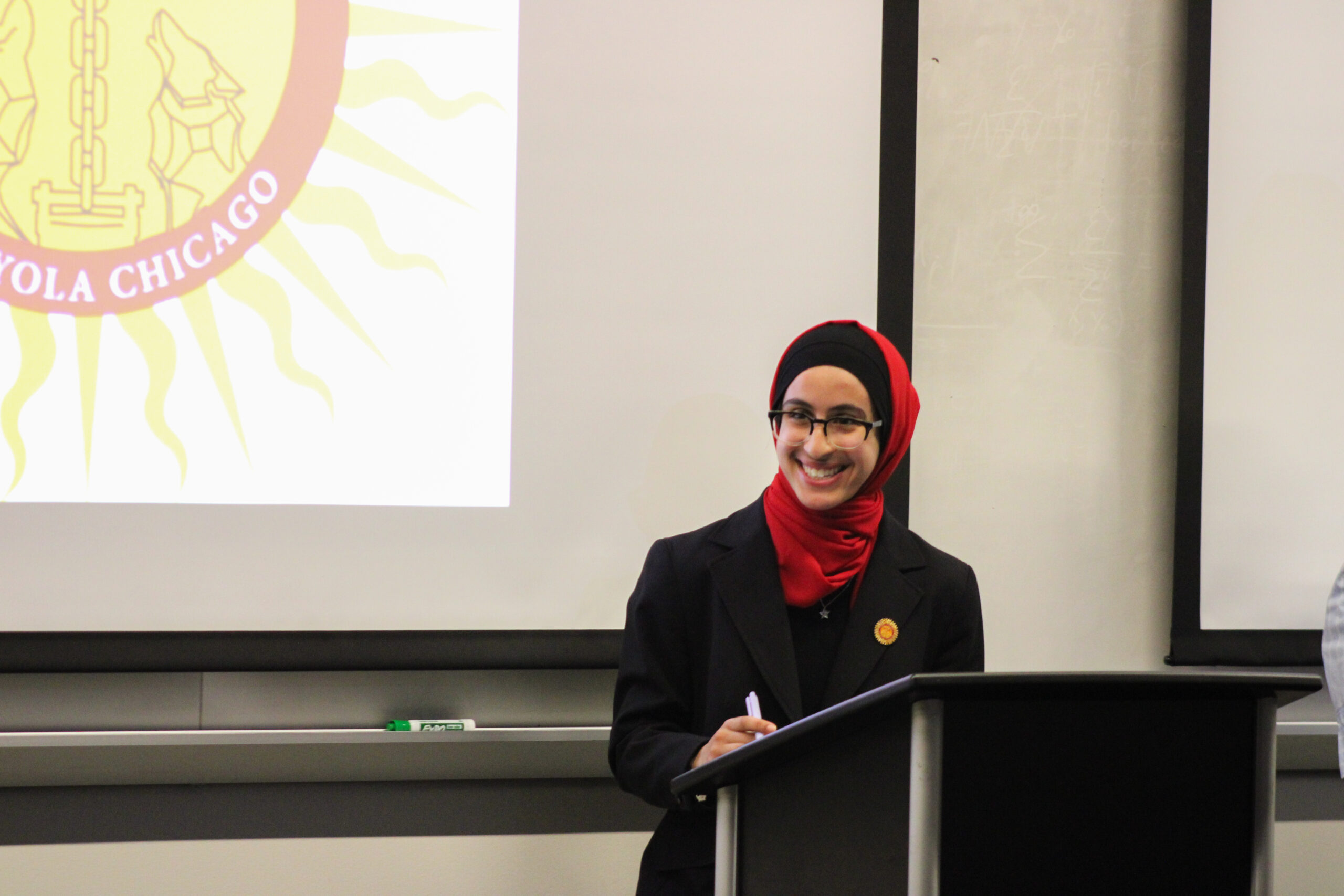
This year’s debates for the Student Government of Loyola Chicago (SGLC) sees candidates for both president and vice president running unopposed.
The debates for president, VP and chief justice took place March 16 and March 23 and featured questions from moderators and spectators, along with periods for opening and closing statements.
President and Vice President
Unlike the year prior, the debates for president and VP only featured one candidate on stage.
Presidential candidate Boas Gelfand said the debate was anticlimactic. He said he’d sprinted from class to make it to the debate, only to find a room with only SGLC members, and no general student body attendees. Nonetheless, Gelfand outlined in his speech the issues he thought mattered to students and what he intended to do about them.
“I wish someone ran against me,” Gelfand said. “It would have been more constructive to have multiple voices, but no one did. I’m not excited to run unopposed.”
Gelfand, a third-year philosophy and political science major, introduced his platform of CARE — community, accountability, reliability and empowerment.
“I was just thinking about the word care, because Loyola students care about each other,” Gelfand said. “[We] care about the community. We care about our school.”
Third-year psychology major Nawaal Butt, the candidate for VP and Gelfand’s running mate, expanded on their shared platform of CARE in her opening statement.
“Our goal is to make sure that Loyola is a space that students feel heard and that their concerns are being addressed,” Butt said. “We plan on communicating with administrators and making sure we are being transparent within our organization and outside of it.”
The pair’s main goal is to make sure SGLC has a voice at all levels of decision making on campus. Their platform aims to create a connection with the board of trustees and ensure student perspectives on issues are considered, Gelfand said during the debate.
“I value cooperation in leadership,” Gelfand said.
Gelfand mentioned the tendency for leaders to exist in a bubble, and the need to connect with a diverse network of people with different perspectives in regard to decision making.
Butt also emphasized a need for transparency within SGLC and in communications with the student body.
“We want to make sure that within SGLC, all members — even those who aren’t required to read reports — are reading them constantly,” Butt said. “We want to make sure that there’s clear cut and concise guidelines on how to do it.”
As a writing center tutor, Butt also has connections to the Information Commons, tutoring and writing centers. Her words in the debate emphasized a need to support tutors and supplemental instructors.
The pair’s campaign also intends to focus on specific issues students care about including an initiative begun by Gelfand two years ago to transition the student body to use mobile forms of student identification, instead of physical cards.
Gelfand intends to push for a 24-hour IC, an idea raised by 2024-25 SGLC candidates, The Phoenix previously reported. In last year’s debates, candidates noted there wasn’t enough money in the budget to pay student workers across a 24-hour period.
Gelfand also reviewed his SGLC career.
He began as a senator, becoming chair of the campus life and operations committee, and winning committee of the year. This year, he became the speaker of the Senate.
The second debate had a larger audience, giving VP candidate Butt a chance to display her love for SGLC and past experience in the program. It also included the only debate for a contested position, chief justice.
Chief Justice
Second-year English and theology major Munya Noman began the debate by introducing her experience and sharing an acronym of her own, TEA — transparency, ethics and accountability.
Noman is the current vice president of the Honors Student Government and the chief of staff for SGLC. Despite these time commitments, Noman said these roles prepare her to handle the position of chief justice with efficiency and impartiality.
Noman emphasized her attention to detail, especially in SGLC operations. She also mentioned the necessary skills in bylaw interpretation she learned working as SGLC chief of staff.
Next, second-year political science and economics major Natalie Voltin began by highlighting her experience in SGLC. Voltin served first as a senator on the allocations committee, next becoming chair of the budgeting committee and also serving as an associate justice.
Voltin used the debate as an opportunity to display her understanding of the Articles of Governance, Loyola’s guidelines for how SGLC should operate.
“As required by chapter two, article Six, section one, subsection five, of the articles of governance, I believe that the literal meaning of the text should supersede other meanings,” Voltin said. “This is necessary to ensure a consistent application of the articles of governance across every case. However, I also recognize that the language of the articles of governance is often unclear.”
Some students viewing the debate acknowledged the theme of a lack of communication between the student body and SGLC.
“It seemed to me that they’re dancing around the fact that, like most students, unfortunately, they do not care about SGLC,” second-year global studies major Gavin Ros said. “They do not see it as an institution that represents them [or] their interests. So I think what should be the top priority for any candidate is to ask, firstly, how we can make positive change.”
Students also reflected on the strengths of both candidates.
“I learned that it’s not actually about the policies and about the literature that they are referring to, but I think it’s more about if they’re talking to me as a student rather than talking at their feet,” said second-year molecular neuroscience and biology major Xela Bui.
Voting is available through a link sent via email to the student body until March 31 at 5 p.m..
Editor’s note: Gavin Ros and Munya Noman are contributors to The Phoenix.