Loyola’s two liturgical music majors share how their art and faith shape their lives.



When Vivian Pearson starts to play the piano, everything else goes quiet. She places her hands that sometimes still shake from nerves, thinks about the tempo, checks her sheet music and counts herself in. As a student in liturgical music, she’s not playing for any ordinary audience, or even herself. Pearson is playing for God.
“Everything is just a peaceful stillness, or a calmness,” she said. “I don’t really hear anything. But I don’t hear nothing. I think that’s where God is present. Present in the stillness, present in the silence.”
Pearson is a third-year music major with a specialization in liturgical music, one of two current Loyola students with the specialty. The last student before Pearson graduated in 2021 — some years, there are none.
Peter Morey, the campus minister for Catholic liturgical music who teaches the organ, spoke to the upsides of the program’s unique nature.
“Yes, we have two students, but we have two students who are really dedicated to the work, and I think have a mature understanding of what they want and what they’re studying,” Morey said. “Hopefully that means that they will become great, worthy, excellent church musicians with what they’ve learned here at Loyola. And I think that’s just as valuable.”
Estimating the total number of the program’s graduates to be in the dozens, Morey noted the similarities in the students he’s worked with.
“There is a faith component to it, there’s a belief that we’re being shaped for or called to this kind of service,” Morey said. “I would imagine a student going through this kind of program is aligned the same way, they feel like there is a greater purpose, or there’s something worthy and faith-filled and spiritual about using the talents you have for that purpose.”
Pearson, who’s loved music from a young age and came from a family deeply involved in their church in Naperville, Illinois, found her calling could merge the two into this greater purpose.
“It was something I didn’t want to let go of. I didn’t want to be like, ‘Oh, I used to be so good at playing the piano,’” Pearson said. “I found liturgical music would give it more spiritual meaning, using my gifts to glorify God.”
Although she played the piano and violin in her local church, Pearson said her introverted nature always drove her away from the performance aspect of the art. She said she “would not have been caught dead in a fire” singing, due to the pressures of perfection and perception.
Through her studies at Loyola, however, along with the help of a spiritual director, Pearson said her mindset has shifted away from — and above — herself.
“We were working through, ‘How does God see me, what I’m playing?’ Or, ‘How does little Vivian see me playing?’” Pearson said.
She returns to the memory of her as a child, looking in awe at the choir loft and being moved by the grandness of the music, wondering how such a sound could be made.
“Now, when I’m doing those things, I take a step back to be like, ‘Oh, my gosh, I am the person little me looked up to, like, wow, how is she doing that?’” Pearson said. “So I have that connection to how little Vivian, or how God as a father would be looking at me, instead of how other people are.”
In this ability to see and feel beyond herself, Pearson described playing for a congregation as a “support beam” people can encounter God through.
“During the mass, instead of having a weight on my shoulder, it’s like I’m holding hands with other people and bringing them up,” Pearson said. “I do have to be able to guide people and to help support them, but I see that as more of lifting other people up and then God receiving that.”
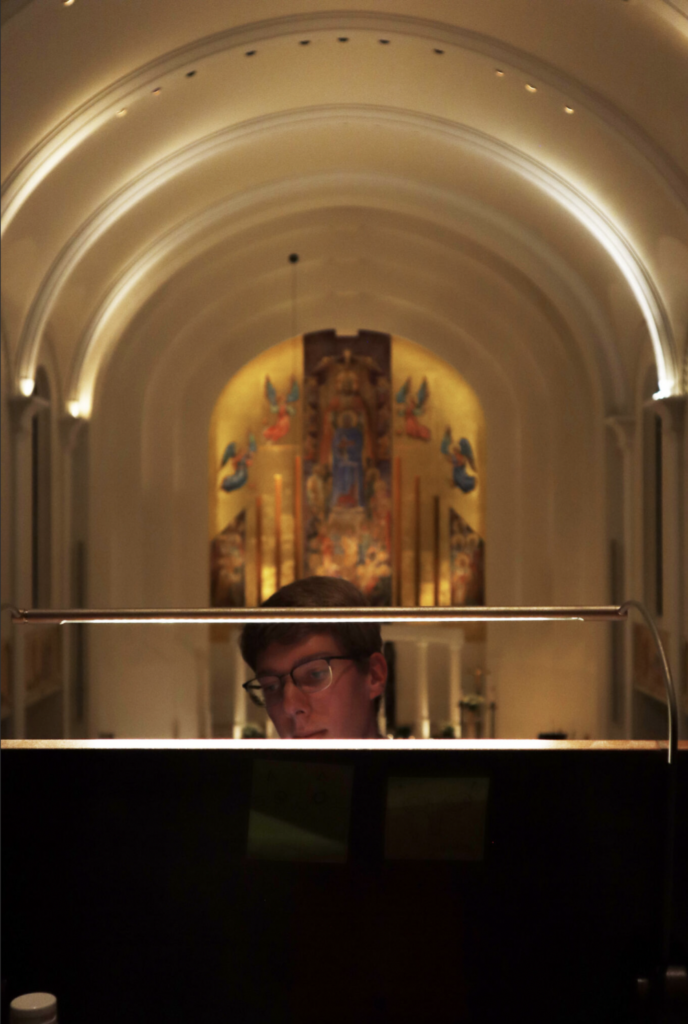
The uniquely selfless nature of liturgical music was echoed by Pearson’s fellow specialist, second-year organist Jonathan Esser.
“It’s always easy for people to find you after mass,” Esser said. “There are always the flashy pieces people will point out. But I think, ultimately, that’s just not the ideal. I think the ideal is, you want good music, but you don’t want to be center of the stage. It is not a performance. It’s a prayer. And hopefully, it’s everyone’s prayer in the whole congregation, not just yours.”
Esser had taken sporadic piano lessons throughout grade school, but when a friend suggested he try the organ, he began teaching himself on YouTube at 13 years old. Shortly after, he started taking lessons. At 15, Esser played his first full mass, and estimates he has played too many to count since.
“There’s this great feeling of joy, being able to minister in this way,” Esser said. “Hopefully people are getting joy out of it, and it’s always a joy to talk to parishioners, to hear how the music has touched them. But also it is my own prayer as well.”
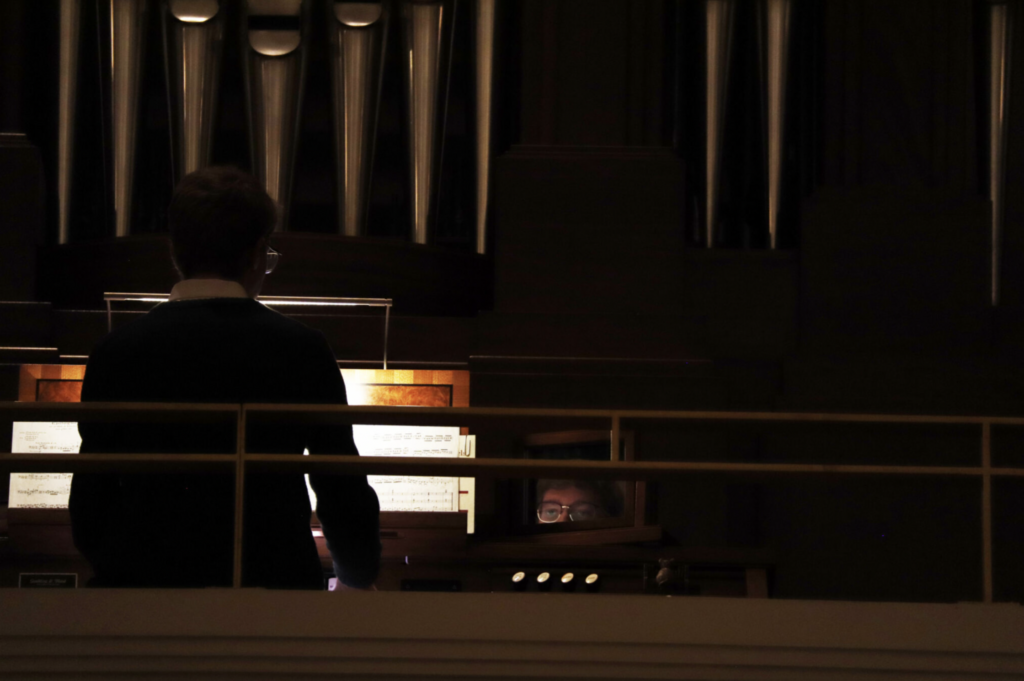
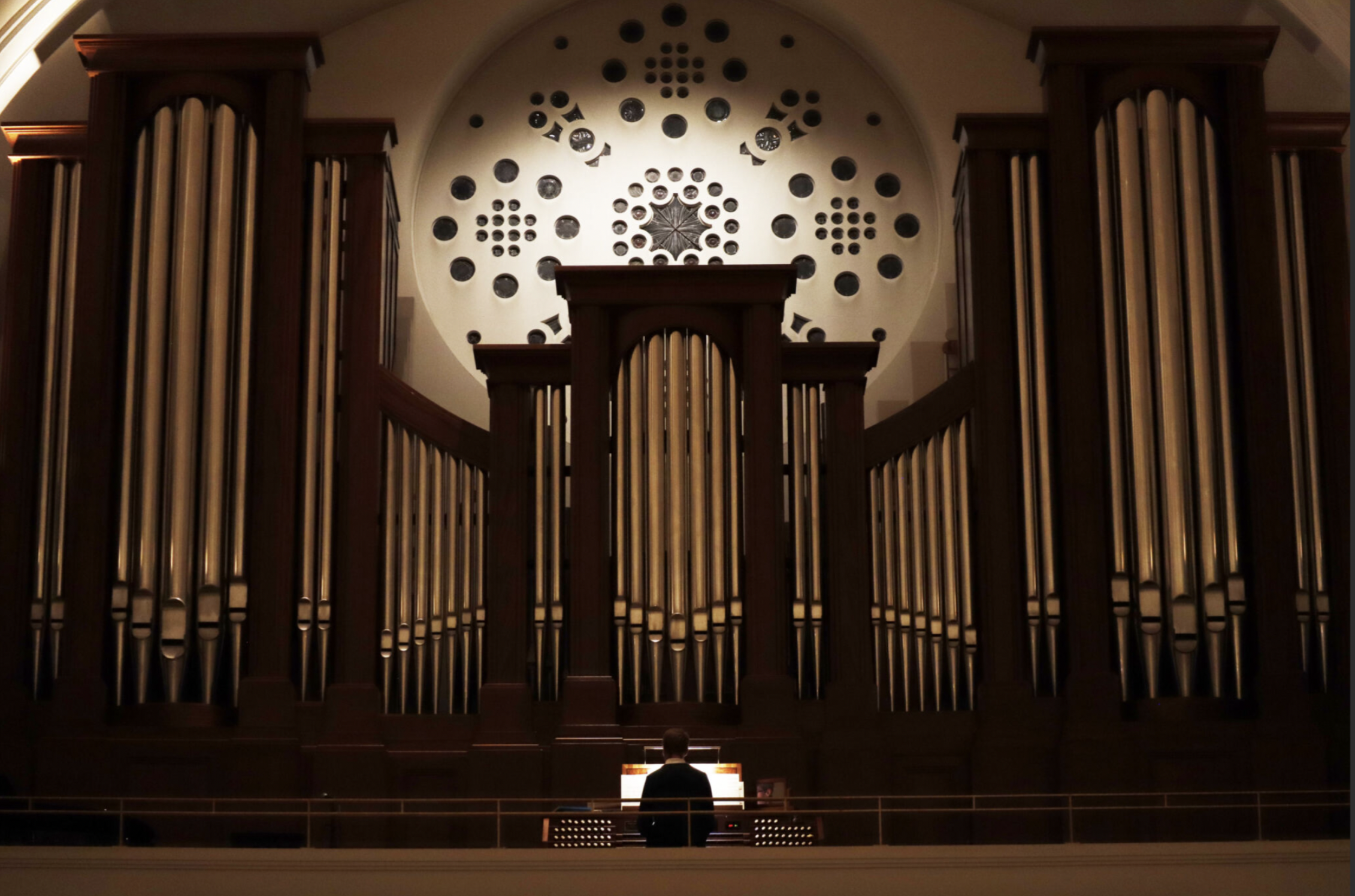
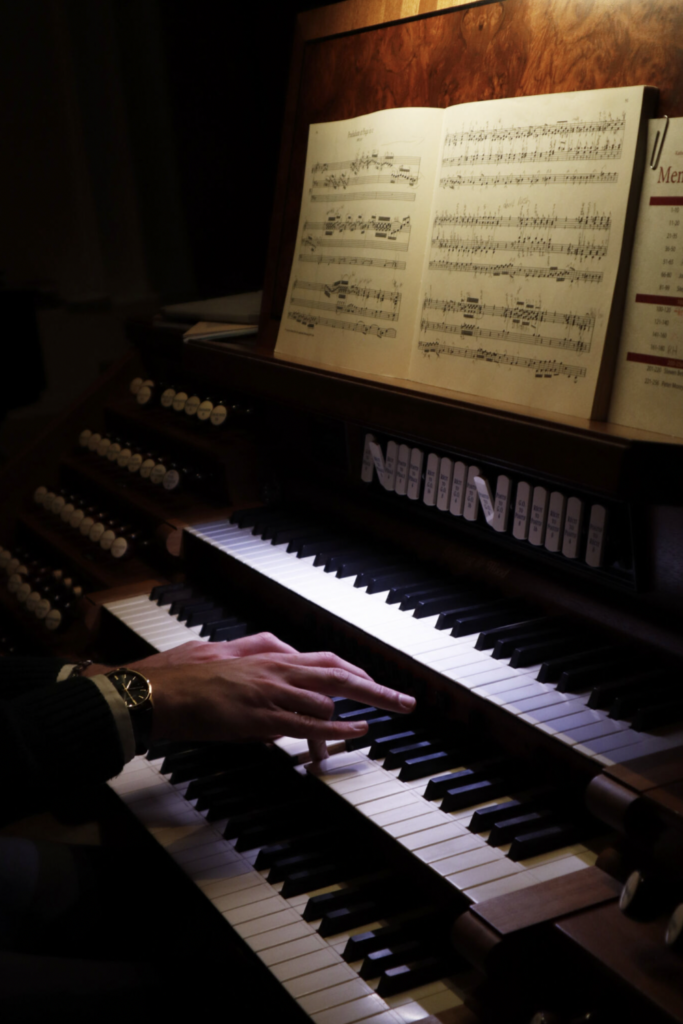
When he plays, it looks almost more like dancing than playing music. The sheer scale of the instrument — Loyola’s organ, which Esser estimated to be on the larger side, has 53 stops, 70 ranks and 3,747 pipes — calls for all hands and feet to be used, waltzing over and under each other in a steady rhythm.
“We’re blessed here, not only to have this for masses and services, but also for the organ concert series and for students to learn on it,” Esser said. “The beautiful thing about this one is how well it’s voiced, and its character. I think it’s one of the best sounding organs, and the room’s acoustics definitely help.”
He presents the organ as an orchestra unto itself — and then some. Each uniquely built for its church, the instrument can seamlessly blend pipes that make the sound of bells, human voices, trumpets, strings and more, with one knob being called “effect of a storm” and another simply “star.”
But to Esser, these are more than just sounds. Part of his studies and passion have been the greater history and symbolism of the instrument’s ritual use. He described how drops of Jesus’ blood can be reflected in the staccato, and the air being pushed through the pipes recalls God breathing life into Adam and Eve in the book of Genesis.
Despite the instrument’s grand capabilities, Esser said his favorite pieces showcase a quieter, softer side.
“Of course, the flashy loud pieces are always going to catch people’s attention,” Esser said. “But it’s almost through those quieter pieces that you’re not blown away by the sheer power, which can convey something, but there’s also the gentle nature of God, there will be those quieter moments of grace.”
The music, Esser and Pearson explained, expresses a reality that words can’t.
“Hopefully, through this different expression of words, there’s a deeper grace and a deeper revelation that can come through,” Esser said. “There’s always beautiful moments that just transcend understanding.”
This allows for their expressions to be received in a deeper sense. Pearson was able to give back some of what she’d learned and gained from her time at Loyola by performing at Sister Dolores Jean Schmidt, BVM’s funeral, an experience she said has remained with her.
“I’m sending her off in a way, giving this to her as she passes from this life to the next,” Pearson said, recalling how she felt choked up in the gravity and beauty of the moment. “It felt fulfilling. I have a purpose. My purpose then and there was to be a part of this wonderful group that is giving something to this wonderful remembrance of her life and what she has done.”
Esser said the music brought him fulfillment after a period of “going through the motions” of faith in early high school. As he studied the music, he said it strengthened his faith, which likewise strengthened his playing, the two continually contributing to one another.
“It’s just such a beautiful thing to give that gift I have grown back to God,” Esser said. “To use it for not only other people’s benefit, hopefully, but my own personal benefit, and to find the grace through the dissonance, or find those graces and times of peace or consolation through the music.”
Morey, who took on the job in 2024, said he felt fortunate to mentor Pearson and Esser as his first students in the program.
“Both of them are really exemplary students in that they have an image already in their head of what they want to do, what they want to be,” Morey said. “And they follow through on that dedication, which is rare.”
After originally thinking she would be a business major or go to fashion school, Pearson described the gifts she received from following her passion as “tenfold” to what she can share and encouraged others to find their unique gifts as well.
“Even though it’s niche, even though it’s so small, if you have this nagging call you’re feeling, dive into that,” Pearson said. “That takes a lot of trust, and a lot of faith and patience to give up what you thought was going to happen. Diving into what is already in store for you is a really beautiful thing.”