Loyola’s financial town halls were hosted March 24-26 by CFO Wayne Magdziarz.



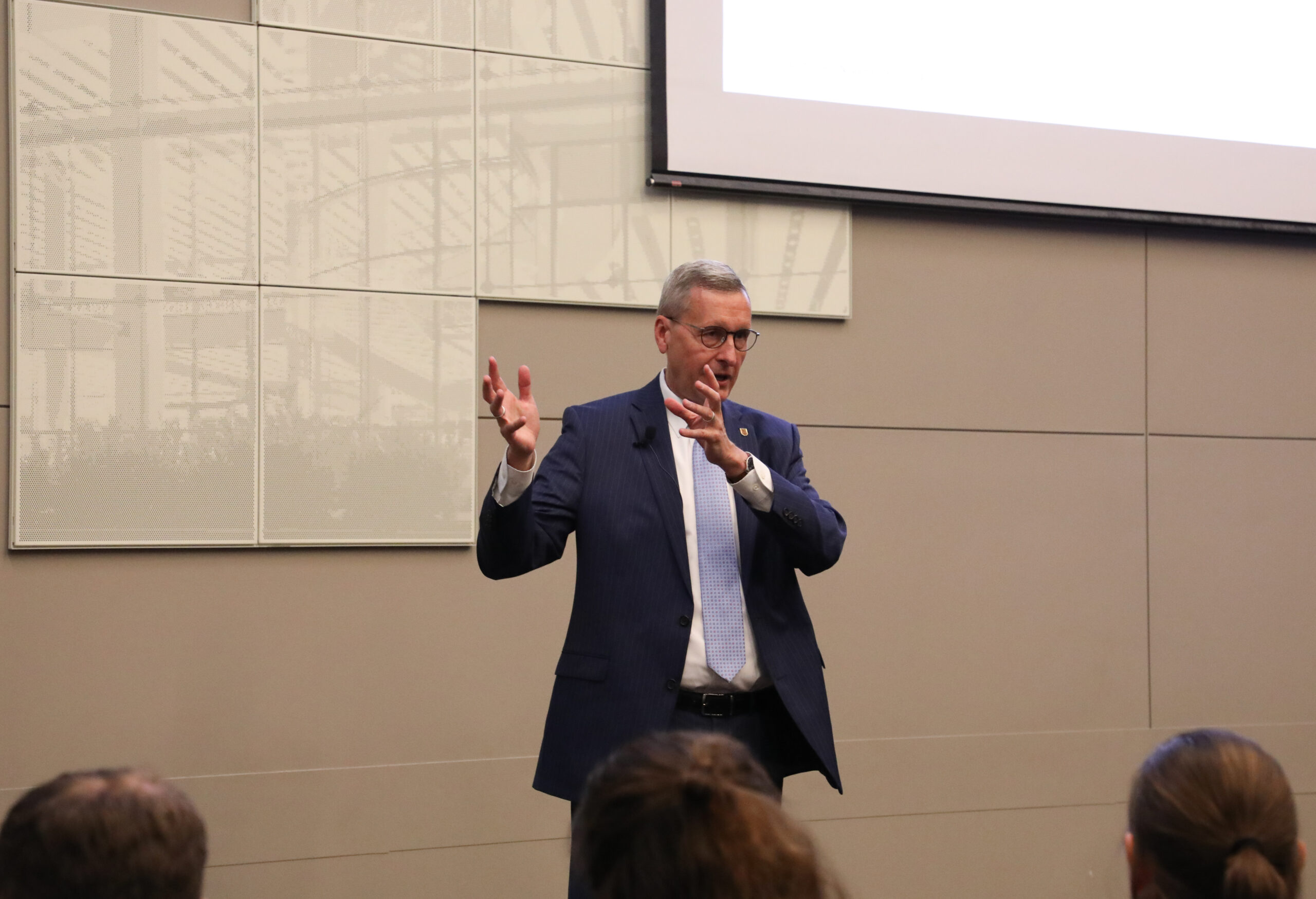
On the agenda for the 2026 Loyola financial town halls, hosted March 24-26 by CFO Wayne Magdziarz, were the issues of reviewing the 2026 Fiscal Year (FY), the 2027 approved FY budget and the road ahead.
Wayne first noted to the crowd of around 60 faculty and students at the March 25 town hall the “tremendous amount of external and internal pressures on higher education from multiple sources.” These problems include tuition and enrollment.
For the current FY 2026, when the current operating budget was approved by the Board of Trustees, the forecasted results of operations were $15 million, which is $10 million shy of what the school usually gets.
Before the COVID-19 Pandemic, the usual budget was $25 million, which in a typical year would go toward funding the school’s debt service, pension programs and other segments of the university twitch are allowed to use their operating surplus — for example, the Stritch School of Medicine, which throws off a “fair amount” of the surplus they receive every year.
Stritch is allowed to keep $10 million for faculty startup funds. When a chair of cardiology is hired, for example, that person typically enters the school with a heavy research flow and an expensive demand for labs and graduate assistants.
At the close of February, the forecast was adjusted down to $9 million.
Revenues are expected to grow by 2% and expenses by 3%. Magdziarz said the numbers in themselves aren’t sustainable, but comparatively there are similar universities whose revenues are 2% with expenses of 8-9%.
“Which just means the tough times are going to come even sooner,” Magdziarz said.
An absolute requirement from the Board and President Mark Reed are making sure there’s sufficient scholarship support for students. The unfunded scholarship fund — essentially, scholarships that provide a discount to students — increased by $17 million or 6% of net tuition fees, a 2% growth from FY 2025.
There are two primary reasons for being off budget by $6 million — negative variances in employee benefits and growth in expected salaries. When it comes to healthcare benefits, the university is seeing no defaults with employees resulting in a $9 million loss.
Expected salaries will grow by about $17 million. The president approved a 2% merit pool which makes up about nine of the $17 million.
The rest comes from lasting salary numbers. When the university budgets, they take into account every staff position being filled for four months — if someone leaves, and it takes three months to fill the position, the salary dollars for that period go unused.
This year saw less turnover than the previous two. FY 2025 saw $18 million in lasting salary numbers, meaning that pool of money went unused.
In 2022, an attendee of the town hall asked Magdziarz if the university would be able to keep up with inflation compensation — at the time, the United States was experiencing 7.5% inflation, The Associated Press reported.
“That was a no-brainer question for me, because the answer is no,” he said. “There’s no institution that possibly could.”
Though, he said the university “really worked hard” to put out some kind of compensation tool for faculty and staff. The university doesn’t distinguish between faculty and staff.
The university has been able to doll out at least some merit increase for faculty and staff that has exceeded the Consumer Price Index.
Magdziarz said tuition is the “lifeblood” of the university.
“Something we really try to honor is making sure a student who’s academically qualified and wants to come to Loyola can come here and doesn’t leave for financial reasons,” Magdziarz said. “That comes with a cost.”
The FY 2027 budget recognizes the potential impact of the demographic cliff — less college-aged students as a result of the 2007-2009 recession. There’s a greater percentage decline in the Midwest, The Phoenix reported.
The university set a tuition increase for next year at 4.4% and will continue to fund an increase in scholarship money for students.
The university spends about $10 million a year on student workers, $3.5 million comes from federal work study. In February, the university was told the work study number would fall to about half a million dollars.
What it means — in a typical year, Loyola employs about 1,400 work study students. In February, administration was told the number might decrease by 500 to 600. A couple of weeks ago, however, they received a “preliminary reading” from the government which told them work study may not be impacted, though it’s not a final determination.
In the fall, the university issued about $200 million in debt, most of it earmarked for the completion of the Integrated Sciences Building, which will house nursing, forensic science, chemistry and biochemistry on the site Campion Hall used to occupy.
Starting in the summer, the university will begin a complete refresh of all the Lake Shore and Water Tower Campus classrooms. The refresh will include painting the walls, new furniture and technology.
The university spends about $60 million in non-salary operating expenses. The expenses include contracts the administration has no control over and discretionary spending such as entertainment, travel and conferences.
Early in the calendar year, Magdziarz said there was a lot of anxiety surrounding what would happen to NIH grants on the federal level. When the Trump administration took office, the President signed many executive orders, some targeting grants related to DEI, The Phoenix previously reported.
Because 21 grants were impacted, there was a $4 million loss. In recent months, the impact has “subsided considerably,” with award money increasing from FY 2025 to FY 2026.
The university also suffered a projected impact of $8 million in indirect recovery costs — the costs of conducting research, The Phoenix previously reported. It would’ve been a 45% to 50% drop. The related executive order went to the courts and was appealed.
“Some of this you probably have heard me say before — in order to maintain our financial strength, I’ll call out a couple of bold moves to take,” he said.
The university can’t maintain the number of faculty and staff they have given current enrollment assumptions. Boosts in enrollments at the undergraduate level, an increase in graduate tuition at the master’s level and bringing in more money from philanthropy would help this. The past three years have shown increases in philanthropy, recently totalling at over $51 million a year.
“I have great confidence that [philanthropy] is going to get better, but as you’ve also heard me say before, as a university that’s 154 years old, we’re a little behind the curve,” Magdziarz said. “We should be a lot further in fundraising than we are.”
He mentioned student retention as a big factor in fundraising. When comparing Loyola to other Midwestern institutions, the university found the Halas Recreation Center and Sullivan Student Services Center “lagged behind” similar resources at other universities. In the campus plan, it’s mentioned there are plans to build a new recreation center, though plans aren’t underway yet and would take 10-15 years to come to fruition.
“We really need to remain competitive, not only programmatically, but also in our facilities,” he said.
Magdziarz said funding for campus planning initiatives comes from “three different buckets of dough” — for example, the new Integrated Sciences Building is funded by a $38 million grant from the State of Illinois and $15 million of university capital and the rest is covered by debt.
In response to general concerns from faculty about the need for an Integrated Sciences Building, he attributed its construction to a “tremendous demand” for nursing programs. He said the university can’t afford to wait in getting competitive with its facilities.
“I hope the takeaway from all of this is that business as usual in higher education is no longer acceptable,” Magdziarz said.