The event was held in McCormick Lounge at noon March 31.



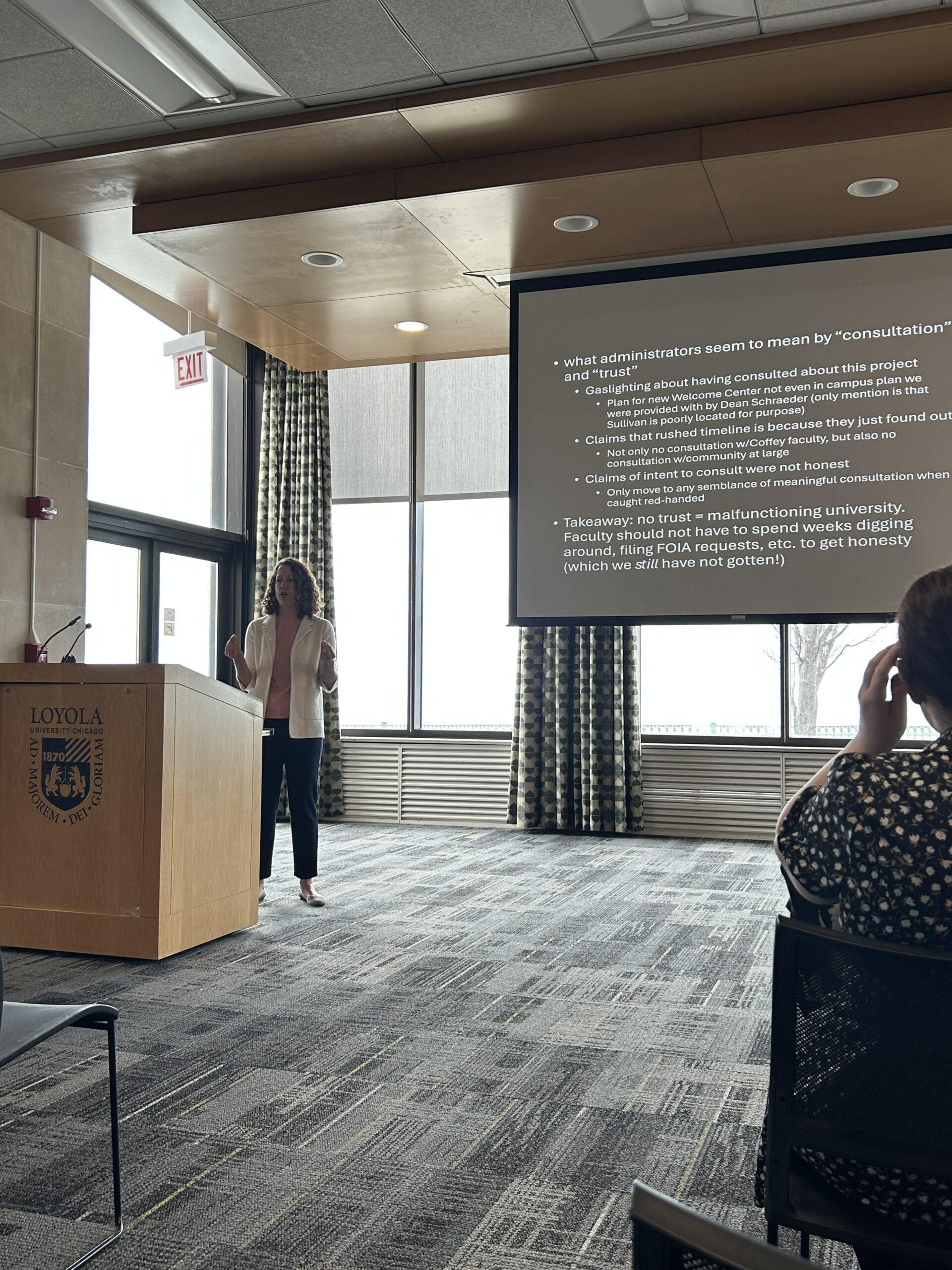
Faculty shared their concerns regarding the demolition of Coffey Hall and the projected plans for relocating the political science, psychology and sociology department faculty who are currently housed there at a March 31 gathering in McCormick Lounge.
Approximately 50 members of faculty were present at the meeting, which consisted of a presentation regarding their main concerns, followed by designated time for questions and sharing concerns.
College of Arts and Sciences (CAS) Dean Peter Schraeder emailed the chairs of the departments housed in Coffey Hall with news of Loyola’s plan to demolish Coffey Hall Feb. 2, according to Chair of the Political Science Department Molly Melin and Chair of the Sociology Department Peter Rosenblatt.
“The University is entering the planning stage for the construction of a second building — a new state-of-the-art Welcome Center — which if finalized and approved, would be built on the site of Coffey Hall, which would be torn down,” Schraeder said in the email. “This will be a great addition to the Lake Shore Campus and crucial to recruitment.”
University planners intended to engage with the three departments to address their needs, Schraeder wrote.
The communication with Provost and Chief Academic Officer Douglas Woods and Schraeder reassured the department chairs they’d have substantial input designing the new spaces. The departmental “input meeting” was held March 10, with architects presenting completed floor plans for the building to the chairs.
The floor plan consisted of windowless offices for professors, a shared conference room between the political science and sociology departments and one shared working space for part-time faculty, Melin said.
Input from faculty was dismissed during the meeting, according to Melin and Rosenblatt.
“The meeting was more of a webinar, and there was always a reason as to why faculty requests couldn’t be met,” Melin said.
Undergraduate Program Director of Political Science David Doherty — along with Melin and colleagues — were told March 18 the building permit was approved March 10. The plans submitted by the architect were “based on feedback from faculty/staff data sets from the college and engagement with CAS leadership,” according to Melin and Rosenblatt.
The two chairs found it hard to believe their input had been taken into account, so Melin emailed University Architect and Assistant Vice President for Campus Planning Patrick Brawley to confirm the data sets from the sociology and political science faculty were used and requested the date the permit was submitted.
“We would like to aggregate questions such as these through the Dean’s office,” Brawley said in an email response to Melin.
Melin said she felt the university was omitting information and misleading faculty in their consolidated response.
Melin and Rosenblatt said administrators are “gaslighting faculty” about having consulted about this project. Administrators’ intention to consult faculty wasn’t honest, they said.
“No trust equals malfunctioning university,” the presentation said. “Faculty should not have to spend weeks digging around, filling FOIA requests, etc., to get honesty.”
The provost’s office, along with the dean’s office in CAS, communicated with the chairs of the affected departments as soon as they found out they’re moving along with the Coffey Hall project, Provost Woods wrote in an email to The Phoenix.
“Nevertheless, communication on this issue has had gaps, and as we identify these gaps, we’re trying to address them,” Woods wrote.
With respect to the program array process, the process is not entirely done — there will be a process which will accept dean-approved appeals of the initial decisions until April 10, according to Woods.
The program array review is Loyola’s process of reviewing the university’s programs in order to distinguish what programs to continue, invest in, restructure or sunset, according to Loyola’s website.
Administration regularly updated the faculty council, a two-way channel of communication between university administration and corporate Faculty, offered to talk to various schools within Loyola in their faculty meetings, sent out written updates and pursued other efforts to be transparent with faculty, according to Woods.
Woods said the universities acknowledge the decline in enrollment, shrinking budget, demands for change from students and increasing time pressures impacting faculty and staff — all of which contribute to Loyola’s inability to offer students programs at the level they deserve.
The program array review process is being used in light of these issues, Woods said.
“We used a thoughtful process, designed largely by a faculty committee and are doing it at a time where we don’t have to react to budget pressure, but rather can make thoughtful, albeit sometimes painful, decisions,” Woods said.
Faculty are also concerned about the financial state of the university, regarding union negotiations, the need to cut expenses programs via program array review and sharply declining applications, Melin and Rosenblatt said.
“Another major concern is about our connection with our students,” Rosenblatt said.
Adjunct Instructor in the Department of English and Part-Time Co-Chair of Faculty Forward Alyson Paige Warren said the union has been negotiating their third contract with the university for the past year, which is proving to be difficult.
“We have met [with the administration] 35 times, and the last time the university put forth any movement on compensation was in September 2025,” Warren said.
In return to the administration’s slow response to their proposals, the union decided they ought to call for a vote to authorize a strike, according to Warren.
The strike would ensure the “true decision makers” are in the room when discussing the union’s proposals and a sense of expediency is instilled in regards to getting things done, Warren said.
“We do not want to strike,” Warren said. “What we want is to be paid a living wage that even barely keeps up with the consumer price index and the cost of living.”
The union also wants enough stability and work life balance to serve students in the way they deserve, Warren said.
Following these concerns, many faculty expressed their concern regarding the lack of transparency from the administration.
There aren’t many opportunities for faculty to talk about what is happening among different departments and campuses, according to Associate Professor of Physics Walter Tangarife.
“Maybe there are some clear reasons in their minds about why they’re doing certain things, but this is definitely not communicated clearly to faculty,” Tangarife said. “We as faculty are concerned and we want to understand.”
Associate Professor of Political Science Jennifer Forestal said she’s concerned with the lack of transparency and faculty consultation coming from the administration.
“The concerning thing to me is the administration has exhibited a pattern of decision making that doesn’t seem to respect students, faculty or staff,” Forestal said. “If those voices aren’t being a part of the process, we have to imagine the decisions are not going to be as good.”
A more robust system of shared governance, a long tradition of Loyola’s which allowed faculty to have a role in decision making, is necessary, according to Forestal.
Based on personal experiences, Forestal said she’s concerned the administration is using the students to defend the decisions they’re making, but disregard how the students may actually feel.
It’s important to have conversations among faculty about how administrative decisions are impacting their departments, according to Associate Professor of Chemistry Jim Devery.
Devery said he’s been concerned with Loyola’s method of sharing information for the past few years.
“It’s very difficult to get information out to all of the people that work at the university,” Devery said.
It’s also important to let the administration know what decisions are working or not working for the faculty as a whole, Devery said.