The cuts come as part of a larger Program Array Review conducted by university administration.



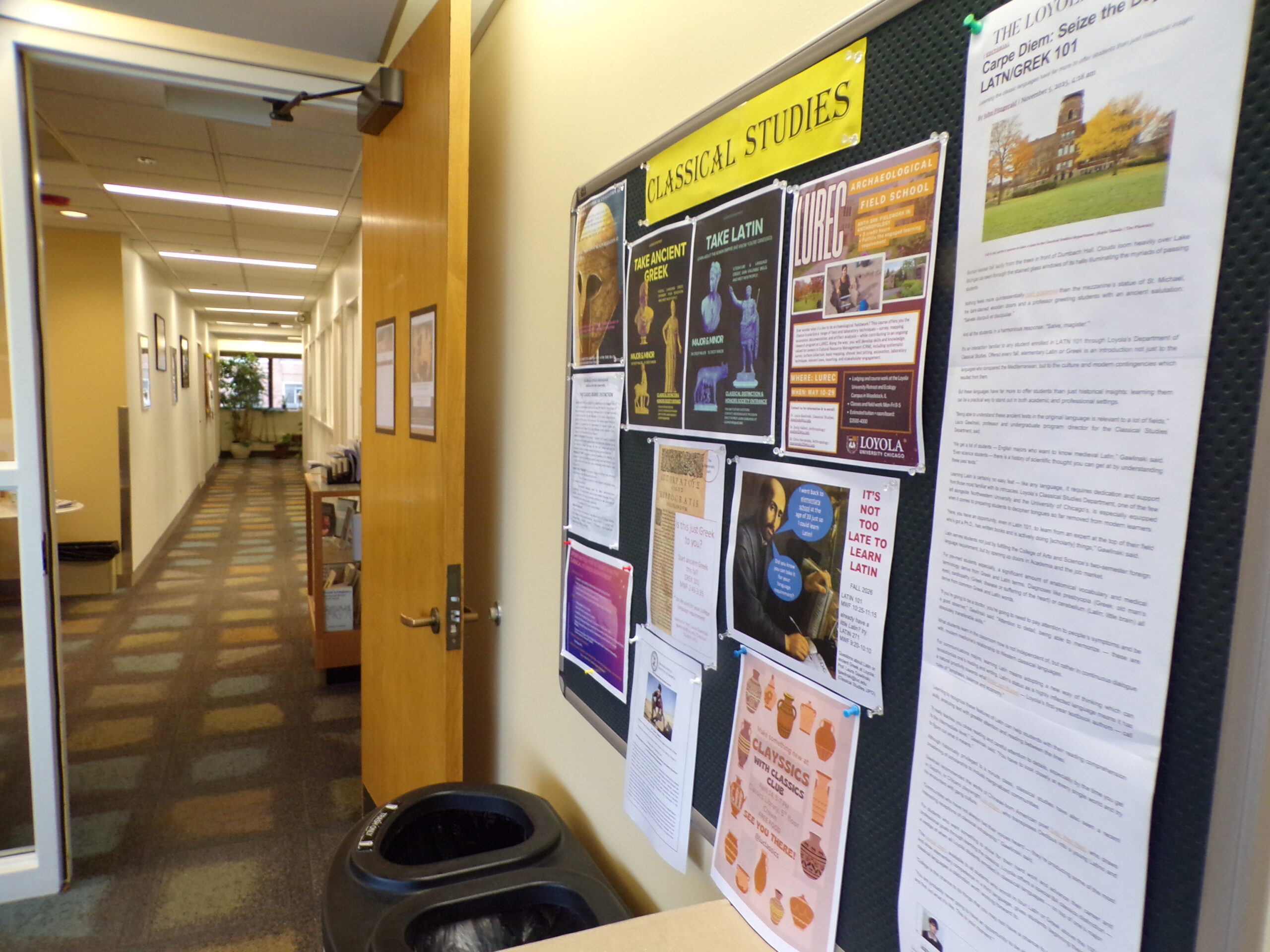
The Greek and Latin majors will be sunset starting next academic year as part of the Program Array Review (PAR) conducted by Provost Douglas Woods and Father Michael Rozier, S.J.
Earlier in the spring semester, there were initial concerns Loyola’s Department of Classical Studies would be cut completely. While details were vague, professors and instructors in the department feared there would be major cuts as a result of the Program Array Review (PAR) conducted by Provost Douglas Woods and Father Michael Rozier, S.J.
The university didn’t respond for comment by the time of publication.
Jonathan Mannering, a Greek and Latin professor in the department, could provide some details, but not all, and referred The Phoenix to a source who requested to remain anonymous.
Fear spread, with concerns rising if both languages would be sunset altogether as they face chronically low enrollment, Mannering said, but the language minors are staying, which he deemed a “pleasant surprise.”
When a program is sunset, any students currently enrolled in it will be allowed to finish, including first-year students, but the program will be eliminated once 2025-2026 first-years graduate.
As of now, the department is keeping the classical civilizations bachelor’s degree.
The classical civilizations major serves not only undergraduate students, but also the post-baccalaureate certificate in classical studies. The program is an important way to invite back Loyola students who pursued bachelor’s degrees in the department, and also invites students from other universities. Returning students benefit from a 25% discount.
In recent years, numbers for the post baccalaureate program climbed after dipping during the COVID-19 Pandemic, and, most notably, Mannering said the program’s profile is rising in reputation as it has attracted out-of-state students. The students who come out of the program go on to master’s programs, and some even go on to or have expressed interest in teaching Greek and Latin at schools in other states.
Mannering calls them success stories.
“Which is good for our department’s profile,” he said. “And what’s good for our department is good for Loyola, right? It should be a circle of virtue that reinforces itself.”
But there’s no reinforcement. Woods and Rozier — at great confusion to faculty in the classics department — seemingly want to go forward with sunsetting the post-baccalaureate program. When pressed for their reasoning, they cited the program’s current operations, which come out to a net loss.
Mannering found inconsistencies with this, as the courses offered for the post-baccalaureate program aren’t exclusive to it, they’re already being taught for majors within the department, meaning any tuition revenue comes on top of what the department is already teaching, no extra labor need be applied.
Mannering said it doesn’t make financial sense to sunset, with the course offerings alone, though additionally, he said the upward trend in enrollment over the next five years would bring in an estimated revenue in the hundred-thousands.
It seems, to Mannering, that the information the university is using to determine cuts is incomplete, and has placed department chairs in charge of gathering data from LOCUS, which Mannering said doesn’t paint the full picture.
A committee of 18 faculty from across the university were involved in the decision-making process. The process began in August, and determinations have been made, according to Associate Professor of Classical Studies and Director of Women’s Studies and Gender Studies Leanna Boychenko.
“I think that’s just too fast to make decisions that are this important, and the data they were using was faulty, which they know and have admitted, but still went ahead and did anyway,” Boychenko said.
Boychenko explained the lack of integrity within the university’s data, specifically concerning how the university broke down the costs for faculty to teach based on student majors.
“If students had multiple majors, the university just picked what they decided was their primary major,” Boychenko said. “They just discounted the other majors.”
In the classics department, no new lines — teaching positions, contracts that are non-tenure track or tenure track — have opened up, which is a concern. For an academic year, they usually do, but Mannering said it’s a much more difficult ask to have new faculty teach the courses the department offers.
One of the department’s recurring part-timers, an adjunct who’s been teaching at Loyola for over 30 years, will be retiring. There’s also a full time non-tenure track instructor, but is only on a one year contract not up for renewal.
Mannering referred to the remaining faculty as a “skeleton crew,” which doesn’t impact what they teach or what they’re able to fulfill for the university core curriculum. Though, it’s hard to offer courses when there are no yearly fulltimers to rely on, he said. As a recent example, four sections in the classics department ended up being canceled because there were no adjuncts available to teach them.
It’s frustrating, Mannering said, because it doesn’t allow the department to diversify its course offerings. The long term concern, however, is of the university not hiring full-time faculty, going forward. If that were to happen, the current full time faculty would be the last, and would result in a slow fadeout, rather than an outright elimination, of the department.
Boychenko said what’s most upsetting to her is not knowing what the extent of the cuts are. Along with faculty, she said students deserve to know what is happening at their institution.
“Once we do know, it’ll be too late,” Boychenko said. “I think that’s why they don’t want to tell us, because they don’t want anybody to do anything about it. That’s really not the way that universities should function.”
In the short-term, courseloads won’t change because the Greek and Latin language minors are staying. Mannering said it’s rare to find a university which teaches Greek and Latin at the advanced levels Loyola offers.
There’s another change on the horizon — a possible restructuring of the College of Arts and Sciences core, which classics faculty fear could negatively impact enrollments.
Occasionally, Mannering said students pick up a classics minor on accident. They enroll in a course on mythology, for example, find they enjoy it and want to learn more. It’s where the core curriculum serves the department well, introducing students to those disciplines they might not find otherwise.
The overlap doesn’t just apply to instances of enrolling in core classes; it also pertains to how the university earns revenue.
As a hypothetical, the anonymous source explained that, in a classical civilization 200 level course, there may be 40 students enrolled in a section. If 20 of them are nursing students, taking a classics course for a core requirement, their tuition revenue goes to the nursing school, not to classics.
Boychenko also said she’s worried about the plans to reform core classes. She mentioned how the provost made similar, drastic changes during his time at Marquette.
“This isn’t the first time that he’s kind of come in and made a lot of changes at an institution,” Boychenko said “It seems to me that you should get to know a place before starting to make these majors changes and find out what’s valuable, even if they don’t seem valuable to you at first.”
The anonymous source said, for the academic year 2024-2025, the post-baccalaureate program generated $88,000 in tuition revenue, but $154,000 in instructional costs.
Post-baccalaureate students pay out of pocket for their education, charged per credit, there’s no fixed price of tuition. Additionally, unlike other departments which may be supported by endowments, the anonymous source said no one is paying the graduate students to attend Loyola. The program is entirely supported by what the students pay.
What it looks like happened, according to the source, is that even though the post-baccalaureate students made up less than 40% of enrollment in any given course, the total instructional costs of all of those courses was attributed to the post-baccalaureate program. The anonymous source said they believe there was an error with the methodology used by the PAR system.
Theoretically, the source said, the post-baccalaureate program should be earning the university revenue because the courses offered to those students aren’t solely for them, they’d be offered anyway as part of the classics department. The instructional cost is therefore already incurred, and any tuition generated by the program either offsets existing deficits, or results in net gain.
The level of communication between PAR leadership and faculty was poor to nonexistent, according to the source, who said information was often shared at the last possible moment.
Ultimately, the anonymous source said, the sunsetting of the Greek and Latin majors changes nothing about the courses the classics department offers.
The upside to the possible core changes, however, is the inherent interdisciplinary nature of classics. Mannering said the classics courses could be repurposed. As a hypothetical, if the core required a course on cultural identity, ancient Greek or Roman authors could speak to the “perennial issue.”
Speaking to the university’s Jesuit values, Mannering talked about empathy and the significance of the cut majors to society today, as he believes the department deals with the most urgent questions of the day.
“One would be, specifically, masculinity,” Mannering said. “You know, what does it mean to be a man? The first word of Homer’s Odyssey is man. And the fact of the matter is, there’s no clear cut answer, and the ancient Greeks and Romans knew that, and they were constantly rethinking and refining and adapting their understanding of male identity over the ages and in different circumstances.”
What’s really concerning to Mannering is how fast the process came through, like a “whirlwind.” Though he doesn’t see any alternative modifications to classics, he does believe Loyola could benefit from more outreach to local high schools to foster engagement in the subject young, and mentioned the school’s dual credit program as an opportunity to increase student recruitment.
Departments impacted by the PAR were given a 12 p.m. April 10 deadline to submit appeals. The classics faculty chose not to appeal the decisions to sunset the Greek and Latin degrees, but did for the post-baccalaureate program.
Deans of the schools through which appeals were submitted would have to approve them before they could go forward. The morning of April 10, Emily Barman, dean of the graduate school, didn’t approve the appeal on the post-baccalaureate program. As a result, the appeal will not be considered.