Joffrey Ballet Chicago takes on a two-week run of the carnival of life that is John Neumeier’s “Liliom.”



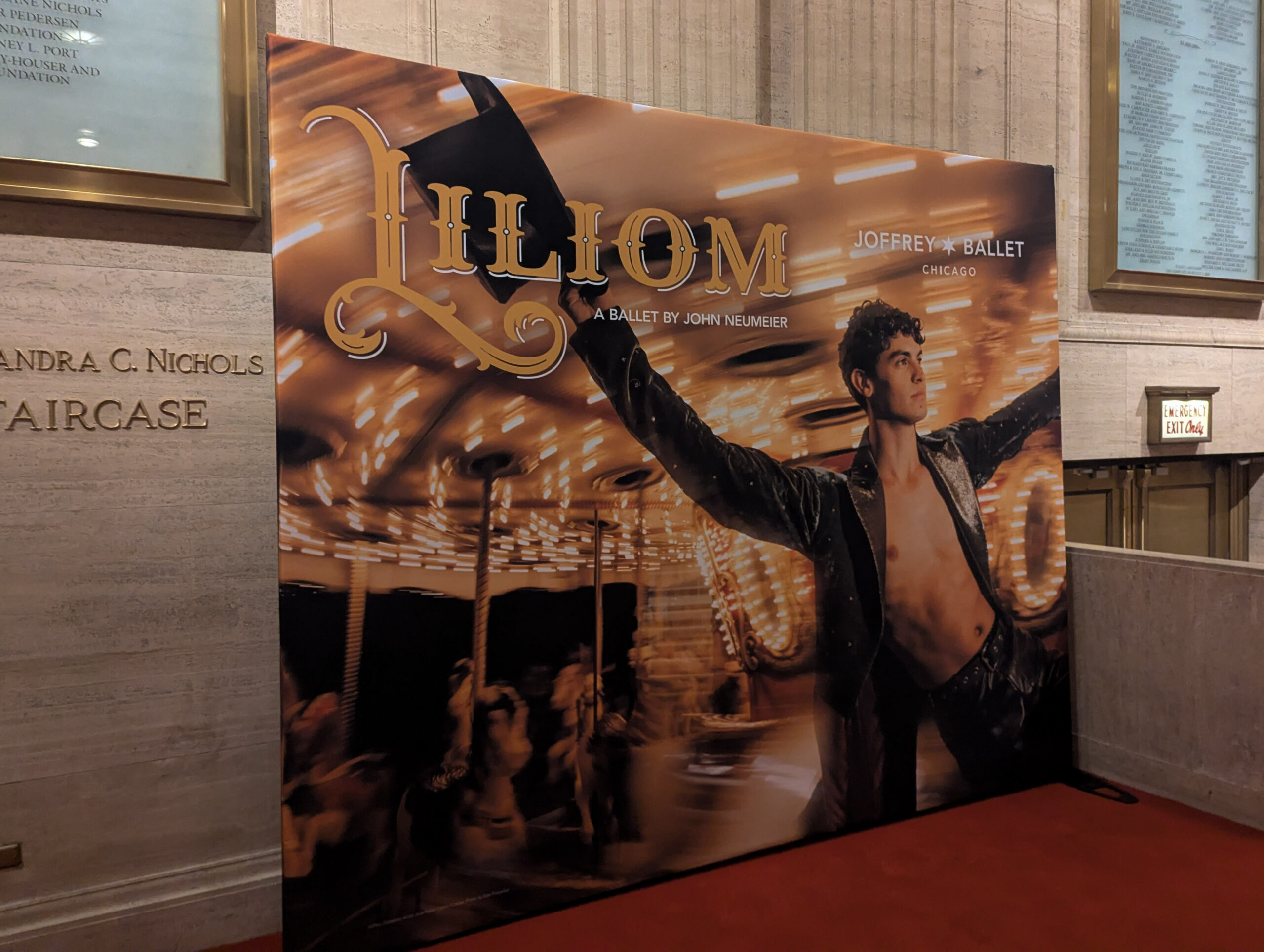
Upon entering the Ardis Krainik Theatre inside the Lyric Opera House, audience members of John Neumeier’s “Liliom” were met with an unusual sight Sept. 19.
The curtains, pre-raised to an industrial wall backdrop and broken by a projection of a brilliant blue sky, were Joffrey Ballet Chicago’s first clue this performance would be unlike any their spectators had seen before.
Per theater etiquette, the lights and chattering in the house dimmed on command of the tuning Lyric Opera Orchestra — but no music played as the first dancer crept along the stage holding a cluster of multicolored balloons.
Stunned into silence — broken only by the occasional coughing attendee — dancer Evan Boersma, portraying the liminal character The Balloon Man, held the audience’s attention in a firm grasp until he hit center stage.
The opening set left the stage, giving way to a dark, rundown Playland — the show’s fictional whimsical setting exquisitely crafted with a crooked sign and fully operational carousel. It’s here the magic began.
Louis, a young boy performed by company dancer Wictor Hugo Pedroso, fantasized about the infamous carnival barker, Liliom, while wandering the abandoned carnival with a child-like sense of amazement in his movement.
Paolo Randon as Liliom is willed on from the back of the stage by The Balloon Man, oozing with mystery and certain danger.
While his poster is plastered around the set, Liliom’s presence hasn’t graced the fairgrounds in years, until today.
Randon’s sharp, overbearing movements juxtapose Pedroso’s gentle curiosity. In a pas de deux of intrigue, what starts off as an innocent encounter quickly takes a turn for the worse when Louis doesn’t recognize the strange man — his deceased father sent from the afterlife to right his wrongs.
This glimpse into the future fades with the faint glowing of a Ferris wheel, the only light remaining on the stage. It grew brighter and more decadent, multiplying as Playland returned to the height of its glory 16 years prior to the epilogue.
Athleticism is at its finest in Randon, who reenters the stage bare-chested, clad only in leather pants and a matching ringleader’s coat. As he prowls the stage, Liliom’s sex appeal is shriek-worthy — earning a few from the dancers on stage — with controlled physicality belonging to a master of bodily awareness.
Unfortunately, the spell breaks when dancers dressed in stereotypical Persian and Chinese costumes enter the fair.
With current conversations about cultural appropriation in ballets, it’s disappointing to see Joffrey Ballet Chicago include these characters in their staging of this ballet — choreographed only 15 years ago — when they do little to support the plot.
Luckily, the viewer is quickly reabsorbed into the story as Liliom meets Julie (Anais Bueno), a timid waitress bewitched by the bad-boy despite her friend Marie’s (Natali Taht) attempts to dissuade her from certain heartbreak.
Marie and her boyfriend Wolf (Jonathan Dole) engage in a wholesome tryst away from Playland, with Liliom and Julie similarly finding themselves in an intimate moment. Cautious yet curious, the latter pair waltzed across the stage, pushing and pulling against the other’s budding affection.
However, the games come to an end when Liliom’s former lover and employer, Mrs. Muscat (Basia Rhoden), learned of his rendezvous with Julie. Forced to find work, he joins the other unemployed men whose precise corps work fueled imagery of their roles as mechanisms in an unforgiving capitalist society.
Once act 1 ends, a defeated Liliom surprisingly remains on stage into the beginning of intermission after Julie gives him a piece of hope for their future. This peculiar act was an ingenious metaphor for the inner turmoil Liliom grappled with when seemingly no one was watching.
The melancholic mood was swept off stage when the second act opened to a still-life of Marie and Wolf’s wedding. A serene gathering of friends quickly takes a turn for the worse when a bustling, theatrical cat and mouse chase between Liliom and police officers leads him to take his own life.
His character grappling with immeasurable grief, Bueno performed a heartbreaking solo of quiet, yet earnest strength as Julie must continue on without her beloved for the sake of their unborn son.
Meanwhile, in purgatory, the verdict of Liliom’s eternal damnation heated up, expressed through cheeky synchronizations between the gatekeeper (Dylan Gutierrez) and devils.
Given a chance for redemption, Liliom returns to Playland 16 years after his death to finally meet the son he watched grow up from the heavens. Pedroso replicated Randon’s steps with eagerness, but showed father and son weren’t the same by softening Liliom’s icon edge.
Julie returns to the abandoned fairgrounds to comfort her son from a force she can’t see but feels oddly familiar — a quality Liliom can’t shake, even in the afterlife.
In the final pas de deux, performed primarily without looking at each other, Bueno and Randon explored a carousel of emotions from hopeful longing to complete loss over the potential life they could’ve had together.
Eventually, the pair make peace with the past, repeating choreography from when they first fell in love to finally say goodbye.
“Liliom” can be watched at the Lyric Opera House from Sept. 17-27. Student Rush tickets are available for purchase two hours before the show at $20. Student ID at the box office is required for ticket pickup.