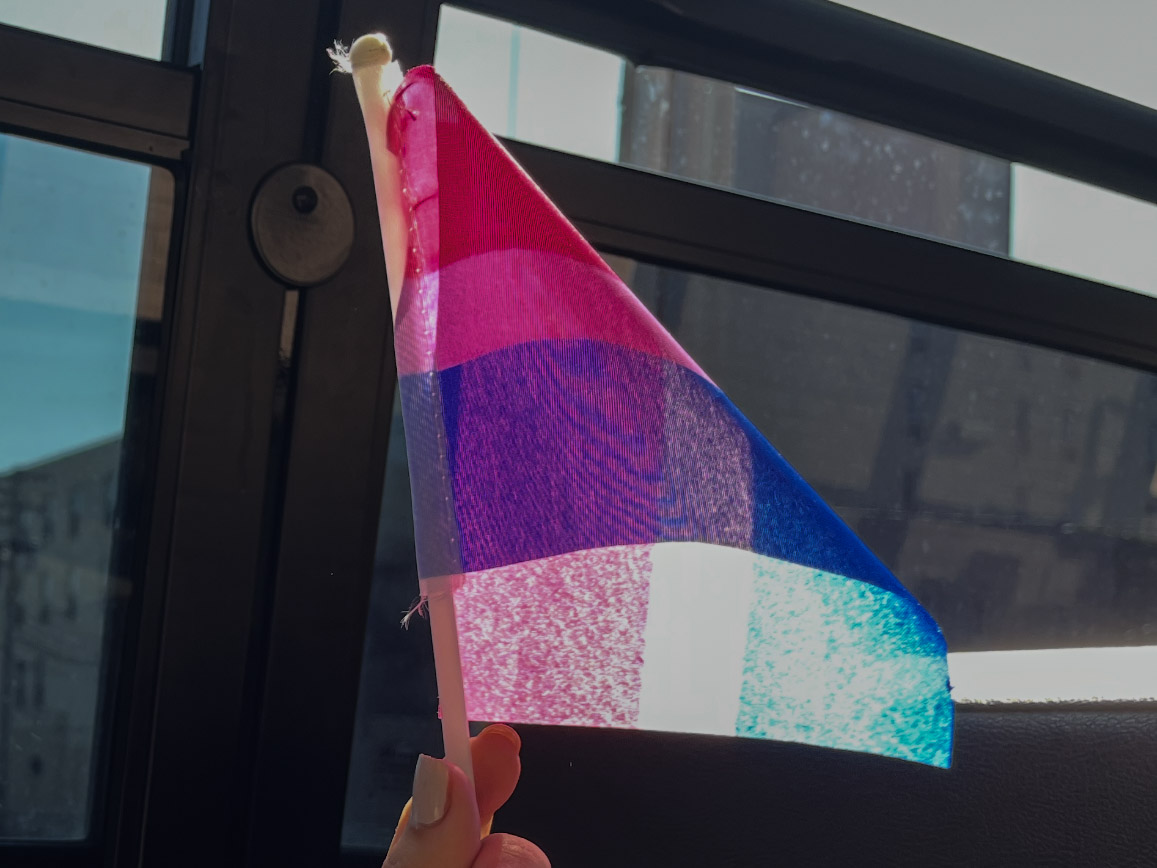
When most think about Pride, their thoughts float to the boisterous, colorful parades held across the world in June. However, Pride isn’t just celebrated during one month, but throughout the year to honor the various identities of the LGBTQ+ community.
Sept. 23, 1999, was the first annual Bisexual Visibility Day created to recognize cultural practices harming bisexuals and create a collective movement for the acknowledgement of individuals who identify as such.
Decades later, bisexuals are still tirelessly fighting for the tenets of this day, both within and outside queer spaces to be seen as more than the misconceptions surrounding them.
People who identify under the expansive bisexual umbrella make up over half of LGBTQ+ adults in the United States. Still, they’re grossly misrepresented even amongst some of the most progressive media today.
In recent years, the hard-fought battle for honest, joyous representation of queer stories in the media has finally started to pay off with content like “Pose” and “Bottoms.” However, bisexuals seem to have largely been left behind in the process.
Ilya Rozanov. Benedict Bridgerton. Jeremiah Fisher. These three characters — whether originally bisexual in their books or adapted to be so in their hit TV series — are all connected through the quintessential bisexual stereotype of sexual promiscuity.
For decades, bisexual characters have been allowed to enter the public eye, but only if they ooze unstoppable sexual prowess. Without fail, these characters are written to hop from one partner to the next due to their attraction to more than one gender.
Media outlets persistently release content that pushes these narratives about bisexuals, furthering their fetishization.
This rhetoric also enables biphobia to spread prejudice across communities without discernment.
Biphobia can appear as a heterosexual partner hypersexualizing one’s attraction to the same sex, or the assumption they’ll want to partake in polygamous interactions because of their sexuality. It can also be the avoidance of starting a homosexual relationship with a bisexual, in fear they’ll inevitably end the relationship for a heteronormative one.
With this treatment, it’s no surprise bisexuals experience higher rates of mental health issues and fewer feelings of belonging than other queer identifying people, even within a community built on acceptance.
Of youths identifying as bisexual, 44% expressed having experienced suicidal acts or ideation, according to the Bisexual Research Center. This is 21% higher than those reported from LGBTQ+ youths in general and 37% higher than those who were straight.
Studies show bisexuals are less open about their sexuality than their homosexual counterparts.
The percentage of gays or lesbians who haven’t told at least one family member of their sexual orientation is 24% lower than the 32% of bisexuals who haven’t done the same, according to LGBT Great.
Bisexual men are less likely to be out to any of their friends than bisexual women, at 30% of the former and 8% of the latter. This is significantly more than the 2% of gay men and 1% of lesbians not out to their closest support groups.
Despite statistics pointing to feelings of alienation across bisexuals, students at Loyola show an overwhelmingly positive amount of support for the bisexual identities.
In an anonymous student identity poll conducted by The Phoenix, with a sample size of 191 participants, nearly 21% of students self-identified as bisexual.
More than 6% of Loyola students selected “prefer not to answer” or “it’s complicated” on the question asking if they identified as bisexual.
When asked what they thought when a person told them they were bi, responses mostly ranged from boisterous acceptance to neutral indifference.
Even though a majority of responses were inclusive and open-minded, a few sentiments of bi erasure — whether intended or not — were noticeable among the open response.
Bisexual erasure occurs when someone questions the earnestness of a bisexual person’s sexual orientation, believing their feelings are confusion or a phase, before an inevitable labeling as straight or queer.
Making an unnecessary decision about someone else’s identity by denying an aspect of their sexuality can harm those exploring their identity and are in search of a safe space.
Because sexuality is a spectrum, bisexuality looks different between individuals. The pressure to match another person’s expectations of what bisexuality looks like can push people to avoid the label.
The B in LGBTQ+ stands for “been forgotten, belongs nowhere, believe me, this is not a phase,” one person, who has identified as bisexual since the 90s, told The Phoenix.
While the tiresome battle against misrepresentation and bias continues globally, bisexuals have found solidarity with each other and allies who want to know the person beyond the label.