88-year-old Ukrainian Holocaust survivor, Gdalina “Lin” Novitsky, shares stories from her childhood living through the Holocaust.



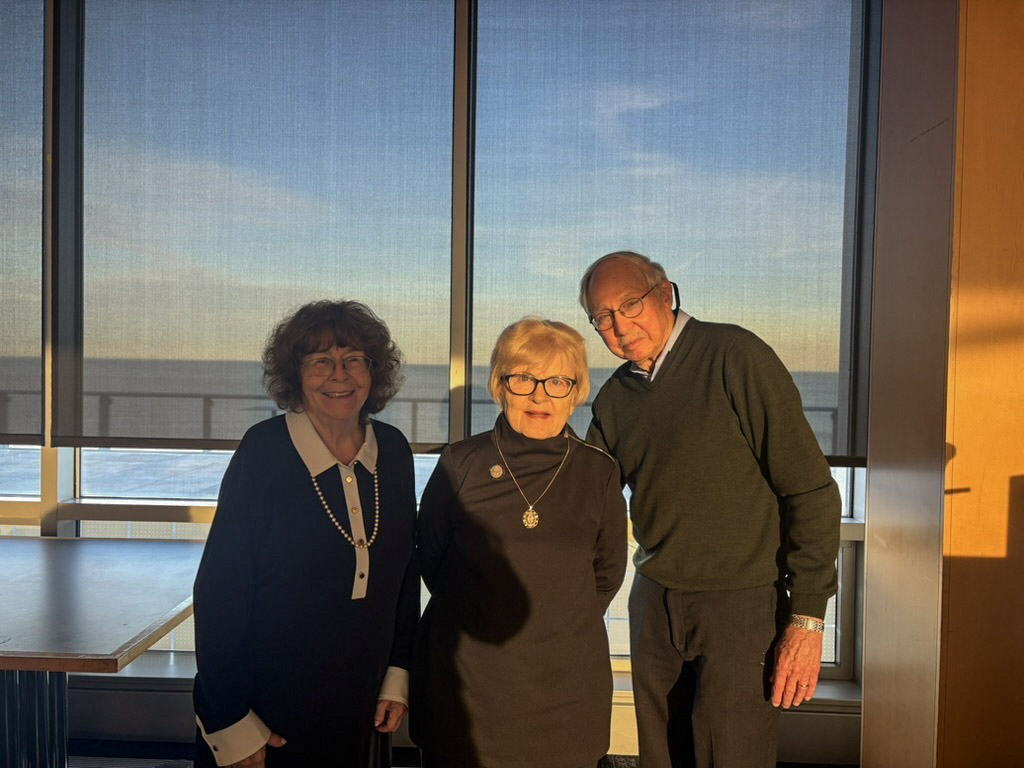
Gdalina Novitsky’s hometown of Kyiv, then part of the Soviet Union, was invaded by Germany in 1941. Her maternal grandmother, Faina Kaplan, was one of the 33,771 victims whose lives were stolen the nights of Sept. 29 and 30, 1941.
The Department of History and Loyola University Chicago Libraries hosted Holocaust and Babi Yar massacre survivor Novitsky, 88, at the annual commemoration and 88th anniversary of Kristallnacht, also referred to as the Night of Broken Glass.
Novitsky said she brought her story to Loyola to spread awareness of the atrocities that occurred in her early childhood to prevent them from happening again.
Kristallnacht occurred on Nov. 9 and 10, 1938 — the same year Novitsky was born. The anti-Jewish riot destroyed around 1,400 synagogues and 7,500 Jewish businesses through the work of Nazis, according to former adjunct history professor Elliot Lefkovitz.
The massacre was named after the Babi Yar ravine near Kyiv as the shootings took place near it, and victims’ bodies were discarded there. The massacre is one of the largest mass killings at a single location in World War II, according to the Holocaust Encyclopedia.
Lefkovitz mentioned how graves were desecrated. Many Jewish homes, orphanages and senior citizen centers were invaded, looted and destroyed.
“In order to warm themselves, the freezing children huddled close to the flames of a burning synagogue,” Lefkovitz said.
Kristallnacht was just one event of many that jumpstarted the horrors of the Holocaust.
Novitsky was just 3 years old when Germany invaded her hometown of Kyiv, now part of Ukraine, in September 1941.
“I do remember all of the events because of the stress of people surrounding me,” Novitsky said. “It came to me also, stress and uncertainty of what was going on.”
Novitsky is the only child in her family, and her father was a lieutenant who fought in World War II. Her mother, afraid of what would come next, decided to flee. Novitsky and her mother went to the Kyiv railroad station and migrated east.
The conditions of the railroad cars were vacuous, and Novitsky recalled staying in kettle cars, where food and water were scarce. The trains had no regulation or schedule and people often became sick and died, Novitsky said.
Novitsky, her mother and her three aunts settled into the outskirts of Al Mate, a city located in the Kazakh Soviet Socialist Republic. There, she recalls falling into different illnesses. Novitsky endured carbon monoxide poisoning, dysentery and scarlet fever as a child.
“I got scarlet fever and spent 30 days in the hospital,” Novitsky said. “To some extent, it was good because I got three meals a day.”
The war ended, and victory was declared for the Soviet Union in 1945, around the same time Novistky started first grade. At this time, she and her family were living in what was called “Village #2.” Novitsky described her school as being one room, with no books or notebooks. Pencils were split into one or two pieces for students to use, Novitsky said.
In 1946, Novitsky and her family returned to Kyiv, and she started second grade. The starvation within the Jewish community in Kyiv was severe, Novitsky said. Her family became lower-class and antisemitism was prevalent.
“The hunger was so severe, people became swollen,” Novitsky said. “Some of them would die on the streets of Kyiv.”
Obtaining a collegiate education was no easy feat for Jewish people at the time, Novitsky said. In Russia, the equivalent to getting an A was getting a five. Students had to receive all fives in school to get into a Russian college. Novitsky showed her report card at the event, which had all fives except for a singular four.
Because of this, she went into the work force at age 17 and eventually was able to enter Kyiv State University’s evening education classes, studying civil and structural engineering — the field she worked in once she immigrated to the United States.
Novitsky and her husband had one daughter together before immigrating to the United States in 1979 and settling in New Jersey before moving to Chicago. She and her husband both worked in engineering, with her husband working as an electronic engineer with General Motors in LaGrange, Ill.
Novitsky said she wished to share her story with the purpose of preventing such atrocities from happening again. She collaborates with the Illinois Holocaust Museum and Education Center to spread her narrative, urging younger generations to never doubt the realities of the Holocaust.
Behind the event’s planning was Lefkovitz, who taught at Loyola for 40 years, retiring in 2017. He began his time at Loyola teaching Western civilization classes before transitioning in the ‘80s to his true passion — educating students on the Holocuast and 20th century genocide. In his time as a teacher, he began to invite survivors to share their stories to students.
“One important lesson is to think of people as individuals — not as types, not as groups, and to not judge them, but to relate to them as individuals,” Lefkovitz said.
Lefkovitz has made moves to educate the public on the Holocaust through his efforts toward mandating Holocaust education for Illinois public high schools and being one of the founders of the Illinois Holocaust Museum, located in Skokie, Ill.
Founding Loyola Hillel Director Patti Ray began to work alongside [when] Lefkovitz to widen the access of education on the Holocaust. Ray came to Loyola in 1987 and met Lefkovitz around the same time. For over two decades, Ray said Lefkovitz would open up his classes for collaboration with Hillel students if they wanted to hear survivors’ stories.
In 2013, the Loyola history department and University Libraries collaborated for the first time to commemorate Holocaust events with a panel of survivors speaking in the Information Commons. Every year since then, annual events have been held to honor Holocaust survivors and victims, and to remember the horrific events that occurred.
Art therapist and Jewish community member Sharon Hyson has been attending Ray’s Hillel programs at Loyola for years, she said. This is her sixth year attending the annual commemoration of Kristallnacht.
“I think Ms. Navitsky’s story just needs to be told over and over again,” Hyson said. “This is my community, and there’s just too much crime and antisemitism.”
Second-year psychology major Carol Marin said she was really moved by Novitsky’s story and believes it’s important such an atrocity never be repeated. Marin also noted how Novitsky’s ability to remember such old memories demonstrates how traumatic they really were.
“This event truly showed you how the Holocaust was not even that long ago,” Marin said. “She [Lin] was only 3 years old and still remembers all of this, you can truly see all the trauma she endured because she remembers all the memories so vividly.”
First-year psychology student Nadia Wilson noted how the speech was moving and very heartbreaking. Wilson said anti-emitism needs to be fought, no matter who you are.
“Even if you’re not Jewish, even if this doesn’t apply to you, there’s something you can do about it,” Wilson said.
Before closing her story, Novitsky urged the audience to be active witnesses and to work against antisemitism.
“We survivors don’t want to give our pasts to your future,” Novitsky said.
Editor’s note: Carol Marin is a contributor to The Phoenix.