The French program, Italian Studies program and Department of Modern Languages and Literatures hosted an open forum for students to discuss the student protests in Europe.



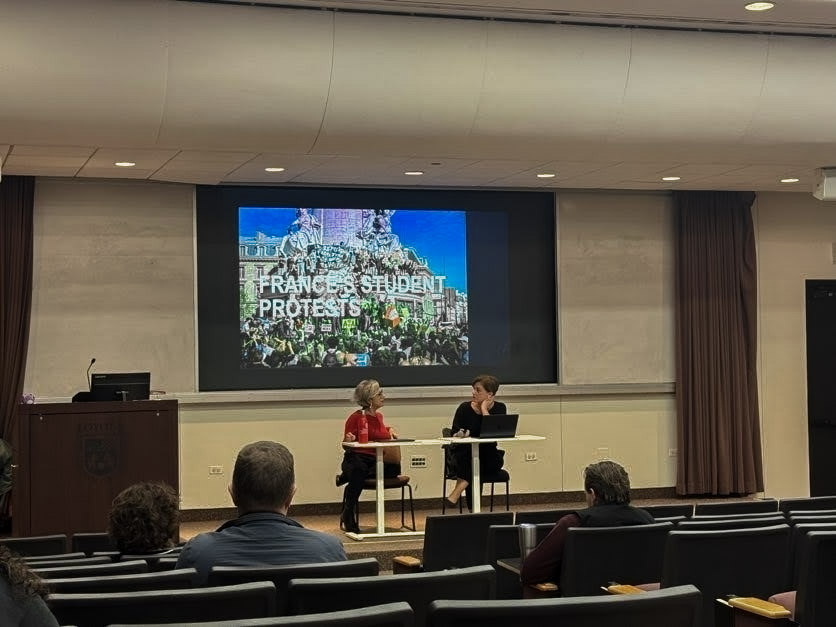
The French program, Italian Studies program and Department of Modern Languages and Literatures hosted a panel and forum Nov. 2 open to students to discuss the wave of protests occurring across Europe, specifically in France and Italy.
There have been over 1700 protests across 31 European countries since Sept 2026, The Associated Press reported. The protests target an array of issues from cost of living to complaints within the education system, The AP reported. Notably, many of the protests were started by or are continuing to be led by student organizers.
French Undergraduate Program Director Eliana Vagalau and Italian Program Director Cristina Lombardi-Diop organized the forum and opened with slideshows explaining the events occurring in France and Italy.
They presented the protests with data from different sources and multiple perspectives. According to Vagalau, it was important to them to remain as unbiased as possible to encourage students to lead the discussion. Vagalau’s goal wasn’t just to educate students on the events, but to demonstrate the power of open conversation and thinking outside of one’s immediate surroundings.
“One of the important things for me is for students to learn to listen to each other, to make space for the others’ claims and information, “ she said. “But mostly to think globally.”
Second-year global studies major and European studies minor Callie Standerfer attended the panel after hearing about it in her classes.
She said she knew she’d enjoy learning about the events but was most interested in the opportunity to engage with her peers in an unique way.
“I wanted to hear other people my age’s opinions about it, rather than just talking to my professor on my own,” she said.
Lombardi-Diop said she recognizes a hunger in students for avenues to discuss current events and social issues in this way.
“What we saw on Monday, it’s really an eagerness for not so much this topic only, an eagerness to know more, but an eagerness to have an open forum,” Lombardi-Diop said. “Where professors are not necessarily faculty necessarily just teaching or imparting knowledge, but they’re sharing knowledge with students, and we learn from each other.”
After Lombardi-Diop and Vagalau’s short presentations with the basic context and timelines of the French and Italian protests, they left the floor open for students to ask questions, voice opinions and share concerns with one another.
Fourth-year environmental policy and French major Kate Ostrowski spoke during the forum about her disappointment with the protest culture at Loyola lacking in commitment among students. She heard about the panel while sitting in her Italian professor’s office and attended hoping to gain a better understanding of the Italian events and to take advantage of the opportunity to converse with her peers.
“I always really enjoy an opportunity to speak and learn,” Ostrowski said.
She said she was also excited to see the two languages she’s passionate about, French — her major — and Italian — her minor — crossing over into discussion with something else she feels passionate about, the power of protest.
“I really admire the European ability to organize and protest effectively, mobilizing mass amounts of people for a common goal, especially students,” she said. “It’s incredible, and that’s something I really wish we had here in the United States.”
Ostrowski also pointed out similarities between the issues students in Europe are facing and issues present in the United States.
“In France, it definitely began as student protests over the quality of their education system, but it sort of evolved into a greater movement surrounding things like cost of living, dissatisfaction with the government,” she said. “Similarly in Italy, a lot of it’s surrounded around the cost of living and affordability, which our crisis is here in the United States.”
The forum also provided students the unique opportunity to learn from their professors who’d experienced the protest culture in Europe — it also reminded professors of their experiences.
“I was very struck by a question by a student who asked us about our own experience with student movements in the past,” Vagalau said. “That really reminded me that I do also have some experience and practice, and memory of it, at different historical moments.”
Students and professors at the forum enjoyed the stimulation from the open discussion format and felt it was a positive experience allowing them to learn with each other without the hierarchy of a professor imparting knowledge in a classroom, according to Vagalau.
In Ostrowski’s eyes, the engaged discussion is just the beginning of the possibilities for student protest at Loyola. She emphasized the importance of students moving beyond the education of issues within society and into actively combating the problems that the European students have taken on.
“Change is not going to be easy, but it’s important,” she said. “One single student protesting isn’t going to make a change in all likelihood. But 50 of us, 100 of us, 1,000 of us, that will do something.”
Ostrowski said the European scale of protest strikes her as a goal for youth in the United States to work toward. Although Loyola students may not see opportunities to participate in protests of these scales, Ostrowski said she doesn’t see a lack of opportunity to begin the work.
“It’s never too early or too late,” Ostrowski said. “Even if we don’t have large, mass mobilizations, like we’ve seen Europe, there are plenty of smaller local organizations and movements that you can get involved in, and you can make a big impact there.”
The forum provided students with a way to meet with passionate, like-minded individuals to discuss the problems they see around them, which is the first step to creating change, according to Ostrowski.
To her, the missing piece is the way Americans view one another. Ostrowski pointed out that in American society, there’s an apathetic, individualistic attitude toward one another. She said she thinks people believe they owe each other either nothing or the bare minimum, but Ostrowski doesn’t subscribe to that way of thinking.
“I think we owe each other the world,” she said. “I owe you the world, and you owe me the world, and so we owe it to each other to build a better future together.”