Actor Victor Musoni discussed the real-world relevance of the play’s centuries-old source material.




In this modern “Julius Caesar” adaptation, “Rome Sweet Rome,” betrayal doesn’t come cloaked in a toga — it drops on the beat.
There are no marble steps, no fainting senators and no men crying “Et tu?” with tragic dignity. Instead, there’s bass, there’s bounce, a haze of marijuna on the floor and Brutus spitting bars under the fluorescent glow of Empire 2.0 — a new Rome where power gets remixed, and politics sound suspiciously like a freestyle gone wrong.
The production, which ran from Sept. 23 to Oct. 19 in the Jentes Family Courtyard of the Chicago Shakespeare Theater, was created and directed by the Q Brothers Collective. It’s a “Julius Caesar” fan fiction on steroids — hip-hop Shakespare with a conscience, a looping mixtape of coups and choruses proving Rome never really fell, it just got better lighting.
At the center of the satire stood Victor Musoni, a Chicago-based actor, dancer and writer who played Brutus, a senator and a friend turned conspirator against Caesar. Musoni said he aimed to stay faithful to Shakespeare’s eponymous character while adding a swagger of his own.
“I still try to maintain some of the uptightness and rigidness that Brutus does have in the original ‘Julius Caesar’ while adding the new element of hip hop to it,” Musoni said. “Naturally, you hear the hip hop beat, your body loosens. You can’t pretend like it’s not going to happen.”
The looseness for the actor isn’t a loss of control, rather an act of slow unspooling. Brutus began wound tight — all Roman discipline and moral geometry — and ended fraying under the weight of the beat and the blood.
To Musoni, the revolution in “Rome Sweet Rome” happens not just in script, but in the choreography — dancers start fluid and free, only to grow stiff and mechanical by the finale.
This wasn’t Musoni’s first mutiny. He first played Brutus in 2018 during his first year at University of Illinois-Chicago. He said that familiarity gave him authority not just in performance, but in shaping the show’s pulse.
“There was a lot of trust in knowing that I knew what I needed and knew what I wanted to do for this character,” Musoni said. “Some of the language in the show I had an impact on because they asked me what I think I would say or what I think Brutus would say.”
Musoni’s Brutus isn’t a static moralist but an evolving rhythm. Revisiting the role, the Chicagoan said he didn’t just level up in technique — he also grew in conviction. In college, Musoni said he wanted to impress people, but now he wants to expose the truth.
The actor said the truth of “Rome Sweet Rome” has less to do with Caesar’s Rome but rather with the current world. His performance carried the awareness of a world burning outside the theater.
“I’ve become more dedicated to my personal politics and dedicated to being someone who speaks up about injustices in our world and what is going on surrounding Palestine, surrounding all of these global atrocities that we are taking in,” Musoni said.
In this remix, Brutus isn’t just wrestling with loyalty — he’s fighting complicity, trying to stay moral in a system designed to reward immorality.
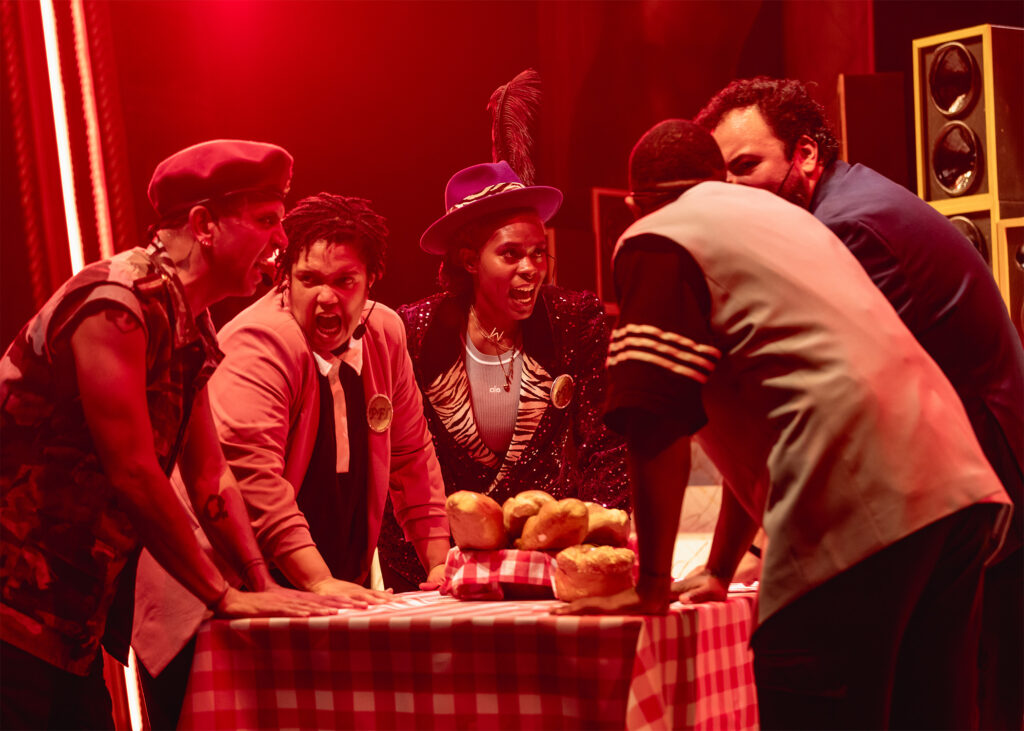
In this topsy-turvy world, tragedy wore a wink. Caesar outlawed carbs, leaving citizens mourning their beloved bread. Senators fumed because all they wanted was a decent sandwich, but Caesar stood firm. To restore unity, the senators came up with the so-called “Panini Bill,” proving even Ancient Rome couldn’t resist a pun.
But no bread was given. Caesar had to die for his stubbornness, according to the cast. While attempting to assassinate him, Brutus stepped out of the fictional realm entirely. The beat cut and the light dropped.
Breaking the fourth wall, Musoni addressed the audience.
“This isn’t funny,” he said. “I am scared. Aren’t you?”
Speaking through Brutus, Musoni asked the audience, “Do you want to kill me?” Though theatrical, Musoni said this wasn’t a performance, rather exposure.
“To be very frank, the audiences of Chicago Shakes are not and don’t look like me,” Musoni said. “They are predominantly white, they’re a lot of times older, and so I’m playing what we would maybe call a losing hand already.”
That losing hand, the artist said, was the light for the anti-escapism moment of breaking the fourth wall. He said this rupture in satire where laughter catches in the throat is necessary to wake people up.
“There are some atrocities that we can’t laugh away,” Musoni said. “There are some things that we cannot pretend are not happening for these 85 minutes. We wake up, we read the news. That shit is terrifying. But I have to go to work. We still exist and still move while there are terrifying atrocities happening.”
The cast debated whether breaking the fourth wall would enhance the story or distract from it, according to Musoni. For him, this choice became more important as Immigration and Customs Enforcement (ICE) agents began infiltrating Chicago.
“This could happen to you, this could happen to us,” Musoni said. “This is not something that we can escape once we leave this place or even while we’re here. The moment of being pulled right back into reality, into the play of the action of the play also signifies ‘Hey quick moment. We’re just talking. We’re letting you know why we’re doing this.’”
The push and pull between the comedy and horror of reality is the heartbeat of “Rome Sweet Rome.” When Brutus returned from the meta-interlude, the others turned on him because he wasn’t wearing his “Peace, Freedom and Liberty” pin. He got killed and his intern Lucy ascended — a shy assistant turned autocrat.
The cycle of violence repeats and loops back into itself — dark lighting, robotic dance and an illusion of peace returning with a new dictator smile. The empire, as it turns out, never sleeps. Musoni said this parallels the world outside of the haven of the theater.
“That is a very clear reflection of living in America,” the actor said. “We have these things that we fight for. We have these injustices we protest against, whether that be a genocide in Palestine, whether that be ICE coming in and kidnapping people, whether that be state-sanctioned murders by police. And they breadcrumb us, quite literally. It’s like, ‘Oh, we’ll paint the sidewalk saying Black Lives Matter so you can shut up.’”
The ending wasn’t tragic, it was exhausting. Lucy gave croutons instead of bread and the revolution served itself à la carte. For Musoni, the exhaustion at the end feels painfully honest.
“How do we survive all of these things?” Musoni said. “What do we as people, what decisions do we make as people to survive? Whether that be questionable decisions, great decisions or bad ones.”
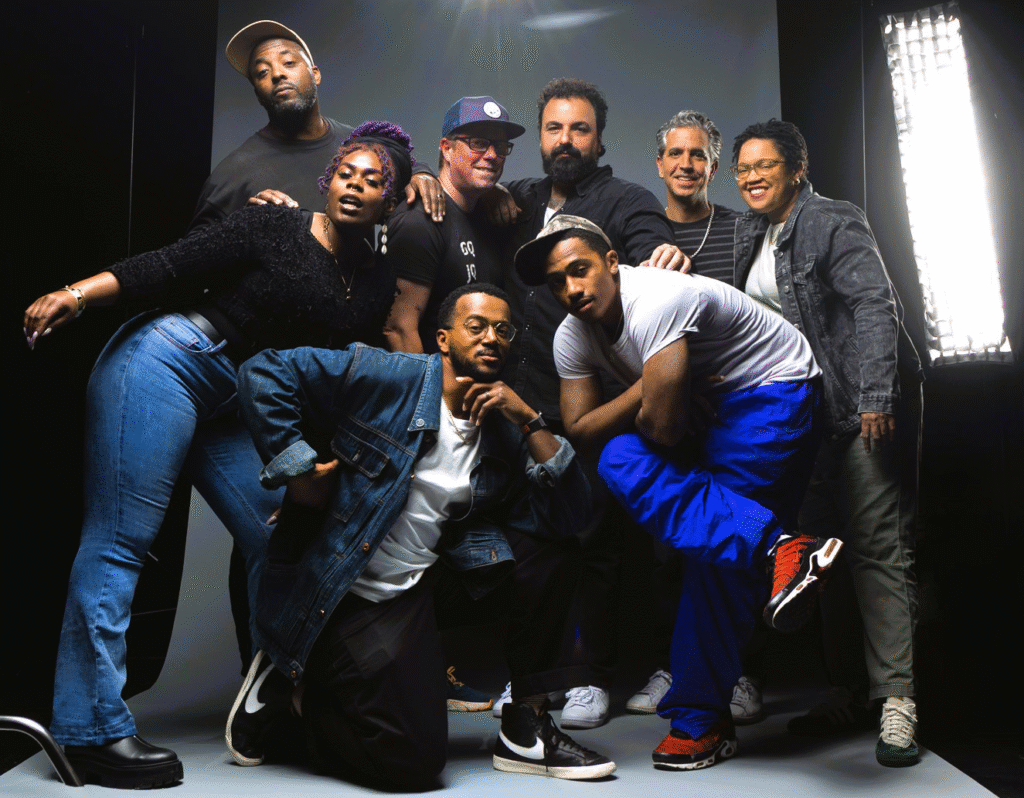
While it paralleled the outside world, “Rome Sweet Rome” also dared to ask what happens when the classics are no longer whitewashed. Its cast — predominantly nonwhite — made the political personal and the historical immediate.
Caesar and Brutus, both played by Black actors, show that power may look different and still be corrupt.
“Caesar being Black is a choice,” Musoni said. “You could consider it a crazy choice, but we’re all people at the end of the day. We can all be under the hand of someone who is evil despite what they look like.”
Still, for Musoni the symbolism hits harder when Brutus — a young Black man — looks out and asks a mostly white audience, “Do you want to kill me?”
“I’m asking someone if they want to kill me,” the actor said. “That hits very differently when there’s a young Black man saying that to a white woman or a white man in an audience. It builds room for nuance in a really beautiful way and also makes the intersections of what we’re experiencing of the margins that everyone has very clear and also unavoidable.”
“Rome Sweet Rome” doesn’t update Shakespeare — it dismantles him and rebuilds a new world where tragedy doesn’t end with an applause. In this remix of empire, Brutus is no longer just a man haunted by guilt or killed by suicide. He’s an artist haunted by recognition.
The performer said this production showed what is lacking in the current world but also how communities can bond together, whether for good or for worse.
“Revolution requires roles,” Musoni said. “Everyone has a role in a revolution. You have the people who are on the front lines. You have the people who are giving food. You have the people who are helping bail. This show goes to show that we all have our role — and that thing could lead to our own demise.”