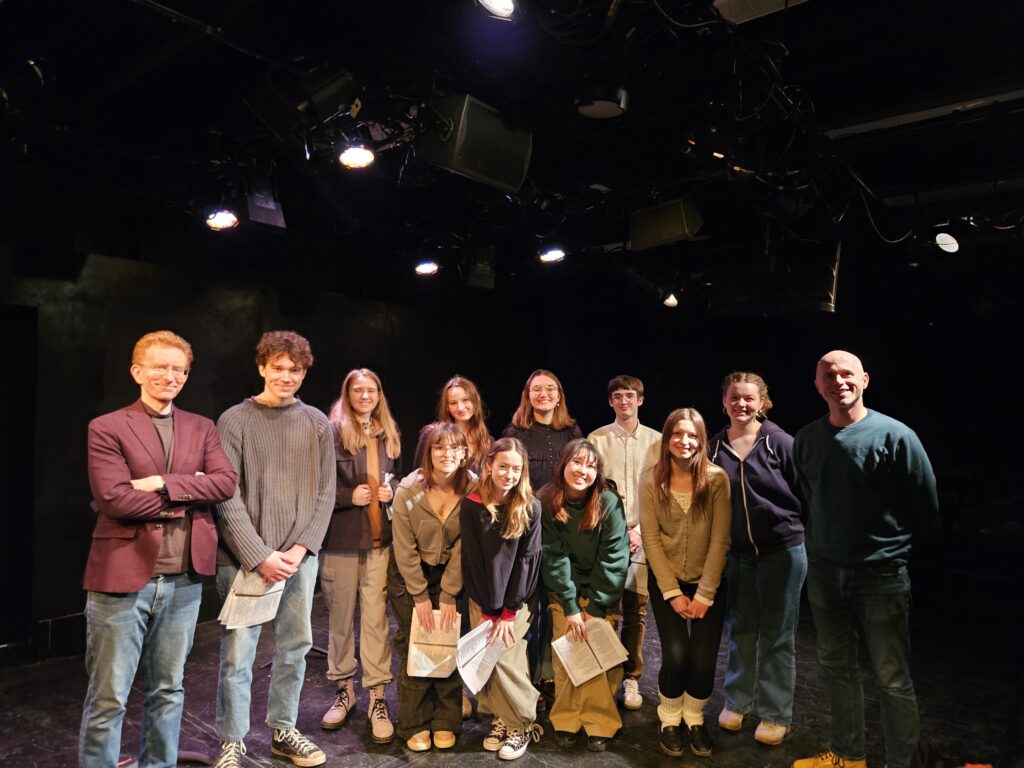
The collaboration between the Classical Civilizations and Theater departments contemplated the role of violence in society. (Courtesy of Jonathan Mannering)




In Seneca’s “Thyestes,” the most horrifying acts never seem to happen in silence. Instead, they’re narrated, repeated, questioned and consumed — not just by the characters onstage, but by the people watching.
Inside the Underground Laboratory Theater on Jan. 31, a staged reading of Roman tragedy “Thyestes” refused to let its audience sit comfortably in the dark. The Classical Civilizations and Theater departments joined together to create an interdisciplinary workshop, led by English. thespian Paul O’Mahony and classics professor Jonathan Mannering.
The workshop, comprised of 10 students, had no costumes or lavish acts. Instead, the students read the play fully only a day before staging it and relied on the power of their voice and lights to convey the play’s emotions to the audience, according to Mannering.
Written by the Roman philosopher Seneca, “Thyestes” centers on a brutal feud between two brothers locked in a cycle of revenge. Atreus, the king, punishes his brother Thyestes by murdering Thyestes’ children and feeding them to him at a banquet. The violence itself isn’t shown onstage, but it’s reported, dissected and repeated through narration.
The production treated “Thyestes” as a live wire — a play about hunger, power and spectacle looking uncomfortably on a world reliant on the act of scrolling. For Mannering and O’Mahony, this forces the audience to imagine the atrocity and confront their role as complacent bystanders.
Mannering said the production brought forth “the very best of Loyola.” For him, the students had a duty to emphasize the play’s aggressive nature through voice alone. The classics professor said this aggressiveness, though suppressed, is inherent in humans.
“It can be said that the proposition of the play is that violence — all acts of violence — follow a cyclical pattern, which is driven by an appetite, desire, hunger, if you will,” Mannering said. “This pattern is encoded in human beings from their very origin. It is passed on to us from our ancestors and seems to be intrinsic to our nature.”
The play is emotionally overwhelming, psychologically destabilizing and socially charged, demanding more than intellectual engagement. Its power emerges through proximity, the closeness between text, performer and audience allowing the violence to feel disturbingly tangible. For O’Mahony, the text came to life because of the passion of the students performing it.
“The text really lives and breathes,” O’Mahony said. “That’s what we’ve been discovering in the very small steps that we’ve been able to take in the time that we had.”
Rather than staging violence as an aberration, Mannering said he framed it as inheritance — something learned, repeated and honed across generations. But the play’s cruelty, he said, doesn’t end with those who act.
“What this play does is it makes use of the medium of theater as performative narrative,” Mannering said. “To reveal, maybe even argue, for another side of this primal urge to inflict pain and exact retribution. Specifically, that human beings also desire to watch, to bear witness, to be spectators at acts of violence.”
For Mannering, the impulse to watch violence sits in an ethical gray zone. Bearing witness can be necessary — even urgent — when it allows atrocities to be named, remembered and addressed. But the same act of looking can also slide into appetite, a pull toward violence satisfying curiosity without demanding response.
The danger, Mannering said, lies not in watching itself, but in how easily witnessing can become consumption.
In “Thyestes,” appetite isn’t just a metaphor for desire or revenge — instead, it’s the engine of the tragedy itself. Hunger rules the bodies before governing morals, collapsing the distance between survival and cruelty. The play refuses to let violence remain abstract or even symbolic, as it highlights the brutality in the most ordinary human need. For Mannering, eating in Seneca’s world isn’t separate from power or punishment — it’s the condition making both possible.
“The play suggests our very need for food is the very fact of our need to eat,” Mannering said. “As a fundamental defining feature of our human essence is in some sense connected to this need to inflict this hunger for violence. In other words, we can’t ever escape our nature because we need to eat. We are mortal creatures.”
The inescapability is what made the play feel urgently contemporary, according to Mannering.
“We are at a point now where we are completely overwhelmed by images being presented to us through the medium of our devices and the medium of technology,” Mannering said. “We can’t escape it. Our present day situation is defined and shaped and controlled and guided by visual media. Does watching, or does being a spectator make us in some way complicit in the violence?”
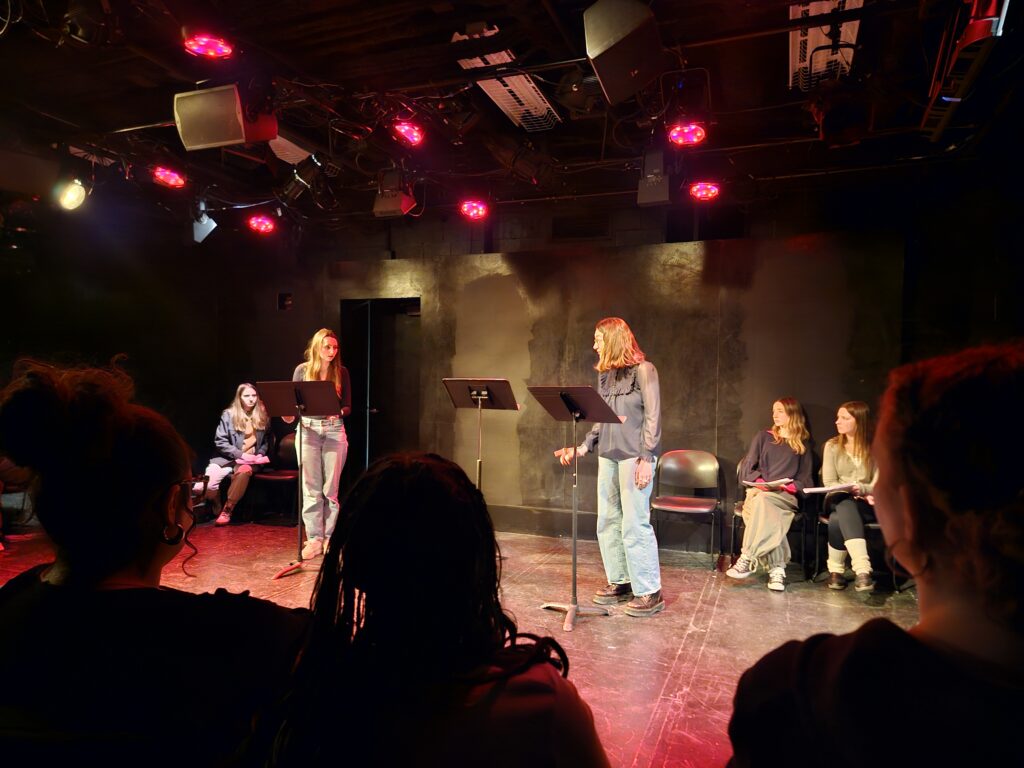
Second-year theater major Helen Schomacker said the audience’s role mirrored the play’s themes of spectacle. For Schomacker, theater plays as a vessel feeding the audience hunger for more pleasure. During rehearsal, Schomacker said discussions of the meaning of spectacle arose, especially in the turmoil times the country is going through.
Mannering said the troubling part isn’t just what humans see, but how they are trained to see it. The constant algorithms being presented and the images overloading screens perpetuate these spectacles of violence to keep going on, according to Mannering.
“Algorithms’ purpose is to keep us hungry for more, always sort of tapping that drive, that urge to keep watching, to keep looking,” Mannering said. “Whether it be horrific acts of horror from around the world or the recent killings in Minneapolis. All of them have become mediated through a particular format. We have to ask ourselves, what difference does that format make to our evaluation of the violence to our relationship, our connection to the violence? And to what we’re going to do about these horrific acts?”
Referencing Renee Good’s death in Minneapolis, Mannering said it’s important the audience realizes Seneca’s world isn’t far from them. Even if the act isn’t as gruesome as eating kids, the killings humans are accustomed to seeing online perpetuate the need for more, according to the professor.
Schomacker said audiences don’t need to recognize themselves in the characters to feel implicated.
“While audiences might not find themselves in the characters, they’re gonna feel themselves in the story nonetheless because it’s so visceral and so detailed and so gross,” Schomacker said. “They’re gonna feel themselves pulled to the brutality of it, and hopefully realize, ‘Oh, I’m just as bad as anyone viewing this. I’m no better than the person who’s doing this act, because I’m just here spectating, and it’s just happening in front of me and there’s nothing I can do.’”
This tension between action and observation is central to O’Mahony’s work. As Artistic Director of English theater company, Out of Chaos, O’Mahony said he began staging weekly plays during the pandemic — an experiment he said reshaped his relationship to classical drama.
O’Mahony said he likes to involve the audience in a way, so they’re not passively watching, rather actively being involved. During the production, some of the student actors were on stage while others were seated with the audience, showing the relationship between being an actor and being a spectator.
For O’Mahony, blurring the lines isn’t just a staging choice — it’s part of a longer relationship with classical texts. The more time he said he spent with ancient drama, especially when he did his 40 weeklong intensive online theater program during the pandemic, the more he’s come to see its relevance not as inherited wisdom, but as something earned through performance.
“We do these plays because they speak to some way about the world around us,” O’Mahony said.
Through his directing and teachings, the thespian said he realized the plays weren’t abstract moral exercises, but studies of recurring human failures around leadership and failure. For O’Mahony, the endurance of classics lies not in their age, but in their refusal to stop mirroring the present.
“These plays were all about leadership, often bad leadership, identity, about where you belong and why you’re allowed to belong somewhere, about gender, about equality, about power and what people are willing to do to get it and then hold onto it,” O’Mahony said.
Taken together, O’Mahony’s approach to staging the classics and Mannering’s contemporary readings of ancient drama make “Thyestes” feel less like an instruction manual of what not to do, but rather an encounter with human nature. By asking audiences to sit in discomfort — and sometimes recognize themselves within it — “Thyestes” refuses the idea of violence, power and moral failure to belong only to the past.