Loyola’s production of Shakespeare’s charming comedy delivered whimsical fun.




In Loyola’s production of “A Midsummer Night’s Dream,” magic unfolds in a deceptively light pastoral setting. The forest scrambles lovers, bends logic and allows the night to do its quiet work, dissolving certainty and replacing it with temporary, unstable desire.
“A Midsummer Night’s Dream” follows four young Athenian lovers — Hermia, Lysander, Helena and Demetrius — whose romantic disputes drive them out of the rigid order of Athens and into the forest. The lovers’ confusion unfolds alongside the conflict between fairy rulers Oberon and Titania, whose struggle over authority fractures the natural world itself.
Running Feb.12-22 in the Newhart Family Theatre, the production is directed by Mark Lococo, chair of Loyola’s Department of Fine and Performing Arts.
Loyola’s staging transforms the forest into a playground — a space of mischief, experimentation and temporary freedom — while still treating it as an active presence rather than a decorative backdrop.
While Shakespeare’s comedy is often staged as a harmless escape, this version resists the urge to smooth everything over. Instead, it leans into the mess of relationships, treating playfulness less as commentary and more as a mechanism keeping the story in motion until the curtain falls.
The tension between relief from the outside world and the paradox of misery and joy shapes how the cast understands the show.
Owen Ingram, a fourth-year theater major playing the mischievous fairy Puck, said the production is deeply invested in reminding audiences how Shakespeare isn’t a chore to suffer through but an experience meant to be felt.
“This show is just a very fun show, and I think there’s a level of want to entertain the audience,” Ingram said. “We want to give them a break from what’s going on in the world right now.”
Ingram said the play’s humor works because it takes the audience seriously, trusting them to connect to emotion before language. Shakespeare’s verse, often perceived as stiff or inaccessible, becomes elastic in performance, according to Ingram.
That same philosophy animates the world of the Mechanicals, the amateur actors rehearsing their own play within the play.
Playing comic relief Peter Quince, “A Midsummer Night’s Dream” marks fourth-year theater major Laura Cortes-Acosta’s first Shakespeare performance.
As a female playing a male character, Cortés-Acosta said she didn’t want to play Quince through a rigidly gendered lens.
“Canonically he’s a male, but in our production, he can be anything,” Cortés-Acosta said.
She said the production’s costuming and performance avoid reinforcing binaries, allowing Quince to exist as a maker first and foremost.
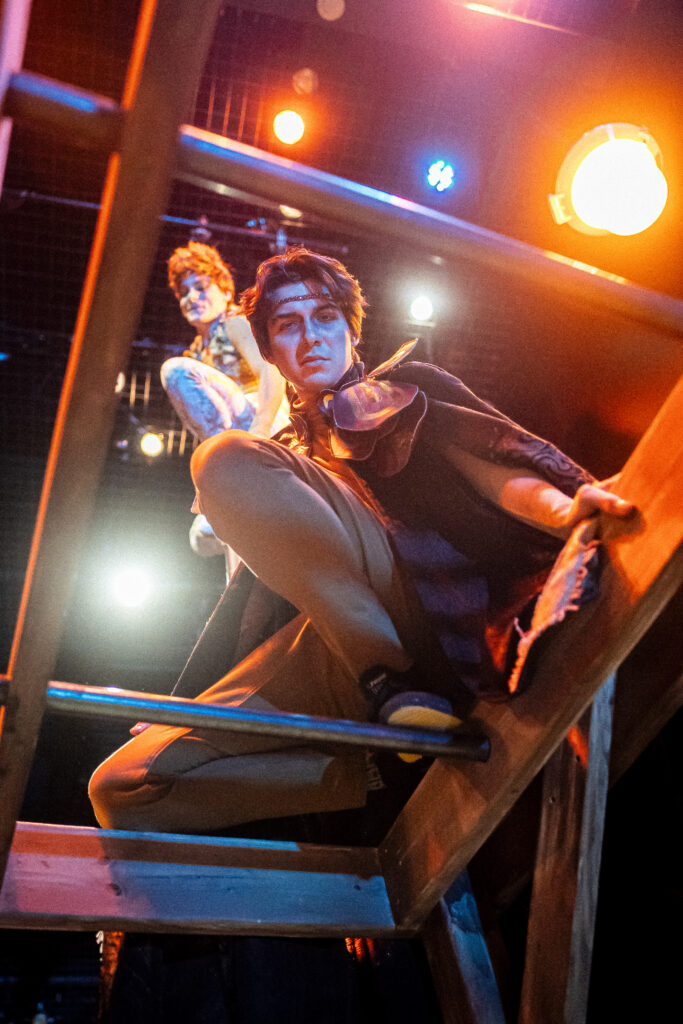
Cortés-Acosta described Peter Quince as someone who believes fiercely in the value of creating something, even if it is imperfect, even if others dismiss it. The Mechanicals prove theater doesn’t require permission, only commitment.
The Mechanicals are reframed not as fools, but as artists driven by passion rather than polish — people who make theater because they need to, not because they are sanctioned to. If the Mechanicals embody imagination in its most earnest form, the fairy world exposes what happens when power fractures under emotional strain.
Lynsey J’Nae Richards, a first-year theater major playing Titania, said the fairy queen’s central monologue functions as the production’s emotional axis. In it, Titania — the ruler of the fairies — describes how her conflict with Oberon, her husband and fellow monarch, has thrown the natural world into chaos — seasons blur, landscapes destabilize and humans suffer the consequences.
Rather than treating the speech as abstract allegory, Richards grounds Titania’s anger in contemporary anxieties about environmental collapse. She said she draws on concerns about energy consumption and water scarcity — particularly how large-scale technological systems strain natural resources and disproportionately affect already vulnerable communities — to fuel Titania’s fury at a world thrown out of balance.
In the play, Titania explains her conflict with Oberon has blurred the seasons and destabilized the natural order, leaving humans to suffer the consequences.
Richards said she connects disruption in the play to modern patterns of ecological strain, shaping Titania’s rage as a response not only to personal betrayal, but to the real, uneven damage caused when power is exercised without regard for the environment or those most exposed to its effects.
“This interpretation of the play shows us not humans but fairies arguing, and that’s kind of the whole basis of the environmental issues as well as the play,” Richard said. “This shows me that sometimes human clashing can be the bones of everything. If resolution can be achieved, maybe peace can be restored.”
Comedy, in that context, becomes a strategic tool rather than a distraction. By filtering ecological collapse through fairy comedy rather than human tragedy, the play makes environmental harm visible without numbing the audience.
The laughter generated by Puck’s interference and the lovers’ confusion keeps the plot buoyant, even as it underscores how misuse of power and refusal to reconcile can destabilize entire systems.
Humor lowers defenses, and Richards said it creates space for audiences to recognize themselves inside the chaos rather than rejecting it outright.
Physical comedy plays a crucial role in the transition of the characters, according to Jordan Archer-Cull, a third-year film and theater major playing Hermia. By leaning into stunts, movement and spectacle, the production invites audiences to laugh while remaining alert and aware of the instability lurking beneath the joy.
“In physical comedy, you can relax and laugh along with the audience,” Archer-Cull said.
For Lococo, balance between comedy and seriousness is intentional. While climate change shaped early conversations in rehearsal, according to Lococo, he said the production never set out to deliver a singular message. Humor, instead, became the guiding principle — a way to keep the play alive rather than didactic.
Environmental themes emerge through character behavior rather than declaration. Titania and Oberon’s manipulation of the world around them mirrors contemporary decision-making driven by selfishness, Lococo said, emphasizing how personal choices accumulate into systemic damage.
Assistant director Mia Luparello, a third-year art history and theater major, said comedy can sometimes articulate truth more effectively than tragedy.
“Since a lot of the climate commentary comes from quarrels between characters, the comedy can sometimes offer a positive example of relationships,” Luparello said. “It’s just an antithesis to what’s causing the destruction in the world.”
The lovers’ storyline offers a parallel reckoning — one grounded not in environmental consequence, but in emotional maturation.
Archer-Cull said returning to “A Midsummer Night’s Dream” after performing it in high school has transformed how she understands the character. Hermia’s passion, she said, feels truer and more fragile with time.
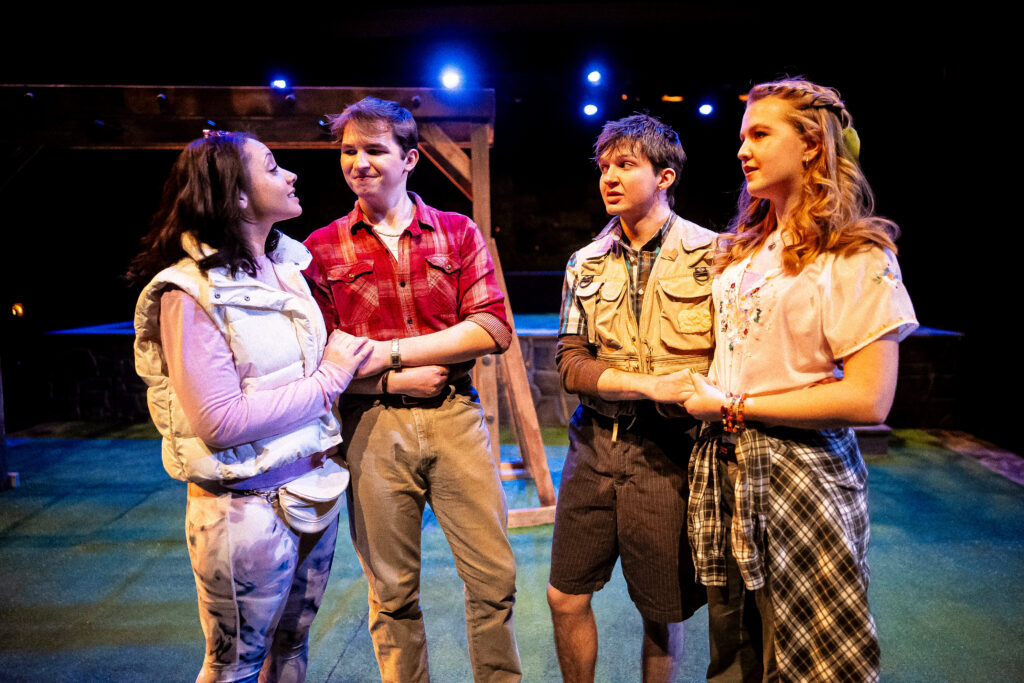
“She really puts herself out there, and when she gets hurt, she really explodes, and it’s so fun to play that,” Archer-Cull said. “But then it’s a comedy, so I just kind of wrap everything up in a nice little bow by the end.”
The lovers’ entanglements mirror the intensity of young love — idealized, all-consuming and often blind to consequence.
“Young love in this story is very idealized,” Archer-Cull said. “Young love, teenage love, is passionate, and it’s exciting, and you’re not really burdened by the realities. Then, over the course of the play, my character has more reality set in. Shakespeare shows love can still make it, even if people aren’t perfect.”
The production’s refusal to resolve everything neatly. Unlike Shakespeare’s tidy ending, this version leaves Titania with agency — and anger — intact, asking audiences to sit with discomfort rather than escape it.
In addition to changing the production’s resolution, both Lococo and Luparello said they wanted to remove the forest element from the play and replace it with a playground. The shift transforms the enchanted woods into a space defined by motion and interaction, where swings, monkey bars and hanging railings invite actors to climb, fall, chase and collide.
What the production ultimately offers isn’t closure, but an invitation to enjoy, to laugh and then to leave with something unsettled.
“It’s important to allow yourself to have fun but also still be able to think about these difficult topics and think about your role and how to treat the world more kindly,” Luparello said.
Tickets for “A Midsummer Night’s Dream” can be purchased on Loyola’s ticketing website.