Muslims at Loyola reflect on the deeper significance of fasting, what Ramadan means to them and what they will be taking away from the month as it comes to a close.



For Muslims, the origins of Revelation began 1,400 years ago, in a withdrawn cave in the desert of Mecca, when the Archangel Gabriel descended from the heavens to impart Revelation to Prophet Muhammad. These first verses were revealed during the month of Ramadan, the ninth month in the Islamic lunar calendar.
“Read! In the name of Thy Lord and Cherisher, Who created man out of a clot…Nay, but man doth transgress all bounds, in that he looketh upon himself as self-sufficient,” (The Quran, 1934, 96:1-7, trans. Ali).
Ramadan is held in regard as the month during which this Revelation began and is revered through specially prescribed forms of worship. Muslims at Loyola believe a shared recognition of the dependency of humanity, as highlighted in these verses, is underscored in their practices of prayer and fasting.
Fasting has been an act of devotion practiced by various faith groups for centuries and is considered one of the five pillars of Islam. Like millions around the world, Muslim students and faculty at Loyola observe Ramadan by fasting from sunrise to sunset for the duration of the month. Ramadan officially ends with the sighting of the new moon, which is projected to be around March 19 or 20 this year.
Loyola’s Muslim Chaplain and Theology Lecturer Omer Mozaffar characterized fasting during Ramadan as “one of the core Muslim acts of worship” and noted much of the practice centers around “mind over matter.”
“Fasting is amongst the most intimate, private acts of worship, where you are conscious of the fact that you are fasting, where the only one who is fully witnessing whether or not you are fasting is The Divine,” Mozaffar said.
The reflexive quality of the act of witnessing comes to the forefront during Ramadan; as worshippers are witnessed by The Divine, so too is The Divine more immediately witnessed by worshippers.
Fourth-year neuroscience major Saniyah Fuzail observed how gratitude can lead to further God-consciousness.
“When you are deprived of something, you understand just how bountiful the blessings are around you,” Fuzail said. “You realize how much abundance there is, but also how much need. It shifts your focus to God.”
Second-year neuroscience major Zaki Mallick said he finds God-consciousness through the struggle of fasting.
“I become more conscious of God every time I feel the physical toll,” Mallick said. “Every time you are hungry or you feel thirsty, you’re reminded why you’re doing this. Your spiritual state depends a lot on your physical state.”
According to Islamic law, there are exemptions in place for fasting from food and drink. Jamie Tiffen, a second-year nursing major, has diabetes, and although there are days when a drop in his blood sugar causes him to break his fast, he said he’s actually able to manage it better while not eating.
Although abstaining from food and drink is perhaps the most widely recognizable aspect of Ramadan, Muslims are called upon to fast from other forms of consumption as well. The eyes and the ears are also considered portals that can affect the spiritual heart. It’s for this reason, Fuzail said, many Muslims avoid consuming music or entertainment that’s overly provocative.
Free from the immersive influence of these proverbial sirens, Muslims like Tiffen find greater clarity in their spiritual odysseys during Ramadan. The act of fasting and the recentering of the Divine presence prompts reflection on what forces govern our actions. Fasting inherently restricts immediate gratification — consequently, as Tiffen said, “our true selves get exposed.”
This year, during his third Ramadan as a Muslim, Tiffen said he’s resolving to read more of the Quran and be more attentive to those around him. Even more than the physical discipline required during Ramadan, it’s this inward moral and spiritual discipline which makes the month personally unique to each Muslim.
Many Muslim students said the Loyola community plays an important role for them in Ramadan. Tiffen discussed how it’s been especially instrumental for him as a convert to Islam.
“I consider everyone here who is Muslim my family, because this is a home for me,” Tiffen said. “Honestly, I don’t want to be anywhere else during Ramadan but here.”
Tiffen also emphasized his appreciation for Loyola’s Campus Ministry.
“Shoutout to Campus Ministry, because they are always helping us, and they are always really, really supportive of anything we need during this month,” Tiffen said.
Ramadan can be difficult in many ways, but Fuzail and Tiffen both expressed hopes that their classmates don’t hesitate to ask their Muslim friends questions or feel obligated to abstain from eating or drinking in front of them.
Ideally, Mallick said, Ramadan should be considered an uplifting time.
“It’s hard for your body, but it’s a vacation for your soul,” Mallick said. “I know I did the right thing if I feel like I miss it.”
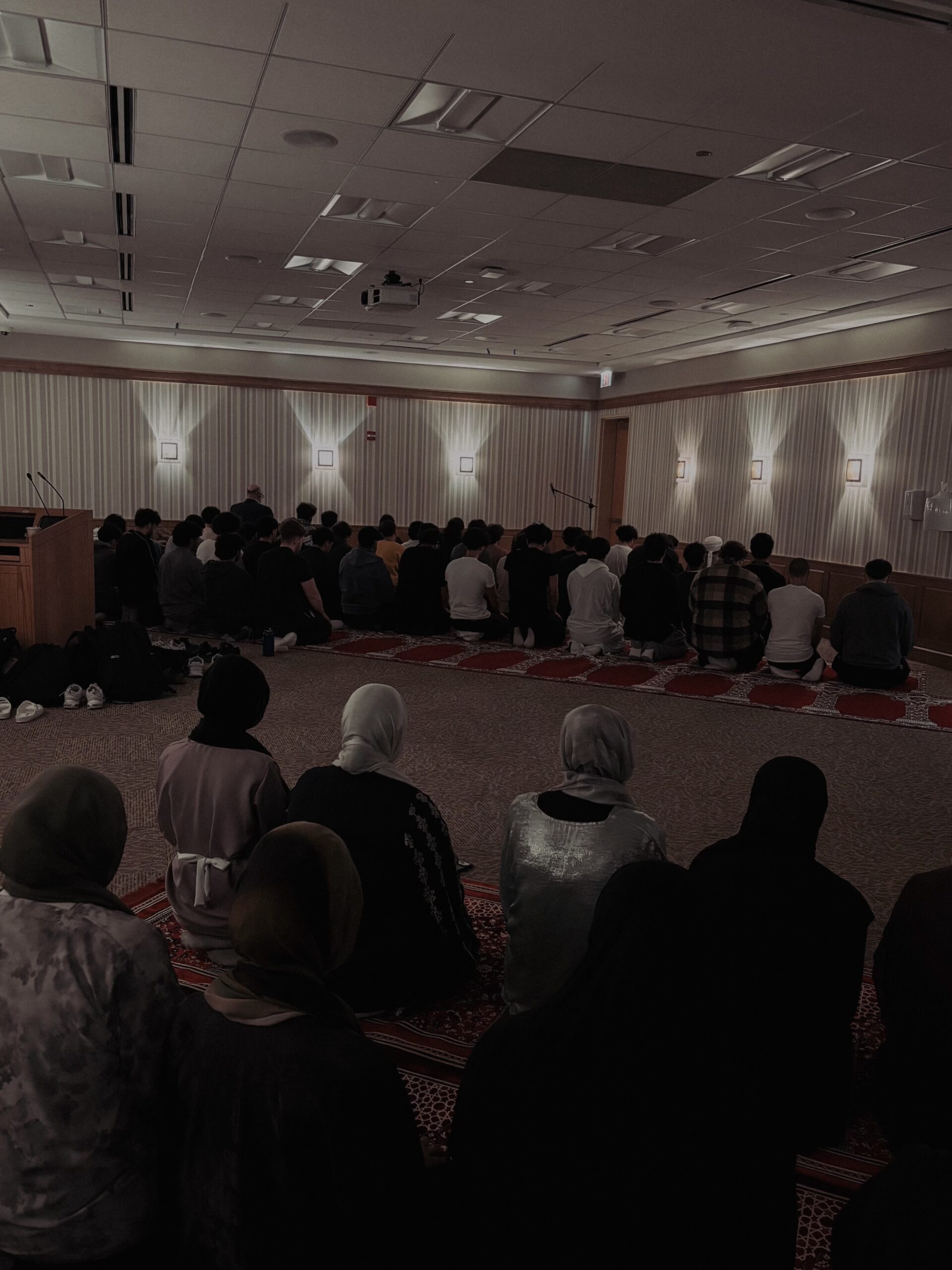
Editor’s Note: A previous version of this article had a photo of campus ministry as the featured image. The article was updated March 11, 2026 with a photo of Loyola students observing nightly Ramadan prayers.