Staff Writer Kevin Stovich describes the demeaning language used against immigrants in the U.S.



Word choice affects how we view our news. If I want all news, no fluff, I’ll visit Axios. For bizarre, witty columns, The Atlantic is a go-to. And when I have an appetite for timely, local journalism, I rely on The Loyola Phoenix.
I, like many other Loyola students, read our school’s student-run paper because of its digestible — yet accurate — presentation.
But scrolling through Instagram on March 23, a specific headline made me freeze.
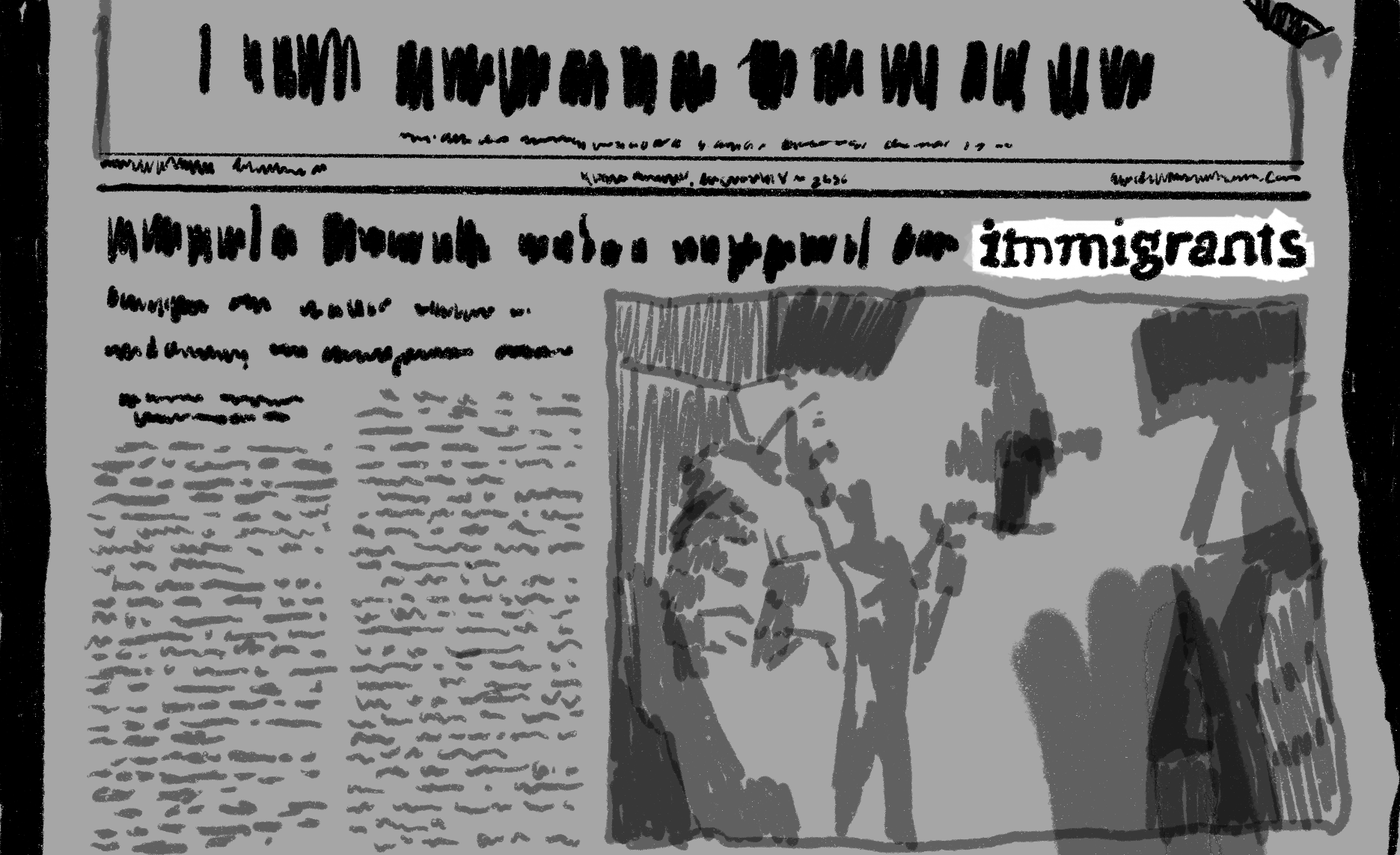
“Immigrant Man Charged with Murder,” read the opening words to a headline of the then-recent update of ongoing Phoenix coverage.
While it stopped me in my tracks, it wasn’t the title’s information that hit me, but its word choice. An uncharacteristically harmful headline overshadowed an otherwise accurate story.
While it was unintentional, the headline’s poor wording was just another piece of kindling tossed into the flames of harmful generalizations.
Looking back at the headlines and social media content from the evening of March 22 to the following day, almost no Chicagoland-centered publications made mention of the suspect’s immigration status in their headlines.
Furthermore, the only local outlet that used the word “migrant” or “immigrant” in its title was The Chicago Tribune, which used it in its online article.
Yet, whether the suspect was documented or not wasn’t the focal point of the story.
These recent events around campus are being weaponized by those with anti-immigration agendas to further vilify those who come to America, painting them as violent and volatile, regardless of their citizenship status or criminal background.
This deliberate malignment manifests itself in various ways, like spreading baseless claims about pet-eating immigrants, but what remains constant is its perpetuation by our nation’s prominent political leaders.
In a 2005 handbook of Republican talking points about immigration reform, the term “illegal aliens” is repeatedly used in explanation, yet is avoided entirely in the GOP’s public-facing script.
“We owe it to the people crossing the borders — not as illegal aliens, but as human beings,” the report reads, categorizing the term “illegal aliens” as sub-human.
The document goes on to stress a Republican’s duty to speak ill of undocumented individuals, as well as calling for citizenship tests to be conducted in only English.
After the killing of Kate Steinle on a San Francisco pier in 2017 by an undocumented immigrant, right-leaning news organizations pushed the same tired rhetoric of the danger they claimed immigrants pose. Steinle’s family has stated they’d rather her death not become politicized.
Today, the current administration — and its associated right-aligned media outlets — have not only returned to this harmful playbook, but are heightening their efforts of dehumanization and ostracization of the immigrant population.
Within the text of Executive Order 14159 — a sweeping directive broadening use of expedited removal, increasing the staffing of ICE and CBP and removing funding from sanctuary cities — the words immigrant, migrant and undocumented appear zero times.
Instead, the word “alien” appears 33 times, often paired with language insinuating their immediate threat to Americans’ safety.
In fact, the administration even celebrates the country’s shrinking immigrant population rate, which was at its height in January 2025.
According to the American Immigration Council report, even though the percentage of foreign-born American residents has grown since 1980, the overall crime rate has fallen by about 60.4%, with violent crime itself dropping 34.4%.
And a 2018 study by The CATO Institute — during Trump’s first presidency — found that of immigrants with prior criminal convictions detained by ICE, 88.9% of those crimes were non-violent and 53.6% were victimless crimes, like traffic violations or immigration infractions.
But the administration’s false narrative is working.
Last summer, while waiting for my ride at a Bay Area Rapid Transit station in my native California, these perpetuated stereotypes manifested into reality.
“Get out of my way fucking migrant,” a veteran-hat-wearing man spat, before hurling a barrage of racial slurs as he passed by.
This — unfortunately — wasn’t the first time a grizzly old man had berated me, but his words still stuck with me.
Not the slurs, but the word, “migrant.”
Out of instinct, I internally laughed — “I’m not an immigrant,” I thought.
I don’t and have never considered myself an immigrant, even if the law does. I was born in Guatemala and adopted before I even reached 18 months. Personally, I’ve reserved the term for those who’ve come to a new country — whether voluntarily or out of necessity — and have to work to adapt their lives to the local culture.
For the majority of my life, I was raised in the United States by a set of American parents, attended an American school, surrounded by American pop culture and — ignoring any cultural identity crises — consider myself an American.
So again, I thought, “How am I a migrant?”
After the absurdity of the situation dissipated, the weight of his words bore down on me.
To be seen as an immigrant is to be seen as dangerous. Being seen as an immigrant is to be seen as an other. Today, just looking like an immigrant is grounds for attack — verbal or physical.
But what does it mean to look like an immigrant?
According to the Supreme Court, ICE officers can detain you if you have an accent, speak Spanish, work as a day laborer or aren’t white.
And even if, in some fantastical world, every single person with a hint of “immigrantness” ICE stopped Gestapo-style turned out to be a criminal, then maybe I would be on board, right?
As of last November, of the over 65,000 individuals detained by ICE, 74% of them had no previous criminal convictions.
Within the same report, from September to November, there was a surge of 5,373 individuals taken into ICE custody; only 3% of the new detainees had prior convictions, meaning a little over 5,200 non-criminals were swept up.
This administration can say they’re trying to protect America against invasion, but they’re inflicting as much pain and damage on immigrants and natural-born citizens alike.
Using data from the National Crime Victimization Survey, experts found nearly double the hate crime victims were immigrants — regardless of race or ethnicity. Additionally, when looking at victims’ citizenship status, those who were naturalized or non-citizens were victimized at an almost three times greater rate as citizens.
Over the past five years, anti-Hispanic and Latino hate crimes have accounted for 13% of all race and ethnicity-based crimes, with 52% of those crimes being assaults, according to the FBI’s Crime Data Explorer.
This dehumanization of immigrants — more specifically, Latino immigrants — is just the beginning.
“Racialized groups are linked across time and space,” Natalia Molina writes in “How Race Is Made in America.” “Once attitudes, practices, customs, policies and laws are directed at one group, they are more readily available for and hence easily applied to other groups.”
We’ve already seen similar smear campaigns against large swaths of people, such as the transgender community or peaceful protestors — all in the name of public safety. When people in power denigrate already vulnerable minorities, the likelihood of their erasure or persecution rises.
I’m a foreign-born arts and culture writer. I’m not a violent criminal, I’m not a “bad hombre” and I’m not a threat to national security — the most damage I’ve done is write a critical review of a concert.
But as we trudge through the rest of this presidential term, politicians and keyboard warriors alike will continue to transform their grief into anger towards immigrants. And despite what such a movement might try to spin, the American public isn’t the group at risk — it’s the immigrants.
The misdirected pain thrust at the undocumented population not only brings about disparaging remarks and racist rhetoric, but social ostracism and physical violence as well.
That’s what I fear.