The six-hour rally comes amidst a possible strike in the future.



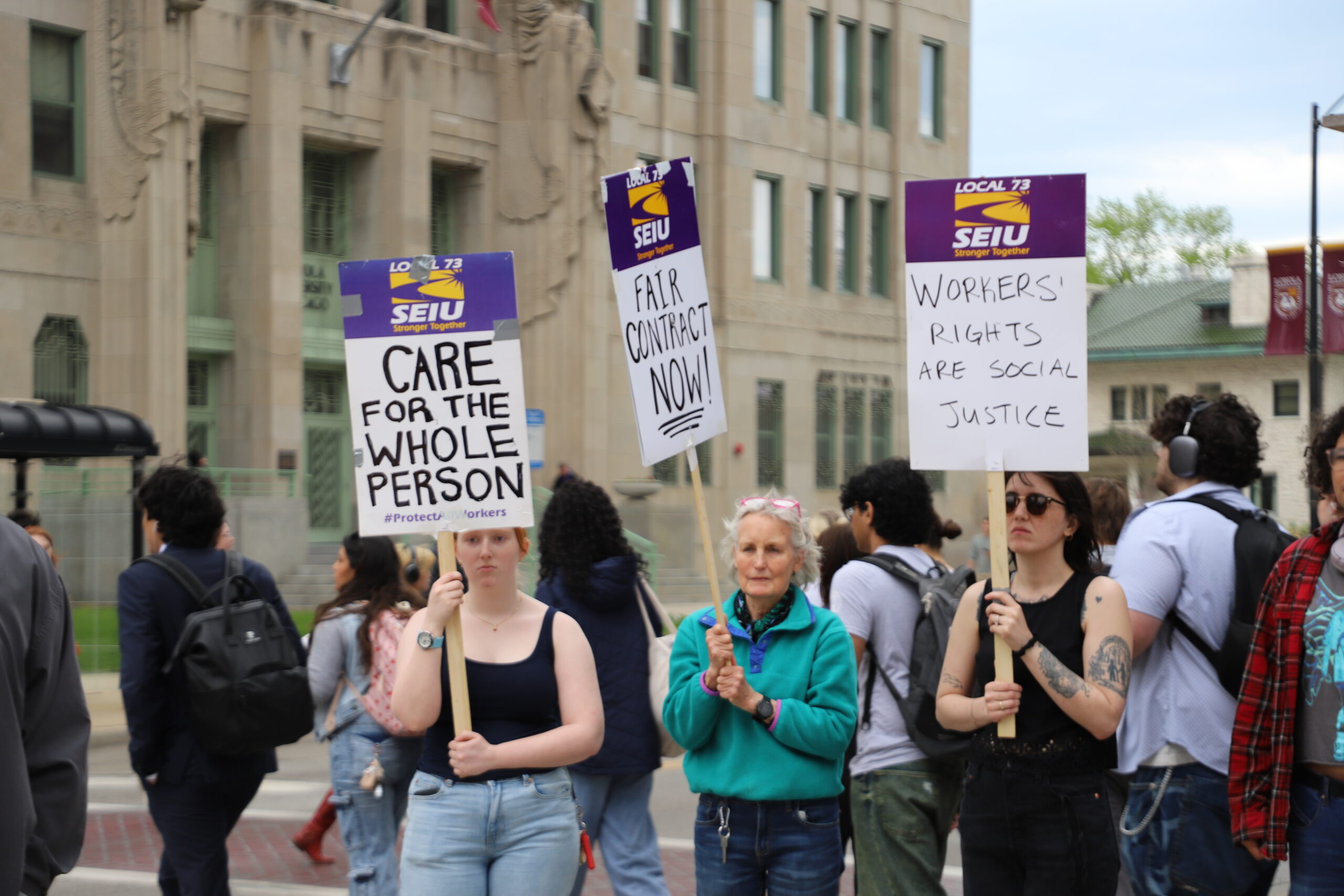
Members of the non-tenure track (NTT) faculty union from the College of Arts and Sciences (CAS) gathered April 21 on the sidewalk at the corner of West Sheridan Road and North Kenmore Avenue for a six-hour rally. Their goal was to put pressure on the university administration amid ongoing contract negotiations.
Several Faculty Forward union members said while they don’t know for sure, a strike is definitely possible. The last time CAS faculty went on strike was during negotiations in 2018 after 25 negotiating sessions, according to Service Employees International Union Local 73 (SEIU). There have been 36 negotiating sessions since bargaining began in February 2025.
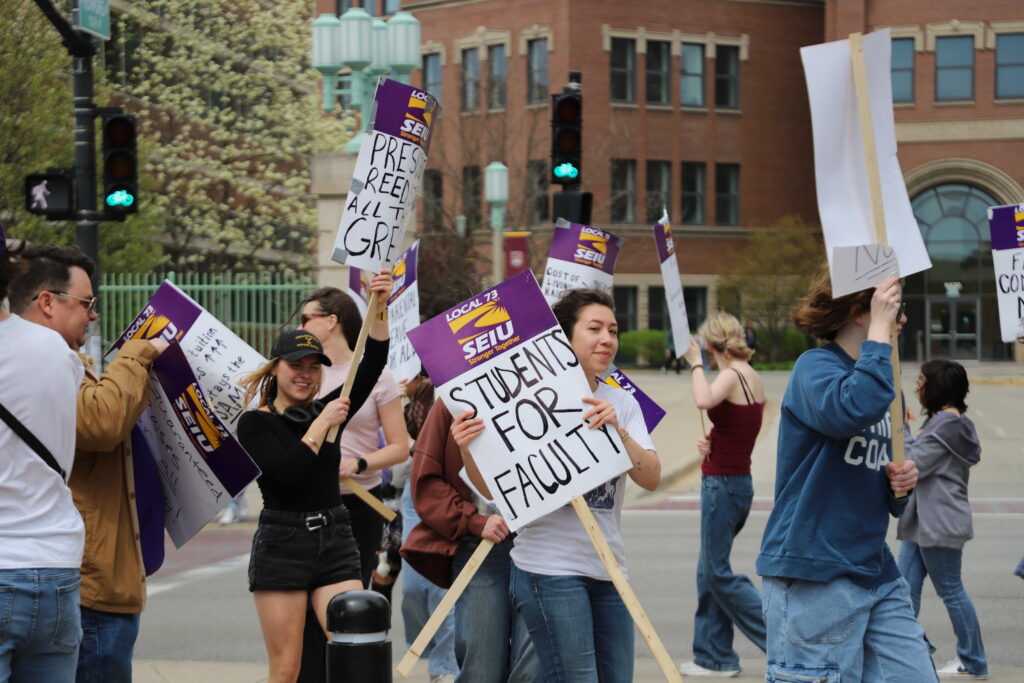
The rally lasted from 10 a.m. to 4 p.m. and was attended by both full and part-time faculty, students and members of the Faculty Forward’s parent union, SEIU. Several members of Faculty Forward gave speeches throughout the event and students on their way to-and-from class passed by while cars driving on West Sheridan Road frequently honked in support.
The protest was in response to a collective bargaining session held April 20 where the university proposed a $1,200 salary increase for only full-time faculty and four weeks of paid parental leave for adjunct and one-year part-time faculty, among other offers, according to the university’s collective bargaining updates site.
Faculty Forward rejected the university’s counteroffer and members of the union bargaining committee said they’re primarily seeking raises for both full-time and part-time CAS faculty to match the rising cost-of-living and other demands like adequate parental leave for all part-time faculty and a manageable workload for full-time faculty.
Sarita Heer is an advanced lecturer on art history and chief steward of Faculty Forward. She said the university continues to “stonewall” on the union’s demands for pay increases.
“One of the reasons we’re upset is when you bargain you’re supposed to be, ‘the boss starts here, you start here and you move toward the middle,’” Heer said. “They haven’t been doing that. When they gave us their compensation proposal, it was the same thing they gave us in September, and they have barely moved on it. Just little teeny tweaks, just little teeny tweaks.”
Several members of the bargaining committee criticized the university’s most recent proposal for only offering salary increases to full-time faculty. Full-time lecturer in biology and member of the bargaining committee Dallas Krentzel said it was “insulting,” and part-time instructor in philosophy and bargaining team member Michael Paradiso said it was “a slap in the face.”
“The vast majority of our union membership for our non-tenure track faculty are actually part-time, or even working on an hourly basis,” Krentzel said. “And so they basically said, ‘Yeah, the majority of your members, we’ll give them nothing.’ That’s what they’ve been offering for months and months.”
In an email to The Phoenix, a university spokesperson said Loyola has provided “meaningful compensation increases” since 2021, and the salary increases for NTT faculty who were working before fall 2021 have outpaced cost-of-living increases in that time.
“The university recognizes and respects the rights of our unionized faculty to make their voices heard and we are equally committed to ensuring that classes are effectively taught and that academic activities are held with the least amount of disruption to ensure that our students receive an outstanding, Jesuit Catholic education,” the spokesperson wrote.
The spokesperson reiterated the university’s most recent salary increase proposals, including a 5% increase in minimum salaries for full-time faculty. The previous April 7 proposal from the university included a 14.2% minimum salary increase for full-time faculty.
Every member of both the bargaining committee and the wider union interviewed expressed frustration with the university’s negotiating tactics and accused the university of being unwilling to compromise particularly on the issue of salary increases.
Several also said they believed the negotiators present on the university’s behalf don’t have the ability to actually enact any of the changes being discussed. Part-time instructor of political science and member of the union bargaining committee Dawn Helphand said she believes the president, the provost and the trustees have the power to make decisions but are absent from negotiations.
Helphand also said the bargaining sessions are “really depressing” but said she thinks the university’s negotiators are doing their best.
“We are the people who decide what gets offered, but the people in the room in negotiations for the administration, as far as I can tell, are not empowered to offer us anything,” Helphand said. “It doesn’t matter whether those people in the room hear us or not, because those messages aren’t getting through to the people who make the decisions.”
The university spokesperson said the administration is hopeful for continued progress and is engaged in good faith negotiations, but didn’t answer a question from The Phoenix regarding whether the president or provost would attend any future bargaining sessions.
“The University’s bargaining team is fully empowered to negotiate with the union and is firmly committed to reaching an agreement that is fair for our unionized faculty and sustainable for the institution,” the spokesperson wrote. “Our energies are focused there, at the bargaining table.”
Several repeated chants called out Loyola President Mark Reed specifically stating, “President Reed you can’t hide, we can see your greedy side.”
In her email statement in response to The Phoenix’s request for comment from Reed, the spokesperson didn’t address the criticism being directed at him individually.
SEIU Local 73 Executive Vice President Jeff Howard, who attended the rally, said some agreements have been made but there’s been little progress on the core issues of workload, compensation, parental leave and layoff language.
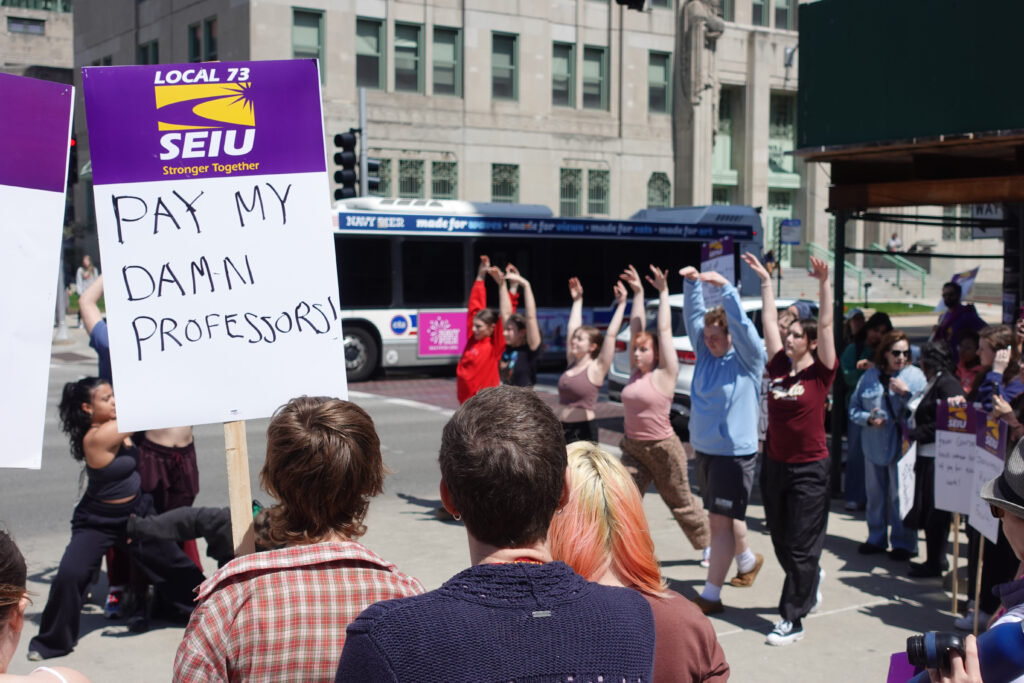
Students from a Modern Dance II class taught by Faculty Forward member Deborah Goodman joined the rally around 12:30 p.m. and gave a brief performance for the faculty and students present. Union members handed out flyers to students passing on the sidewalk which detailed the union’s demands.
“Loyola’s administration has tried to divide us by proposing an inadequate, one-time payoff to full-time faculty, while offering no raises at all for part-time faculty,” the flyer reads. “The total union compensation we are asking for amounts to less annually than what President Reed makes in one year.”
Many students passed by the circle of chanting union members on their way to and from class, and a number of students joined the protest, including first-year Kate Schneeberger. She said before joining the rally, she had a class across the street on the fourteenth floor of the Mundelein Center and could hear the crowd during her test.
“We need to have better pay for these teachers because so many teachers have had to take out other jobs and do other things just to support themselves when this should be their main source of income,” Schneeberger said. “They shouldn’t have to be doing multiple jobs just because they’re not a full-time teacher here.”
Part-time instructor of philosophy and member of the bargaining committee Michael Paradiso said he arrived late to the protest because he had to commute from his other part-time teaching job downtown.
Part-time instructor of English Ovidiu Brici said he’s been a member of the union since being hired in 2021 and said he also teaches at both DePaul University and the University of Illinois Chicago “just to make ends meet.”
SEIU Local 73 Field Organizer Owen Schmidt brought a small drum to the rally and said the rally had really good energy with lots of students and faculty showing support.
“I was in punk bands a lot as a kid, so it’s nice to be able to use a little bit of music just to keep the energy up,” Schmidt said.
Brici said he’s currently teaching six classes and would love nothing more than to teach at just one school, and said he thinks the union has been exploited by the university in negotiations leading the union to exhaust all their “resources and sanity.” He said the union should’ve gone on strike “months ago.”
The next bargaining session will be held April 23.
Correction: A previous version of this article misspelled Sarita Heer’s name. The article was updated April 23, 2026 to reflect the correct spelling.