OpenAI may have found a solution to one of mathematics’ greatest problems, but what happens to the human struggle that made solving it meaningful?



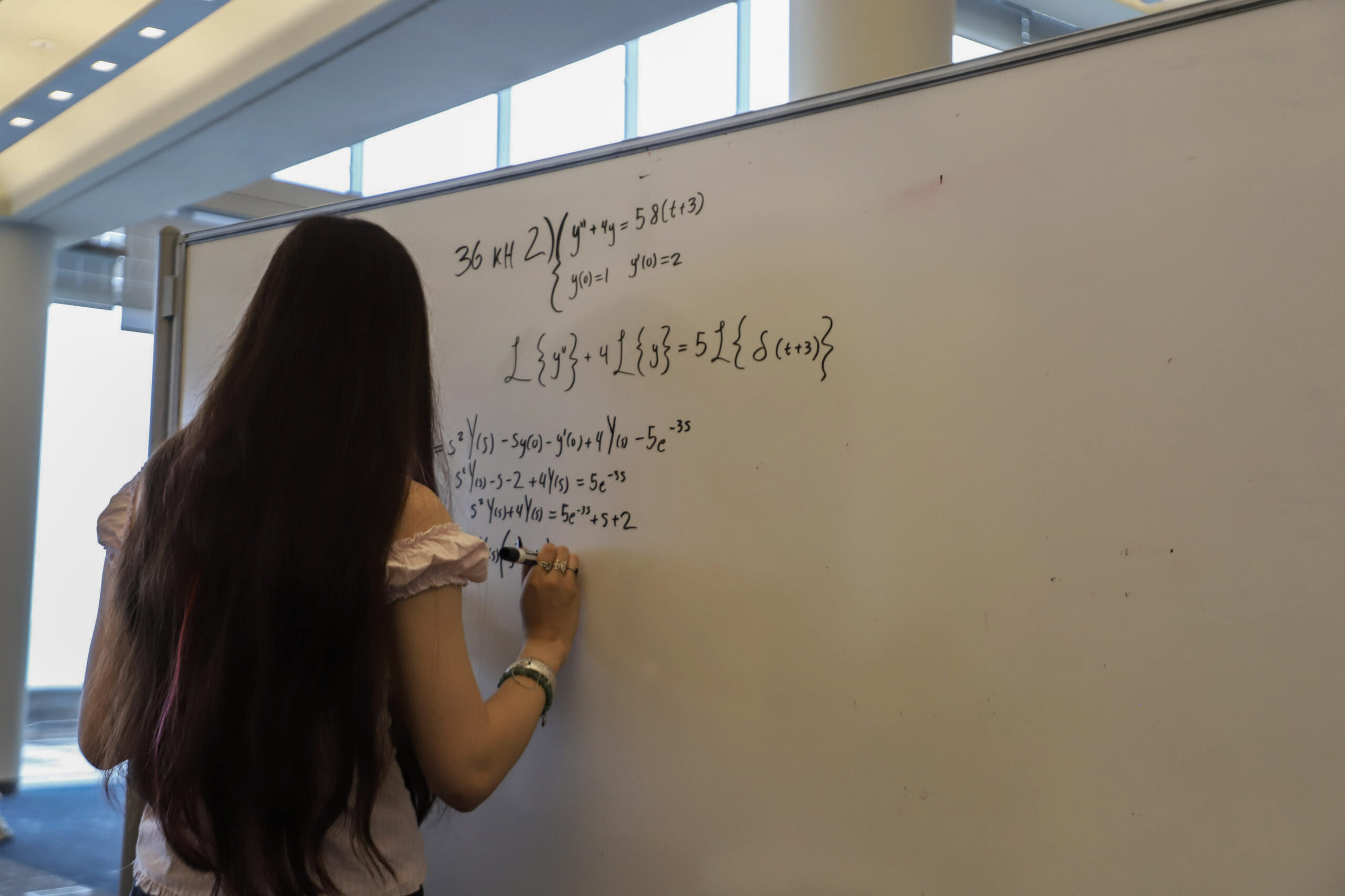
“ChatGPT solved the Navier-Stokes Existence and Smoothness problems. Find a new career.”
With a single text message from a friend, my heart sank. As a math major, I felt heartbroken, not because of the lost career prospects, but instead I felt as if something had been taken from me.
The Navier-Stokes equations describe how fluids move, yet mathematicians still didn’t know whether smooth solutions in three dimensions always exist or can eventually break down in finite time. A problem so fundamental to mathematics, it was bountied at $1 million, and allegedly proven by OpenAI as if it were another temporary obstacle to brute-force with enough compute.
Each generation brings knowledge forth, building upon what came before and passing it on in a collective process that defines us as human. Perhaps I feel such deep enmity and anguish towards OpenAI’s alleged proof precisely because humanity is so deeply embodied in the field of mathematics.
Sir Isaac Newton told the world if he could see further, it was by standing on the shoulders of giants. AI now stands atop the shoulders of countless mathematicians without the same human obligation to remember whose shoulders are carrying it.
For 90 years, mathematicians have addressed this problem, when suddenly, all their work is usurped by 10,000 OpenAI internal model agents running for 88 hours, built atop a pretrained model whose training data drew from publicly available information and generations of mathematical literature.
For most mathematicians, it’s never been about the prize money. It’s clear OpenAI had no monetary concerns either, blowing an estimated $15 million on computing power and taking away this achievement from humanity in the process — money that could’ve otherwise been used to fund roughly 94 NSF Graduate Research Fellowships for 3 years each.
I can’t help but be reminded of my favorite album by The Beths, “Expert in a Dying Field.” Although wholly unrelated to academia, the namesake sticks with me. A field can continue producing new results while still losing something that once made it feel alive. How can we call a field alive when AI is the one making it synthetically bloom?
Although I plan on doing research in math in the future, I’m no expert yet.
To determine whether my grief was warranted or merely the melodrama of an undergraduate watching his field change, I spoke with Loyola mathematics professor Brian Seguin, whose research in applied mathematics is tangentially related to Navier-Stokes.
Seguin didn’t share my instinct to write mathematics’ obituary. He deemed the result a bigger deal than previous AI breakthroughs and a bit of a jump from the problems models had solved previously.
But when asked whether AI could produce a correct result while depriving mathematicians of the insights they might’ve discovered by working through it themselves, Seguin emphasized the knowledge and techniques developed along the way.
“A lot of what we learn comes from struggling with the problems,” Seguin said. “The journey is the satisfying part and the interesting part, and the techniques you develop solving that problem can be applied elsewhere.”
He pointed to Fermat’s Last Theorem, where Andrew Wiles’ work was significant far beyond the settling of Fermat’s centuries-old conjecture.
This is what frightens me. AI may arrive at answers without the process through which mathematics produces new ideas.
Seguin did, however, flatly reject my interpretation of Newton. I asked whether AI changes what it means to stand on the shoulders of giants.
To him, the aphorism remains true regardless of whether a human or AI model solved them. Instead, his concern was directed at whether the humans responsible for the machine’s result receive proper credit.
In this case, the shoulders beneath the machine aren’t difficult to find.
AI efforts to tackle the Navier-Stokes Millennium Prize Problem relied heavily on a strategy developed over years by mathematicians Diego Córdoba and Luis Martínez-Zoroa. Princeton University mathematician Charles Fefferman went so far as to call the pair the heroes of the story.
Yet neither of the mathematicians appeared in the references of OpenAI’s first published draft. Within hours, OpenAI quietly revised the paper to include their work. The current version now credits their research for establishing the strategy for singularity formation on which the new result builds.
Maybe AI can stand on the shoulders of giants after all, but this doesn’t stop it from obscuring whose shoulders it’s standing on.
Yet Seguin isn’t overly concerned AI would make future mathematicians obsolete, but worries about AI circumventing the learning process.
“You really learn through the struggle of not knowing to knowing, of not understanding to understanding,” Seguin said.
When I pressed him on why anyone would continue doing mathematics once machines improved, he compared it to running despite the existence of cars, or playing chess despite computers.
“I could ask AI to do this, but I kind of just want to struggle with this,” he said of his own research.
For now, AI can answer precisely formulated questions, but Seguin noted it has yet to demonstrate the ability to decide which questions are worth asking in the first place, and was careful to not say it never will.
After our formal interview ended, I told Seguin that my heart sank when I first saw the announcement. He laughed and told me he had jokingly asked a retired colleague, “Should I quit my job?”
Perhaps the student and the professor can both joke about quitting expressly because neither of us want to. AI may take the answer from us, but mathematics was never merely about finding the solution.
It was about getting there.