Written empowerment of women authors is a focal point of this year’s literary festival.



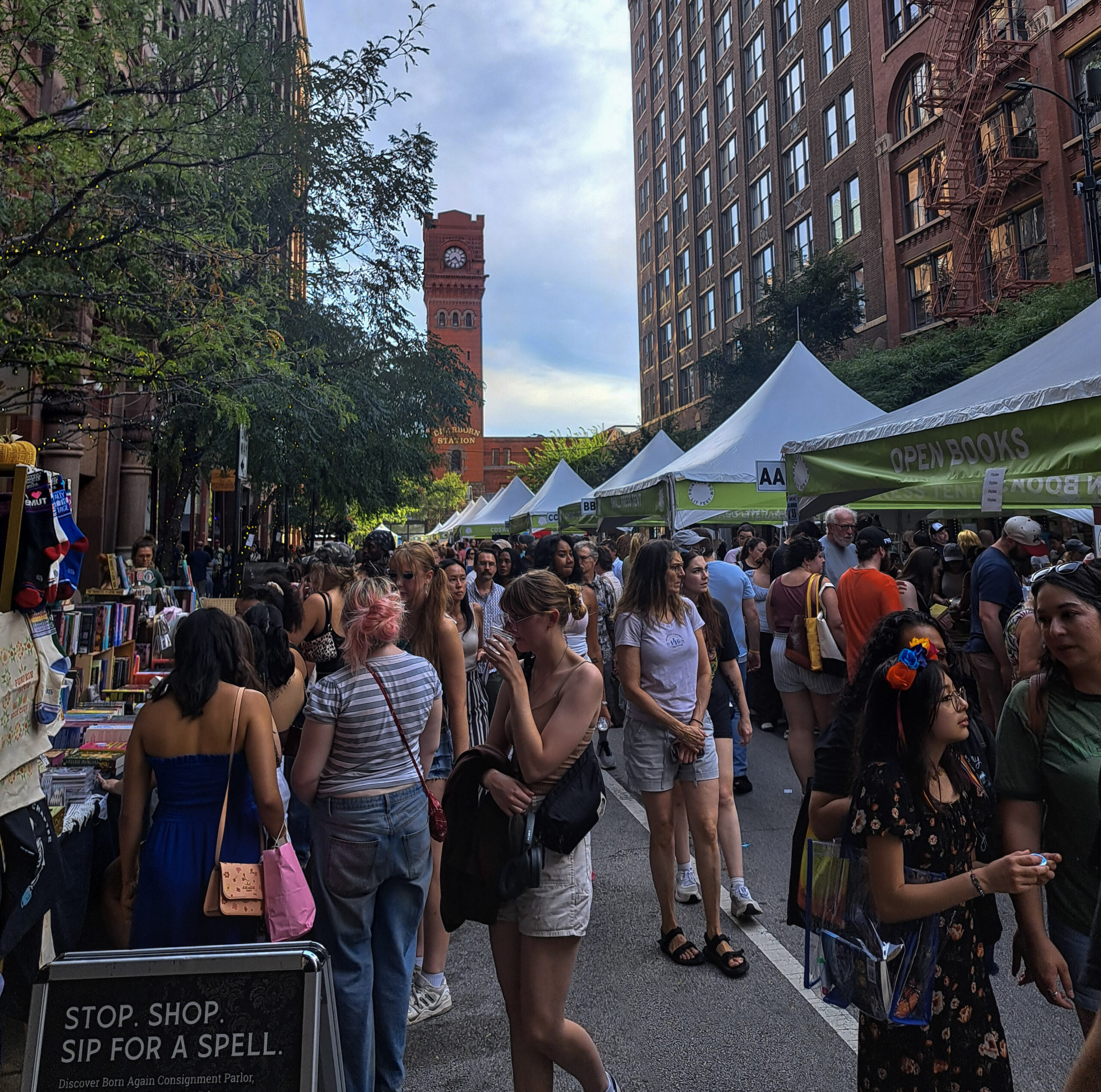
Picture this — it’s a warm, sunny weekend filled with hundreds of book lovers, countless oversized tote bags, a seemingly never-ending setup of publishing tents and a collection of crisp novels fresh off the presses.
And it’s far from a literary fantasy.
On Sept. 12-13, Chicago’s South Loop welcomed a bustling hubbub of aspiring writers and literature lovers to the 41st annual Printers Row Lit Fest.
Charming independent publishers and personable booksellers opened booths across the South Side neighborhood, transforming the quaint scene between Polk Street and Ida B. Wells Drive into a wordy, walkable library of wonderfully-written proportions.
From 10 a.m. to 6 p.m., the festival presented a witty concoction of presentations and panels between its over 100 exhibitors, highlighting 263 unique speakers — everyone from authors and academics to comedians and policymakers.
This year, the venue’s center stage welcomed some of the most marginalized yet masterful contributors to the literary world into its captivating lineup — multifaceted women writers.
Award-winning author Tracy Clark spoke of her upcoming suspense thriller “Edge” on a panel with fellow thriller writers David Saul Bergman and Randy Richardson.
As the only African American and woman panelist of the presentation, Clark quickly captivated guests through details of her writing process, expertly articulating the questions constantly pursued when curating each new project.
“What is evil? What is justice?” Clark asked. “It’s the stuff that keeps me up at night.”
The Chicago native expressed how her Midwest identity emanates throughout the pages of her projects, where both fictional protagonists and victims wind up in authentic depictions of Chicago neighborhoods and hideaways.
“I try to write a place as a Chicagoan would see it,” Clark said. “We have over 71 neighborhoods in Chicago, I try to highlight them if I can.”
The driven thriller writer doesn’t stop there, using her relationships with Chicago policymakers and public service workers to depict character identities as accurately as possible.
“I’m lucky enough to know a lot of cops. I listen to what they say — more importantly, what they don’t say,” Clark said.
Overarching themes of political corruption and greasy greed burst between the lines of her work, adding elements of action and conspiracy into her already frightening fictional worlds. The concept fuels her writing, blending her signature elements of creative expression — themes of both evil and justice.
“The people who are doing this aren’t looking at actions, they’re looking at money,” the author said. “They aren’t going to stop until they are stopped.”
A supporting act to Clark’s powerhouse presentation followed suit, highlighting a panel of intersectional female writers behind newly niche women sleuth stories.
Crime-thriller author Lori Rader-Day spoke about her recent award-winning release “Wreck Your Heart,” a mystery centering around the fictional Dahlia — an aspiring Chicago-based country music artist turned makeshift detective.
The unique storyline makes Rader-Day’s writing all the more captivating.
“She’s up against being a woman in country music,” Rader-Day said. “It’s a career path that doesn’t work out for women the same way as it does men.”
The twangy-loving writer is referring to the country-music phenomenon “tomatogate” — a controversy surrounding the idea that women-performed country singles shouldn’t be played back-to-back on live radio.
For Rader-Day, Dahlia’s identity as a young woman with a dream paralleled her own identity as an independent businesswoman.
“She’s really unemployed except for her non-money-making career in country music,” the “Wreck Your Heart” author said. “It reminded me of the career I and other writers try to pursue in publishing.”
Following the conversation on the country creation, audiences heard from a brand-new voice at the center stage scene — Yosha Gunasekera.
A woman of many talents, Gunasekera serves as both an attorney and author, passionate about blending her Southeast Asian and legal justice identities into her debut novel “The Midnight Taxi.”
The dual-skilled professional currently lives her life protecting the falsely accused, inspiring her to center the novel around a female taxi driver in Manhattan, New York racing against the clock to clear her name.
“I wanted to bring the criminal legal system to light,” Gunasekera said. “People would be in such disbelief about the stories I would tell them. It’s based in my experiences.”
Although Gunasekera’s piece isn’t set in Chicago, she shared the commonalities of human authenticity and location-based accuracy with the women sharing the stage with her.
“I wanted New York City to feel like a character, and that was really the point,” Gunasekera said. “I wanted to write a character who wasn’t always happy. It added a complicated wrinkle that made her such an interesting character.”
Closing out the female-dominated literary celebration was mystery writer Shannon Baker from Tucson, Ariz. — author of the Kate Fox mystery series.
Kate Fox is the sheriff of the Nebraska Sandhills, and Baker uses each novel as a launching pad for her crafty crime-solving strategies. Although Fox doesn’t always live by the book, there’s no doubt Baker’s tales are designed to feel empowering nonetheless.
“She has a fair amount of autonomy,” Baker said. “I didn’t want to do all the research for police policy, so Kate can do whatever she wants. That’s why she’s an amateur.”
In a time when legal policies consistently attempt to silence marginalized voices, there’s something refreshing in witnessing the success of these creators — with multitudinous talents and careers driven by ambition — write of strong, autonomous women finding success in difficult situations.
Within the works of these writers, hidden hints lie inside the details between the lines of each project, crafting an intricately woven web of plot design mixed with a splash of unstoppable woman power. It’s a time-consuming writing experience, but one that allows for stories to unify entire communities.
“The idea is that, when you get to one clue that sets the solution, the other clues that had sent you all over the place light-up like string lights,” Rader-Day said.
The awe and inspiration of these feminist Printers Row panelists is a page-flip in the right direction, giving audiences a powerful plot twist they’ll never forget — we deserve to be heard.
And they’re just getting started.