The university is transitioning its digital classroom interface from Sakai to Brightspace. The switch began with the SOC.



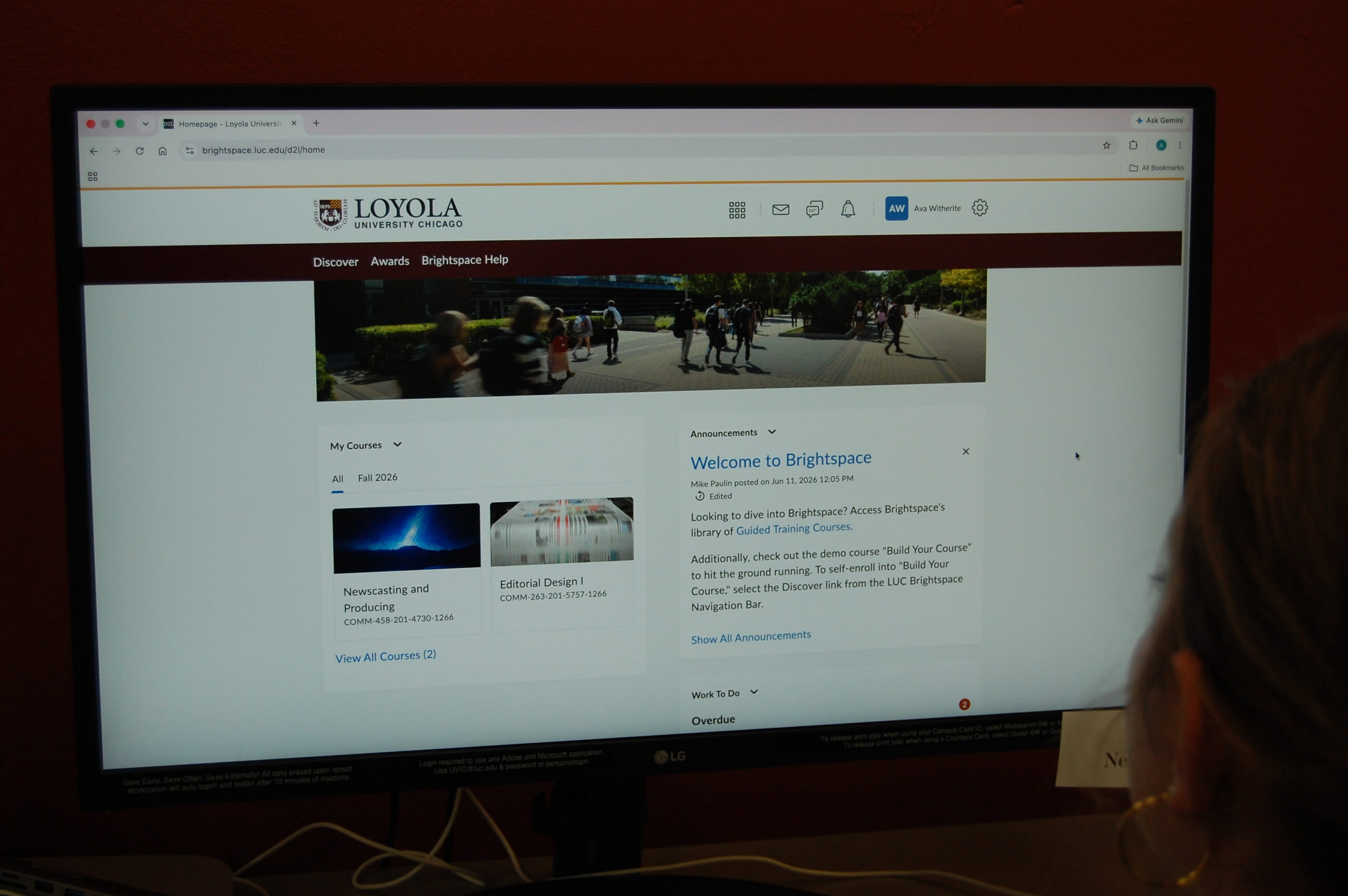
Loyola is making the switch from Sakai to Brightspace as part of a change in learning management systems. The School of Communication was chosen to pioneer the website this semester while the rest of the university will integrate by the end of the Spring 2027 semester.
Brightspace is a cloud-based learning management system created by Design2Learn (D2L). The system also integrates D2L Lumi, an AI assistant which gives instructors feedback on their courses and flags any material or assignments students had specific struggles with based on grades.
Sakai is a 100% open source learning management system. It was created by educators for educators and provides for teachers needs while aiming to provide the best learning experience for all users.
The switch to Brightspace was a “long time coming,” according to Executive Director for the Center of Faculty Development Lauri Dietz, who was brought on to help lead the switch to a learning management system best suited for Loyola’s needs.
The difference between cloud-based and open source management systems is who runs and owns the information. Open source gives underlying access to all the code and data while cloud-based is managed almost entirely by the vendor funding and running the system.
“Sakai is an open source learning management system,” Dietz said. “A lot of the universities who were part of that open source community were all starting to move towards other learning management systems. The question really wasn’t if we were going to move away from Sakai, but more when.”
Second-year multimedia journalism and political science student Anjali Acosta said she found Sakai to be complicated for both professors and students and is excited to make the complete switch to Brightspace.
“I like the layout of it,” Acosta said. “I’m using it for two classes this semester, and it’s a lot easier to find where everything is compared to Sakai. It’s also more aesthetically pleasing.”
Loyola students have been using Sakai since the 2011-2012 academic year. Other universities that use it include West Liberty University, Northwestern State Community College and Johnson University. Many universities that previously used Sakai, like Pepperdine University and Rutgers University, have terminated their contracts with the platform.
Information Technology Services (ITS) had been spending the past few years building relationships with other learning management systems like Brightspace and Canvas, according to Dietz. When Dietz arrived at Loyola, she said she sent out a survey to gauge the university’s opinion of Sakai and determine if there was a “universal dislike” of the system.
Fourth-year advertising and public relations major Shayna Keyes said they thought Sakai was pretty straightforward and not too complicated.
“I don’t think it’s better than Sakai,” Keyes said. “I think it’s worse honestly.”
Film and Digital Media Program Director Ayesha Abouelazm said she was afraid of the shift after being at Loyola for over 10 years.
“With new platforms there’s a lot of learning and unlearning,” said Abouelazm. “I want to know more than my students so if they have questions I can answer them.”
Abouelazm also emphasized how it was unfair for more senior faculty who aren’t as adaptable to technology to be expected to switch systems. She said she thinks there should’ve been more time for faculty to get the lay of the land.
School of Communication Dean Virginia McDermott said Loyola choosing Brightspace as the new learning management system was partially because of the fiscal responsibility, mobile interface and add-ons Brightspace offers.
Specifically, Brightspace uses an accessibility reporting tool, which allows instructors to automatically access course reviews and read feedback on how to improve and adapt their courses to screen readers, which makes content more accessible within the system for those who need it.
The assessment feature also aggregates data at the program level to track how students are progressing toward learning outcomes, allowing the university and professors to make timely adjustments and ensure students are meeting their goals, according to McDermott.
McDermott said there’s two main differences between Brightspace and Sakai. Brightspace uses its predictive models to signal to instructors early on if there’s an “at risk” student. In Sakai, an instructor has to manually open the Sakai Statistics eTool and filter through all the data to see if a student is falling behind.
Brightspace records the amount of times students log in, the content visited and the time spent on each form of content. When on the analytics tab, professors can search up a variety of data sets including usage of the site and visits to specific modules, which are all presented in clear terms. Looking at the assessment features, the system can track grade distributions, class averages and students’ performance for each question answered.
Sakai had analytics tracking but lacked the same sophistication Brightspace has. In order for professors to see data similar to what Brightspace offers with one search, they’d have to look at the individual data dashboards themselves.
“Brightspace has one of the most sophisticated assessment tools,” McDermott said. “That’s on the back end for us to figure out if students are learning what we think they are learning in the timeline we want them to learn it.”
Beyond the analytics dashboard, Brightspace also offers Lumi, a “suite of AI tools” designed to add AI capabilities to the platform, according to D2L. While Lumi isn’t currently enabled at Loyola, instructors will be able to use it to build course modules while students may also have access as a course aid, according to Dietz.
Lumi will be able to show in real time how students are performing in courses and “guide reaching strategies and learner success.” Educators will have tools like module summaries, insights, feedback and outcomes — all created through the AI suite, according to D2L.
With the exception of Sakai, McDermott said all the learning management systems the university observed had the ability to track and access students using AI.
“The outdated abilities of a 100% open source and community built platform did not have the capability to get as much data on students as interfaces with machine learning tools,” McDermott said.
While Lumi will be an option for instructors to use, Dietz said the university trusts their faculty and staff to use it as they see fit for the course.
“Our overall philosophy is really trusting faculty and wanting to honor academic freedom,” Dietz said. “We are not setting any mandates for use of AI or turning on any of the AI features. Brightspace offers local control, so it is up to each instructor whether or not the AI features will be turned on.”
Loyola’s university-wide AI policy, according to Dietz, doesn’t apply one single approach banning or welcoming the use of AI, but rather provides departmental and faculty autonomy. She said this gives individual instructors freedom to write into their syllabi how AI should or shouldn’t be used in their class.
Since Brightspace offers more AI integration than Sakai, Dietz said the university wants to be transparent with faculty about the tools available to them and the information they can access.
“We want to be really sensitive about the transparency around what is available for faculty regarding what they are seeing and how,” Dietz said. “I will bring that [disclosure of AI usage] back to our leadership team to make sure that we have got that planned.”
The university is on track to be fully integrated into Brightspace by the end of the Spring 2027 semester.
“Long story short, I really like it,” Abouelazm said. “It’s a lot more clear, and there are a lot more options. Yeah, you have to learn a bit more, but I did a lot of learning on my own and just like anything else, practice makes perfect.”