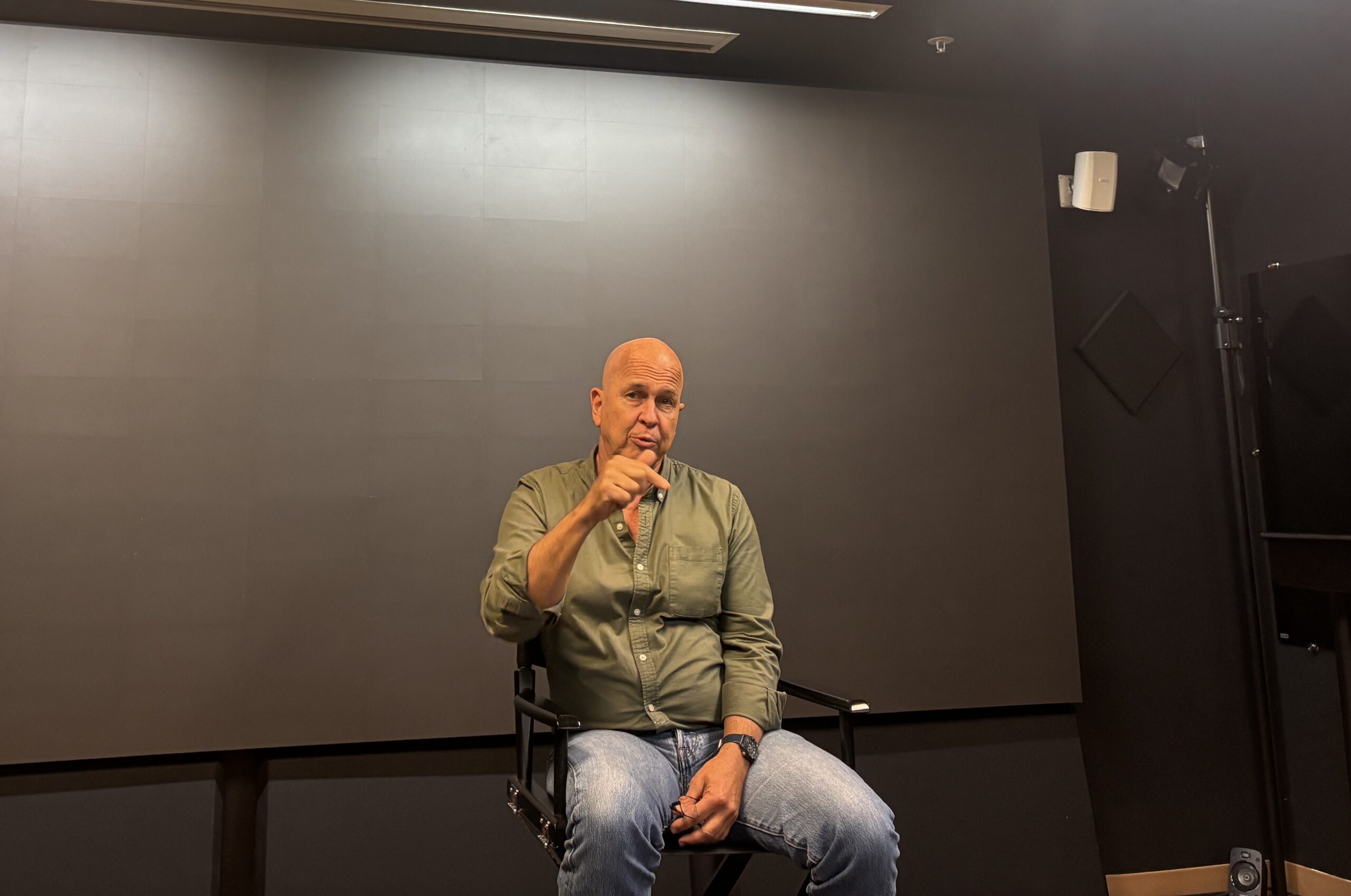
Free press advocate and journalism professor Peter Greste visited the School of Communication Oct. 7.



When Australian journalist Peter Greste was called in to cover political turmoil in Egypt for three weeks in 2013, he expected the reporting trip to be routine. He’d spent nearly a decade covering East and Southern Africa for the BBC before taking on the same role at Al Jazeera.
Two weeks into the assignment, Greste and two of his Al Jazeera colleagues were arrested on terrorism charges after authorities raided his hotel room. Greste spent 400 days in prison before his miraculous release, though he remains a convicted terrorist in Egypt.
After his return, Greste, now a professor of journalism at Macquarie University in Sydney, Australia, became a staunch free press advocate and wrote “The First Casualty,” describing his experience. The book has since been adapted into 2024 movie “The Correspondent.”
Greste visited Loyola Oct. 7 for a screening of the movie and a Q&A about his career and the time he spent in jail. The event was hosted at the School of Communication.
Before the screening, The Phoenix sat down with Greste to talk journalism, press freedom and the changing media landscape.
Phoenix: Since your experience in Egypt, you’ve become an advocate for free press. How do you translate that experience into smaller attacks on journalism that happen every day in reporters’ careers?
Greste: What we’ve seen is a slow erosion of press freedom and an erosion around the norms of how they accept and work with journalists, particularly how politicians and governments work with the media.
I place the origin of this problem back at 9/11. [Former President] George W. Bush declared the War on Terror, and he said ‘You’re either with us or against us.’
And one of the things that he did, first of all, was that he created a war of ideas.
We made it almost impossible for journalists to do their traditional role and that’s to be independent and cover four sides to the conflict.
Phoenix: In the United States right now, just in the last few weeks, we’ve seen the White House ban three publications. Do you think that’s just a continuation of press intolerance?
Greste: Absolutely, with that ban there’s been more headlines and very strong pressure, as it should be. But it’s just the latest in a very long history of this administration, and it goes back not just this administration, it goes back to the first Trump administration. We saw [President Donald] Trump describing, in his campaign values, these journalists as enemies of the people.
I’m not suggesting that the United States is about to start locking up journalists in the way that we were in Egypt, but there’s a direction of travel here, and that direction of travel is the same.
Phoenix: I thought it was interesting what you were saying about ‘You’re either with us or against us.’ Do you think there’s an element to being a journalist that you have to kind of be ‘against’ the government a little bit?
Greste: We do, but that’s because there’s a reason that we privilege press freedom in the First Amendment, and that’s not because you want to feel like a special class of individuals, but because we recognize that there is a vital need in a functioning democracy.
That’s a bit of a cliche, but it’s worth remembering why it’s there. It’s there because there is a deep imbalance between government and citizens and individuals.
That’s why journalists spend all their time looking at big businesses and the wealthy because they have enormous reserves of power, and the best way of balancing that power is to monitor, observe and report the way that power is used and the consequences of it. That inevitably means that you are not against the government, but you’re always challenging and questioning, trying to understand the consequences of the way power is used.
There’s nothing wrong with that. That is what journalism is supposed to be doing.
Phoenix: Is there anything in particular that you could point to as being the biggest danger to journalism, whether its physical safety for journalists or political ideas?
Greste: There’s a confluence of problems, and I think in some respects they’re interconnected.
I think growing populism — around the world, not just here in the United States — populism treats the free press as cholesterol, and that’s not unique to this country either.
I also think the proliferation of media online has changed our relationship with the press.
In the past, when politicians wanted to speak, they kind of had to go through journalists. That’s what the media is actually, the means by which you communicate. And now, with social media, people can communicate unfiltered.
The point of good journalism is to filter, to question and to put things in the correct context. It’s not just merely collecting information.
Phoenix: I recently read a piece you wrote about ‘both-sideism,’ which I thought was really interesting, describing the difference between being balanced and being fair. Could you explain that idea a little more?
Greste: This is related to some criticism of the ABC…that their reporting [about Israel] was unbalanced, and therefore antisemitic, because it shows too much suffering of Palestinians without paying as much attention to the Israelis.
If one person said it’s raining, and another person says it’s not, your job isn’t to include both sides, it’s to look out the fucking window and see.
Both-sideism implies equivalence between two sides. It implies that both sides need to be taken with equal seriousness.
Editor’s Note: This interview was edited for length and clarity.