Frédéric Chopin’s music carries audiences through a newly adapted stage production of Loyola alum Stuart Dybek’s ‘Chopin in Winter.’



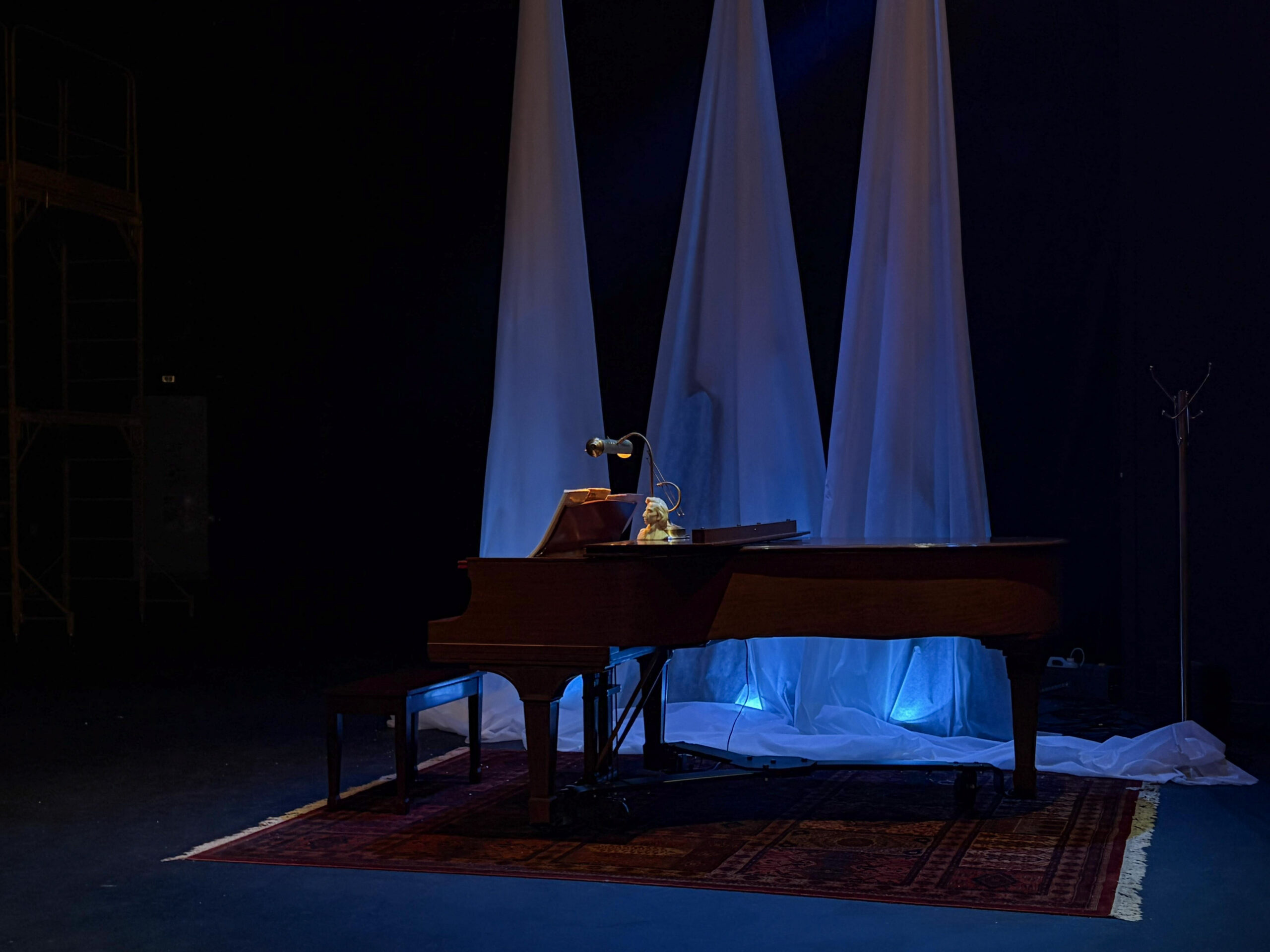
Almost 40 years ago, Stuart Dybek, a 1964 Loyola graduate who returned to complete his master’s in literature in 1968, sat down in Michigan’s snowy winter with the music of Frédéric Chopin playing in the background and wrote a short story, “Chopin in Winter.”
In 2026, this short story became a play at the Chopin Theater in Wicker Park running from Sept. 27 through Oct. 18.
“There’s nothing else in the city like that theater,” Dybek said.
Within the quaint theater, “Chopin in Winter” takes place on a small, intimate stage. Sharing a name with the venue might seem like a lot for this show to live up to, but it measures up.
The play opens with actor Yasen Payenkov narrating the story in almost complete isolation. As the lone actor, he forces the audience to keep their full attention on him for the entire duration of the 75-minute production.
The show takes the audience through the life of a young boy who lives in Pilsen, experiencing love and complicated family dynamics as a child of Polish immigrants. The story tackles heavy themes, but ultimately allows the audience to view the life of this child through the lens of an unnamed narrator and see these themes in a personal, intimate way.
“We get a chance to go, ‘What would I have done? How does that make me feel?’” director Dexter Bullard said.
Payenkov may have been the lone actor, but he wasn’t the only person on stage — Jana Pavlovska accompanied him on the piano.
Pavlovska stays silent, allowing the piano to shape her role as a young woman with whom the boy seems to be infatuated. However, in the end, Chopin’s music, not the musician, is the thing the boy is infatuated with, bringing him closer to his grandfather, his culture and even himself.
According to Bullard, something the audience might not understand is the way the pair rehearsed — never independently. Payenkov and Pavlovska worked together as a machine, stringing together music and dialogue.
“They’re feeling each other like jazz musicians,” Bullard said. “When he says something like the swirling snow, her fingers are swirling over the high keys and making this imagery of the notation and the image of the words kind of come together.”
While this is the first time the show is being performed with Chopin playing over it, the story itself was written in a very similar manner.
“I now have this permission to sit here in isolation, and shut the rest of the world out and just try to disappear,” Dybek said, reminiscing about listening to Chopin while writing.
Dybek also spoke on the differences between writing a story and turning a story into a stage production. He credits this production for the new elements it brings to a story he wrote years ago.
“I was still really developing a voice as a writer, and I long ago forgot all about that, but I began thinking about finding its way into my mind as I was watching that performance,” Dybek said.

The stage performance of “Chopin in Winter” encapsulates this feeling of nostalgia and reflection. The music holds the memories from Dybek’s past, and the story asks the audience to draw on their own nostalgia.
“You start thinking kind of cliche thoughts like ‘What would that kid sitting there writing have known?’” Dybek said.
Loyola was an important factor in the story’s genesis, Dybek said, highlighting the importance of the liberal arts and Jesuit education. While on the premed track going into college, it was Loyola that convinced him to pursue a career in writing.
Perhaps the biggest difference between reading “Chopin in Winter” and watching it live is the presence of an audience itself.
“In the theater, you literally sit beside people you don’t know. Here’s something intimate or exquisite or dangerous, and your body reacts with this stranger,” Bullard said. “All around you are strangers, and that creates a community feeling.”
When Dybek watched the show for the first time, he said he was not only taken back to the experience of writing the story, but also got to view it from a more objective lens as part of the audience.
“There’s magic that’s created,” Dybek said. “I felt it in that room yesterday. It was a little room. There was a piano player. There was one actor. There was a script, which was my story. And the intimacy was so palpable. You could feel the breathing in the room.”
Something glaringly important about this show and the story Dybek presents is the necessity of the art and community.
Callie Standerfer, a current Loyola second-year, saw a preview of the show Sept. 27. Standerfer spoke about the intimacy of community and culture the show presents.
“I thought it was a lovely look into what it was like growing up in the mid-twentieth century as a child of Polish immigrants,” Standerfer said.
The music blends with Dybek’s words and the intersections of art present themselves. The show makes it difficult to walk away without assessing the importance of art in the everyday.
Sharing this sentiment, Bullard put it bluntly: “I want the audience to go away and listen to some Chopin.”