Guest writers Siena Negron and Sean Kennedy propose more Loyola students should be environmentally conscious.



Loyola’s known for its impressive sustainability efforts. From the Searle Biodiesel Lab fueling our shuttles to the geothermal heating system in some of our buildings, the school champions a widespread approach to sustainability. Loyola even became the first Chicago university to reach carbon neutrality in 2025.
No matter where one goes on campus, they’re sure to encounter at least one student wearing L.L.Bean and Blundstones, posting climate-friendly hashtags and eating only organic foods — all while holding a plastic Starbucks cup in their hand.
Despite Loyola’s efforts to protect the environment and maintain its sustainability, there’s a prominent culture of performative climate concern among its student body.
While many students raise concerns about climate change inside and outside the classroom, there’s a significant inconsistency between their words and their actions.
What does it mean that, as students, we can have raging climate anxiety, claim to do our part by asking for reusable straws for our birthday and still be ignorant of simple methods of sustainability?
Today, two of the most widely known and essential sustainable practices people use are recycling and composting. Loyola also incorporates these programs into their sustainability efforts. Loyola offers a thorough recycling system throughout each of its three campuses as well as a weekly composting program for students and campus buildings.
Interestingly, many students aren’t aware of the ways they can incorporate these sustainable practices into their everyday lives.
First, the recycling system. Despite having recyclable utensils or cups available in campus cafes, more often than not, students end up throwing those items in the trash without taking a second look at the bin they really belong to.
Starbucks is one of the most popular — if not the most popular — coffee shop around Lake Shore Campus. Despite the fact that Starbucks offers a discount to customers who bring reusable tumblers — even for specialty drinks — customers typically opt to use the plastic cups.
Furthermore, while Starbucks claims to have earned the Widely Recyclable designation from How2Recycle on their website, another study from Beyond Plastics found that over the course of three months and across 21 different states, not one Starbucks cup ended up at a plastics recycling facility.
Other Loyola hotspots include Metropolis Coffee Company near Lake Shore Campus and Foxtrot Cafe & Market near Water Tower Campus. While both offer some recyclable and compostable utensils, neither provides a place other than a trash bin for their disposal. The many students who flock to these cafes may be using sustainable products, but they’re still ending up in plastic garbage bags.
While these are two examples of cafes that aren’t entirely effective in their sustainability efforts, Rivers & Roads, another Loyola favorite, does a great job in providing climate-friendly options for their customers.
Their drinks are made with only compostable cups, they don’t automatically place plastic lids on their cups and each waste bin is clearly labeled for recyclable, trash and compostable products. As students, and for anyone concerned about the current state of the climate, this is the kind of business customers should be investing in.
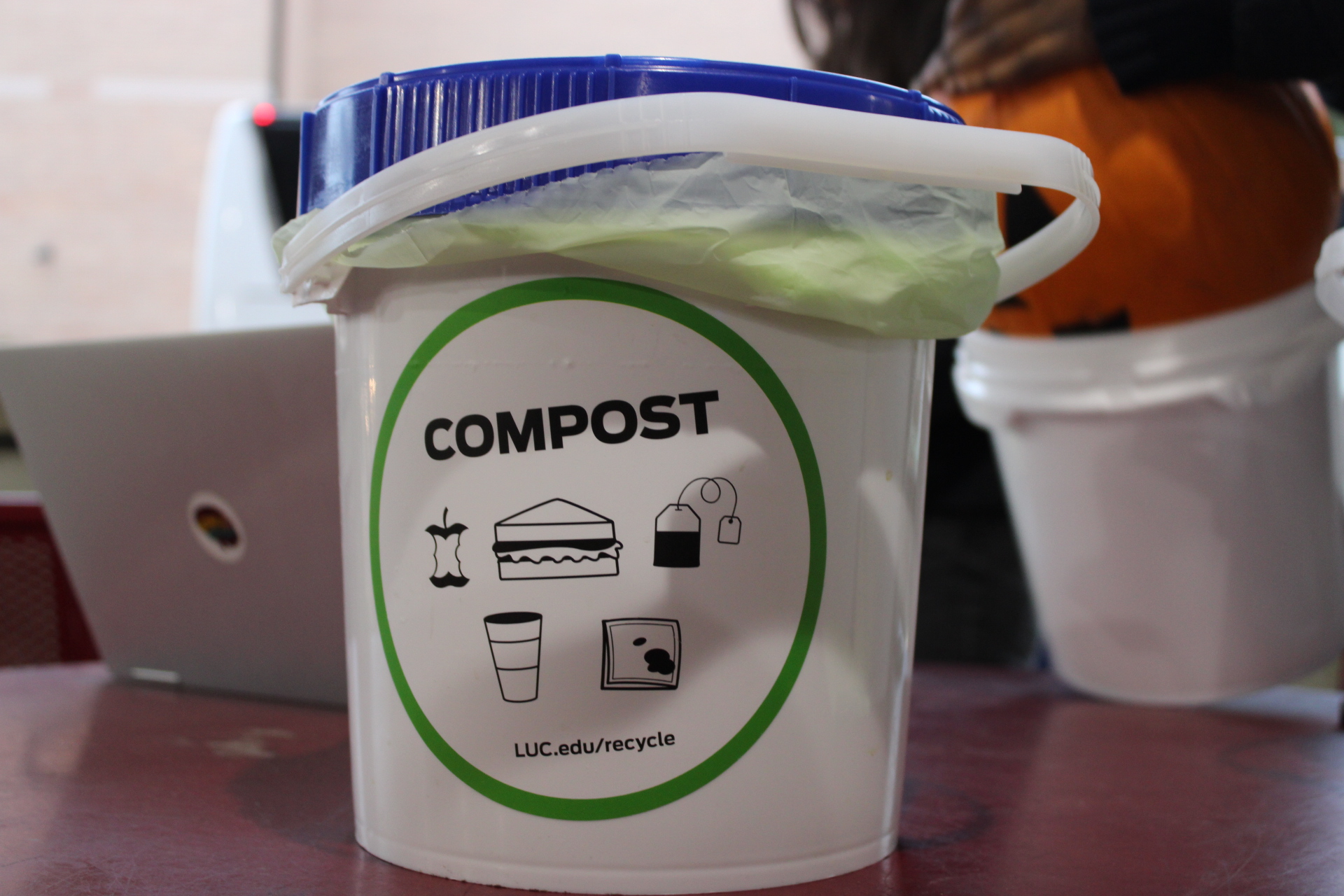
Aside from being more aware of recycling efforts, students also have a responsibility to use Loyola’s compost program. Apart from composting in the dining halls, Loyola’s Compost Bucket Program has been running since 2013. Through the program, students receive their own compost bucket and can empty it weekly at the Lake Shore, Water Tower or Health Science Campuses.
According to Maya Kelly, Loyola’s sustainability manager, Lake Shore Campus has roughly 50-70 compost participants annually, while Water Tower Campus has two to four and Health Science Campus has 10-15 participants. This semester alone, the Compost Bucket Program has collected 850 pounds of compost.
Without disregarding the fantastic work and involvement of these students, it’s also important to acknowledge the steps many others could be taking.
Students can choose to compost their food instead of throwing it away. They can choose to bring tumblers to Starbucks. They can choose to be more conscious and knowledgeable about recycling efforts.
Above all, they can be proactively environmentally friendly instead of simply claiming to be so.
For those wanting to get involved with Loyola’s composting program, email sustainability@luc.edu.