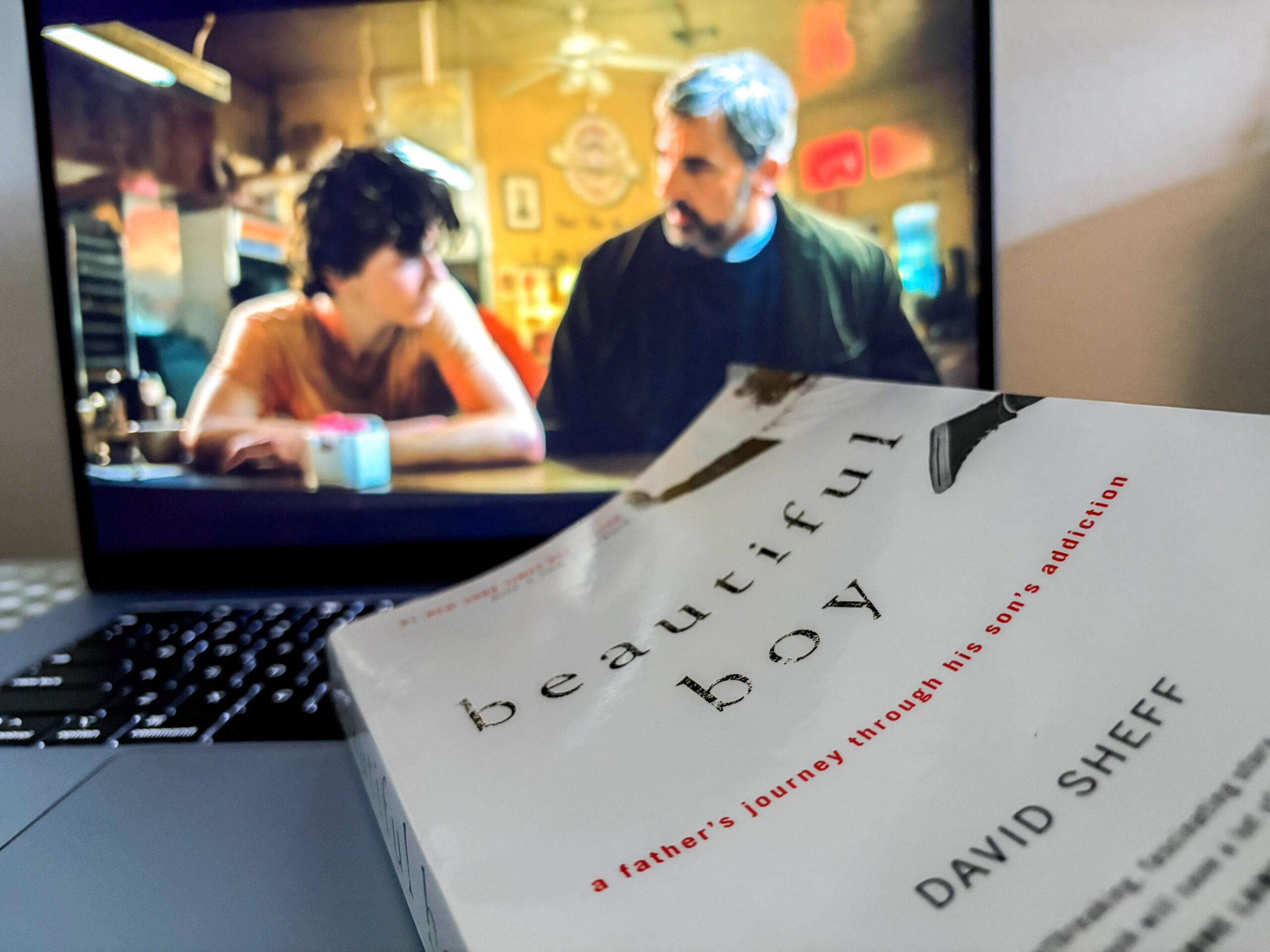
David Sheff’s 2008 memoir “Beautiful Boy” was turned into a 2018 film of the same name.



Content warning: Substance abuse
Nic Sheff first got drunk at 11 years old on a ski trip with his family. His father found out through a confrontation months later. He wonders if he might’ve prevented this.
In his 2008 memoir “Beautiful Boy,” David Sheff writes about his experience with a son living with drug addiction. In 2018, this memoir was turned into a film starring Steve Carell and Timothée Chalamet, directed by Felix Van Groeningen.
“Fortunately I have a son, my beautiful boy. Unfortunately he is a drug addict. Fortunately he is in recovery. Unfortunately he relapses. Fortunately he is in recovery again. Unfortunately he relapses. Fortunately he is in recovery again. Unfortunately he relapses. Fortunately he is not dead,” David Sheff writes.
Through the introduction of his memoir, Sheff introduces the reader to his son, Nic. This first segment serves to present the problem of Nic’s addiction, and the impact that it has on his family. After the introduction, Sheff begins his memoir at the start of Nic’s life.
An important note that Sheff makes in his memoir — and which also appears in the film — is addiction can happen to anyone and to any family. That is the call to action in this story.
“I was a typical parent who felt that this could not happen to us — not to my son. But though Nic is unique, he is every child. He could be yours,” Sheff writes.
The film doesn’t follow the same chronological timeline as the memoir — instead, it begins with Carell speaking as David, researching an article the real Sheff wrote for The New York Times. Similar to the memoir’s introduction, the film immediately informs its audience of Nic’s methamphetamine addiction. In contrast to the memoir, it doesn’t jump back to Nic’s beginning.
Storytelling through flashback works effectively in the film format, as taking the time to detail Nic’s entire life would likely be too tedious and redundant. However, the memoir succeeds more than the film in this narrative regard, able to tell Nic’s entire story. Notably, the novel shows that Nic is deeply gifted and intelligent in his childhood, driving the point that addiction can befall anyone — a point not thoroughly portrayed in the film.
The memoir details Nic’s childhood, with scenes showing him as a three-year-old participating in circle time, helping to make pancakes, attending kindergarten and making prank calls with his friends. Sheff recounts a time when Nic had nightmares, and he sang John Lennon’s song “Beautiful Boy (Darling Boy)” to help his son fall asleep.
After an introduction to Nic’s addiction, the film displays a short montage that flashes between Nic as a young child and Sheff looking for a runaway Nic as a young adult.
The film uses its medium to the story’s advantage, offering accessibility not inherent to reading with a short engagement time and guiding visuals. It also includes a perspective that Sheff’s memoir doesn’t: sections of Nic Sheff’s own memoir, “Tweak: Growing Up on Methamphetamines.”
While both David’s memoir and the film condense years of anguish and grief, the memoir more thoroughly covers the roots of Nic’s drug abuse and nearly a decade of addiction. To a certain extent, both narratives explain that grief can’t be completely captured through any form of media — it’s a lived experience.
Much of the memoir is Sheff questioning the ways he could’ve prevented his child’s descent into addiction, whether he could have talked about drugs differently — Sooner. Later. More open. Less open. By presenting these hypotheticals, Sheff shares a reality of unanswered questions, conflicting emotions, and misguided blame that many family members and loved ones of addicts face.
Sheff also shares much of his extensive — and often obsessive — research into addiction, mental health and other topics related to his son. One such topic is the effect a divorce might have on a young child.
“We say ‘everything’ to each other. It is our way of saying I love you, I will miss you so much, I am sorry — the jumble of feelings when he comes and goes,” Sheff writes about sending a young Nic to spend the summers with his mother.
The absence of depth in portraying Sheff’s more obsessive tendencies in the film leaves out a key component of the memoir. Sheff shares that love for an addict doesn’t mean there isn’t also anger and resentment. The film misses out on the ability to let the audience feel exactly what Sheff is feeling. It misses out on the reality.
An important part of both Sheffs’ lives is music. Groeningen (“The Broken Circle Breakdown,” “The Eight Mountains”) curated the soundtrack for the movie, including a range of music commonly loved by both Nic and David Sheff and mentioned in each of their respective memoirs. The film chooses not to use an original score, and instead focus on the Sheffs’ shared music taste through its soundtrack.
The track that brings the movie together is John Lennon’s “Beautiful Boy (Darling Boy),” a direct reference to Sheff’s memoir and an emotional high point for the audience.
On top of music, Carell (“Crazy, Stupid, Love,” “Little Miss Sunshine”) and Chalamet (“Marty Supreme,” “Dune”) give standout performances as David and Nic Sheff.
Under soft piano, the film ends with a crying Nic sitting outside next to an equally emotional David. After the scene fades out, a handful of messages appear. One shares that at the time of the film’s release, Nic Sheff had been sober for eight years — a number that has grown since 2018.
“Drug overdoses are now the leading cause of death for Americans under 50,” another message reads. “The help is out there — for those struggling with the disease, their loved ones, and for those who grieve.”
The memoir similarly ends with an afterword written in 2009 calling for society to take a different approach to treating addiction.
“Consider the related tragedies that can result from drug use — crime, accidents, suicide, drug- and alcohol-caused illnesses, lost productivity — and you’ll begin to fathom the enormity of the problem, much of which is hidden,” Sheff writes in his afterword.
Drug overdose, while recently and very slowly decreasing, is still a major issue in the United States. This was true with the memoir’s publication, the film’s release and in the present, making both iterations hauntingly prescient.
Much of the story is used to point to real reasons addiction needs to be treated. Much of the story is also about love. Even in the grief of Alcoholics Anonymous meetings, or not knowing whether your child is alive, there is love.
“Nic says, ‘Everything,’” Sheff writes, recalling their shared way of expressing their love. “I respond, ‘Everything.’”
Addiction is an endlessly complicated matter. Sheff writes about the drastic, changing emotions of having a child addicted to drugs. He also acknowledges it’s still infinitely worse for Nic.
A memoir almost certain to inspire tears and a film colored with emotional performances, “Beautiful Boy” is a story that reflects many lived experiences today. Even in 2026, it’s one necessary to be told.
“Fortunately there is a beautiful boy. Unfortunately he has a terrible disease,” Sheff writes. “Fortunately there is love and joy. Unfortunately there is pain and misery. Fortunately the story is not over.”