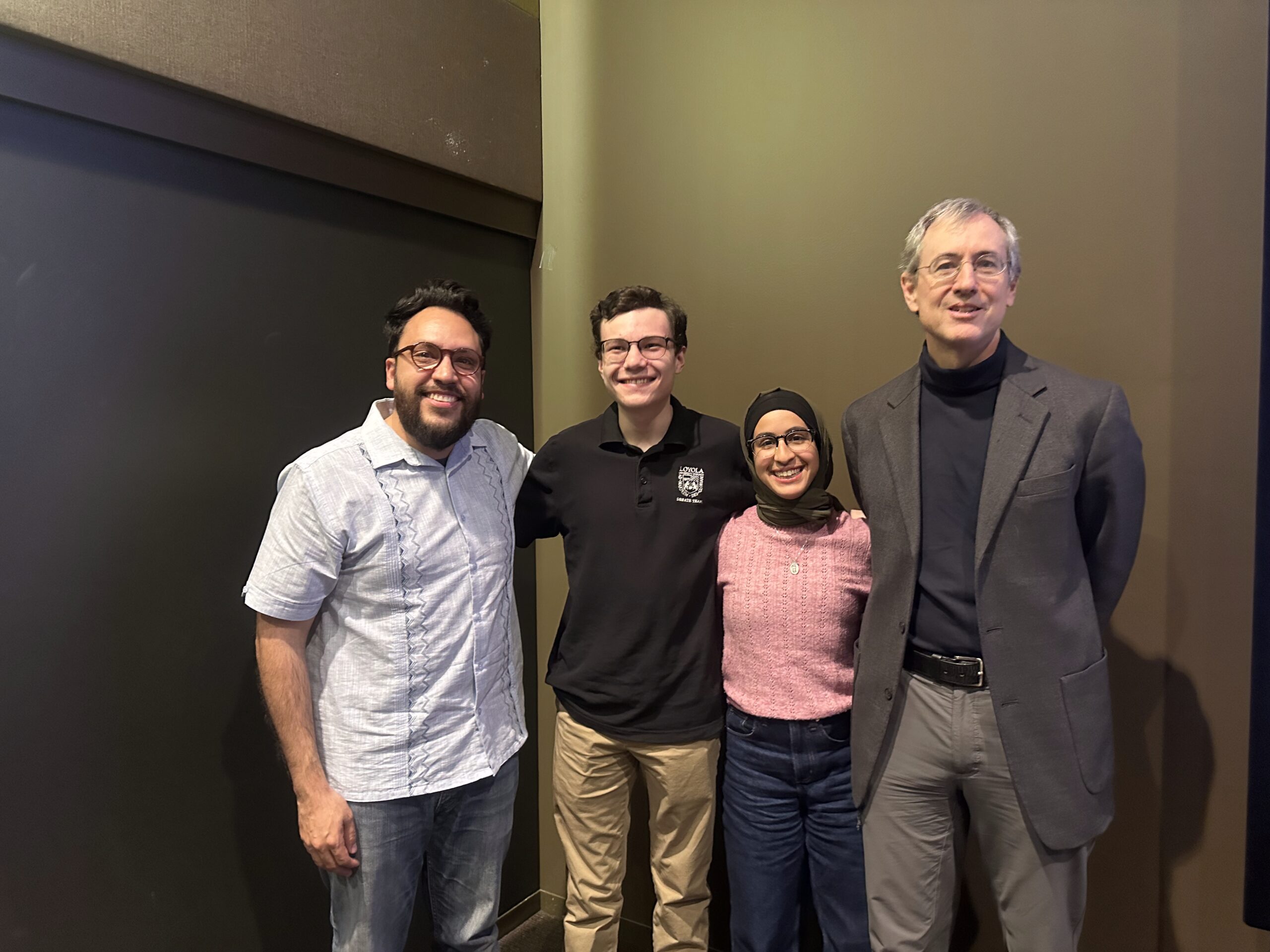
The iconic opening guitar riff of AC/DC’s “Highway to Hell” could be heard from Damen Cinema April 9 as theology professor Hugh Nicholson marched into the nearly packed theater, serving as the defense in the Theology Department’s second annual theology debate.
The strings of Rosalía’s “Berghain” then rang out, as in came theology professor Josefrayn Sánchez-Perry, along with second-year theology and English major Munya Noman and second-year global studies major Gavin Ros entered, carrying a life size cutout of Pope Leo XIV, prepared to serve as the opposition.
The four debaters were tasked to defend or oppose the need for organized religion in society, and argued whether individuals could be spiritual but not religious. The event was the second annual debate hosted by the theology department, the first discussing the existence of God, The Phoenix previously reported.
The debate began with opening remarks from Ros, one of two students defending the need for organized religion and opposing the idea of spiritualism without religion. In his argument, Ros compared spirituality without religion to political interest without action.
“It’s like someone saying they’re very political, but they don’t vote,” Ros said.
Ros continued to argue organized religion promotes activism and humanitarianism citing Gandhi and his use of Hindu values to promote his campaign of peace and decolonization in India. Ros closed the opposition’s opening remarks by discussing his skepticism of anyone who believes the idea of organized religion is oppressive.
The debate was continued by the only member of the defense, Nicholson. During his time at the podium, Nicholson conceded religion has sparked movement in social justice, but he refuted the idea of a net-positive impact made by religion and argued religion has done more harm than good.
“More often than not in history, religion has a different function,” Nicholson said.
One of the functions of religion is to preserve hierarchy in societies, Nicholson said, and he cited the Divine Right of Kings in 17th century England. While many religious movements begin with the intention of equity or equality, he said they’re eventually used to exclude different groups.
The opposition then took the floor to rebuttal, as Noman argued the structure of religion is what gives it a net-positive effect on society. She continued to refute the harms of religion, stating religion gives society its strongest community.
“You cannot be secular without having an actual structure,” Noman said. “That’s what religion provides.”
The opposition continued to hold the floor as Sánchez-Perry stepped up to the podium. Sánchez-Perry argued against spirituality outside of organized religion, and he said spirituality is often deeply rooted in cultural appropriation. He used the example of yoga, a Hindu discipline which has been adapted into individual spiritual practices.
“Those of you who go to hot yoga on Broadway, show your hands,” Sánchez-Perry said. “Do you then go up Devon, and pay respect?”
Sánchez-Perry continued to show how religion is appropriated in other settings, pointing at the religious garbs he wears when teaching. He said many department stores have appropriated the item as a style of clothing.
“You can go to Target and buy the same thing,” he said. “Isn’t that appropriation?”
A refutation was then made by Nicholson, who defended those who don’t find community within religion. While religion can be meaningful to some, no one should feel “blackmailed” into converting, as life isn’t impoverished without religion, Nicholson said.
Nicholson then diverged into a rebuttal against cultural appropriation, arguing almost all religions have taken other cultural practices and implemented them into their own disciplines. Nicholson recalled the example of yoga used by defense and claimed many parts of the discipline have origins elsewhere.
“The practice itself is the product of cultural appropriation,” he said.
Nicholson said the problem isn’t within the implementation of different cultural practices in one’s life, but rather claiming wrongful ownership or creation of said practice, which he said isn’t often done by spiritual individuals.
In the final rebuttal made by the opposition, Noman rejected the idea of “blackmailing” individuals into religion, and said religion is simply spirituality embodied into physical practice. Before she closed the floor, she continued to stress religion isn’t about limits, but instead providing spiritual guidance.
Before the final remarks were made by each position, members of the audience posed questions regarding previous statements, or made other points of consideration. The seven questions raised new arguments on the benefit of structured religion and acts of violence within religion.
The debate ended with closing remarks from Ros and Nicholson, where both debaters summarized the arguments made and restated their biggest claims. Ros concluded his statements by saying religion is necessary for societal structure with the most positive impact, while Nicholson asked the simple question, “necessary for whom?”
After the debate, both students on the forum agreed the debate was a success, and said they were happy with the space made for productive conversations about religion and the large turnout of students interested in discussing theology.
Among the differences in opinion about the need for religion and the efficacy of spiritualism, first-year advertising and public relations major Abigail Rosales said hearing the different perspectives of each argument was meaningful to her and is important for all students.
“At the end of the day, that’s why we’re at university,” Rosales said. “To get an understanding of different perspectives and ideas, and be able to share our own personal beliefs as well.”
Gavin Ros and Munya Noman are contributors to The Loyola Phoenix.