Loyola’s campus plan doesn’t address the intersection, and students believe the city should take action.



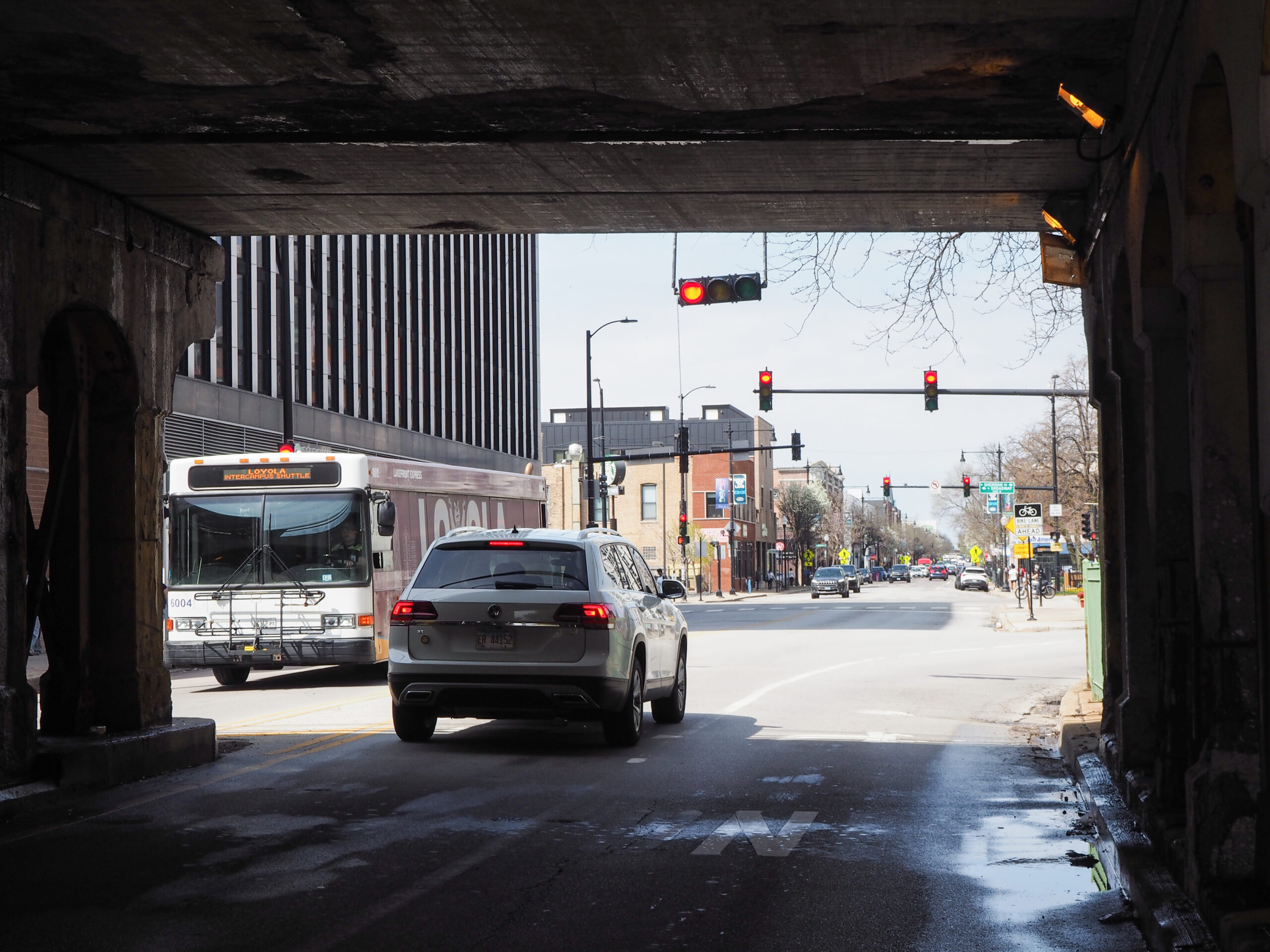
At the red light near the overpass where the Red Line travels over West Sheridan Road at Loyola’s Lake Shore Campus (LSC), pedestrians and vehicles come dangerously close to each other on a daily basis.
According to data collected by The Phoenix, 42 cars ran the red light right after the overpass — which in this article will be referred to as the overpass light — across three non-consecutive days between the hours of 4 and 5 p.m. — 19 cars April 7, eight cars April 8 and 15 cars April 13.
Additionally, during those same times and days, a total of 91 individuals jaywalked the crosswalk to the right of the overpass light, which for this article will be referred to as the north branch crosswalk, as it veers north and bridges West Sheridan Road and North Sheridan Road. There were 18 people who jaywalked there April 7, 18 people April 8 and 55 people April 13.
For the purpose of this article, The Phoenix considered a car to have run a red light when the light turned red before the bumper of their car touched the stop line and they continued to move forward, fully passing the line. Pedestrians were counted as jaywalking when at least a third of the time they spent in the intersection was while the crosswalk signal was on red, or if they crossed in an area not marked as a pedestrian walkway.
Despite the high number of cars The Phoenix recorded running the overpass light, from Jan. 1, 2023 to Dec. 31, 2025, nine vehicles total were pulled over for traffic light violations at various intersections along where West Sheridan Road intersects with LSC. This includes the intersections at North Kenmore Avenue, North Winthrop Avenue and North Sheridan Road, according to documents obtained by The Phoenix.
Adam Hyde, the director of the Traffic Crash Investigation and Safety Engineering division of the Northwestern Center for Public Safety, said this disregard for traffic signals in cars comes likely from the placement of the overpass light, which is partially hidden by the above Red Line tracks.
Because cars are unable to see the light until after they’ve driven under the overpass, they often don’t have enough time to react and stop their vehicle.
Among the cars who ran the overpass light were two Chicago Transit Authority (CTA) buses — one April 8 and another April 13 — as well as a Northwestern shuttle bus April 7. The CTA Northbound 147 bus that ran the light April 13 at 4:24 p.m. had to stop suddenly to avoid hitting a pedestrian in the north branch crosswalk.
From the beginning of one red light signal to the end of the next, the entire cycle for the overpass light lasts about one minute and 50 seconds. The pedestrian signal for the north branch crosswalk is about 17 seconds long.
The distance between the stop line at the overpass light and the north branch crosswalk is about 87 feet. There is an approximately 2.5 second gap in time from when the overpass light turns red to when the north branch crosswalk pedestrian signal turns green. If a vehicle is traveling at the West Sheridan Road speed limit of 30 miles per hour — 44 feet per second — and passes the line just before it turns red, they will reach the pedestrian crosswalk after about 2 seconds.
This leaves little room for error considering the high volume of pedestrians using and jaywalking the north branch crosswalk daily, many of whom are students at Loyola.
The Phoenix obtained documents citing two pedestrian-vehicle collisions between Jan. 1, 2023 and Dec. 31, 2025 on the stretch of West Sheridan Road that passes through LSC leading up to the overpass light.
The first incident took place Sept. 24, 2024 at 1139 W. Sheridan Rd., the reported cause being weather. It resulted in one non-incapacitating injury, according to the data from the city. The second incident, which took place Feb. 10, 2025 at 1100 W. Sheridan Rd., had an undetermined cause and resulted in one non-incapacitating injury, according to the dataset.
Additionally, an 18-year-old Loyola student was struck by a CTA Southbound 136 bus Feb. 4, 2025, and was then transported to the hospital in “critical/stable condition,” The Phoenix previously reported. This incident was not present in the data set shared by the city.
A few days later, The Phoenix reported a fourth pedestrian — an 18-year-old Loyola student — who was struck by a CTA bus Feb. 10, 2025 at the intersection of North Winthrop Avenue and West Sheridan Road. This incident was also not reflected in the data, although the investigation was reportedly handled by the Chicago Police Department, according to the article.
The Chicago Department of Transportation didn’t respond to The Phoenix’s requests for comment.
In addition to a slightly hidden traffic signal, there are zero pedestrian signs to warn vehicles of the upcoming intersection on the entire length of West Sheridan Road passing through LSC, which Hyde said would be the first step for the city to improve the area.
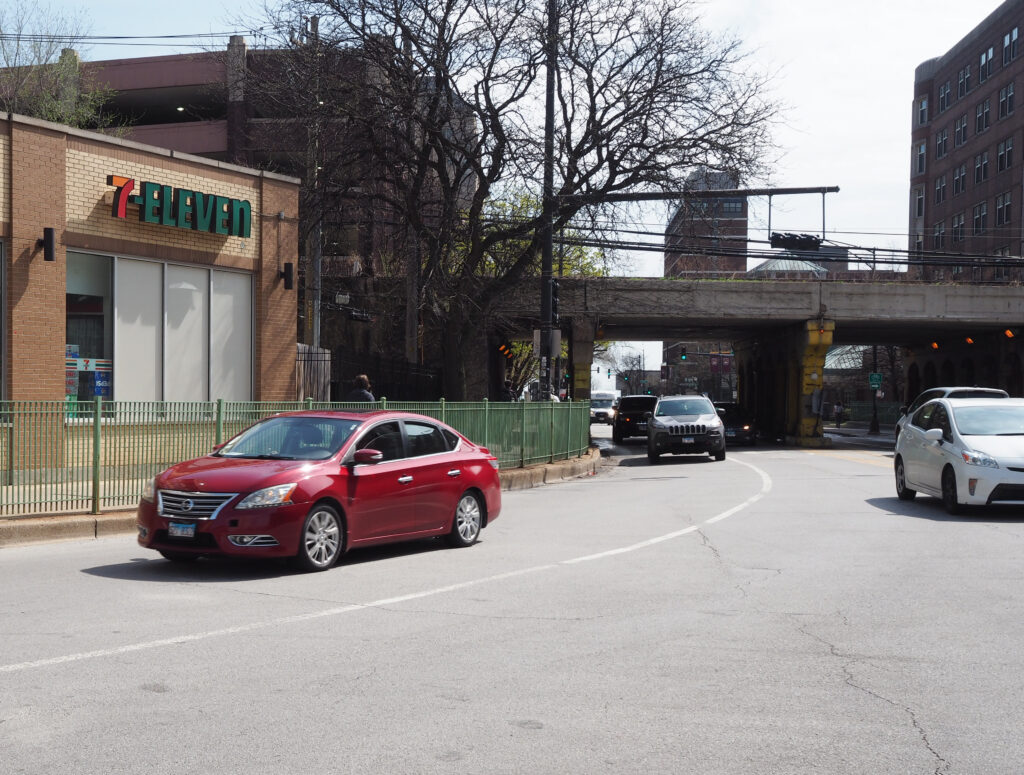
Beyond increasing pedestrian signage, Hyde also said the city could move the light to be in front of the overpass, giving drivers more reaction time. He said there’s a post installed in front of the bridge that makes it seem like the city began the process of relocating the traffic light, but then stopped halfway through.
The city didn’t respond to The Phoenix’s requests for information about the original design plans, the last traffic study conducted and the construction year of the intersection by the time of publication.
Loyola recently assumed responsibility for the traffic triangle located in the center of the intersection at West Sheridan Road and North Sheridan Road, which they then spent time renovating in 2025, The Phoenix previously reported.
Fourth-year multimedia journalism major Lucas Wagner has lived in an apartment near the overpass light and subsequent intersections surrounding the traffic triangle for the last two years. He said he uses the intersection daily to get to his friends’ apartment, which is located on the opposite side of West Sheridan Road. Due to the way the series of intersections are designed, he said he finds it easier to jaywalk, and does so regularly.
Although he hasn’t ever had a close call with a vehicle while jaywalking, he said he hears honking coming from the area of the overpass light and north branch crosswalk all the time in his apartment.
“I really noticed it right away, right when I moved here,” Wagner said. “I was like, ‘This is really dangerous.’”
Sometimes, Wagner said he plays crossing guard, attempting to fend off cars who are barrelling toward pedestrians in the north branch crosswalk and signaling to the vehicles to stop.
“There was a time when there was an older lady trying to cross, and I was holding my lacrosse stick out so that these drivers could actually see because there’s just not enough signage,” Wagner said.
Wagner said he sees a lot of cars running the overpass light, but he thinks it’s more due to confusion than actual malice. He said he thinks people jaywalk as much as they do because the intersection is aggravating to use properly and requires pedestrians to go out of their way.
Implementing an additional crosswalk across West Sheridan Road at the Eastern corner of the traffic triangle would make him happy.
In 2024, the university released their Campus Plan, which provides a comprehensive look at their hopes for how the intersections along where West Sheridan Road — a road that comes directly off the end of Lake Shore Drive — passes through LSC.
They include details about their desire to improve pedestrian accessibility and safety at both the intersections of West Sheridan Road and North Winthrop Avenue, North Kenmore Avenue and both the entrance and exit to Campus Road.
“Pedestrian activity along Sheridan has surged dramatically since the last traffic study was conducted in 2012, while vehicular activity has remained stable,” the Campus Plan reads. “High pedestrian crossings have increased by three to six times at Winthrop Ave and Sheridan Rd.”
Among the short-term solutions listed in the plan are increasing the number of pedestrian signs in the area, but references to this change are made in relation to the crosswalks at North Winthrop Avenue and North Kenmore Avenue, which are located East of the Red Line tracks.
There is no mention in the Campus Plan about increasing pedestrian warnings leading up to the overpass light or north branch crosswalk, which Hyde said were lacking in signage.
Additionally, the Campus Plan addresses congestion issues at the intersection of North Sheridan Road and West Arthur Avenue, located north of the overpass light.
The university declined to comment on the overpass light, and referred The Phoenix to the Campus Plan. There’s no mention of the overpass light in the plan, nor is there mention of their maintenance of the traffic triangle it’s directly next to.
Wagner’s roommate, fourth-year marketing and sports management double major Daniel Finerty, said he also frequently jaywalks across West Sheridan Road because he finds using the intersection properly to take too much time.
“You’ve got to watch for cars because nobody uses a turn signal,” Finerty said. “Like, if you’re going to run across the street, you’ve got to be prepared to spring and avoid some cars.”
Finerty said he also hasn’t had any close calls with vehicles while jaywalking across West Sheridan Road, but he thinks the risk is “100%” worth the reward.
“It just feels like so much less of an inconvenience,” Finerty said. “If it saves me five minutes and gets me there faster, I don’t really mind it.”
Although he said he knows the intersection can be confusing, he also thinks some of the drivers responsible for running the light know better and are just confident they can get away with it.
“There are people who take advantage of the fact that it’s confusing and will just run it because they know the intersection, and they know there’s not a camera there,” Finerty said.
Fourth-year biochemistry major Gianna Pane said she uses the intersection on a daily basis to get to-and-from her apartment and her classes, and always notices how unsafe it is. She said although she sees a lot of people jaywalk at the north branch crosswalk, she never does because she’s always worried about a car hitting her.
“It’s a little bit scary,” Pane said. “I feel like a lot of people will run the light before and then keep approaching, so most of the time I am really careful in looking out and looking both ways, even if it does have the walk sign.”
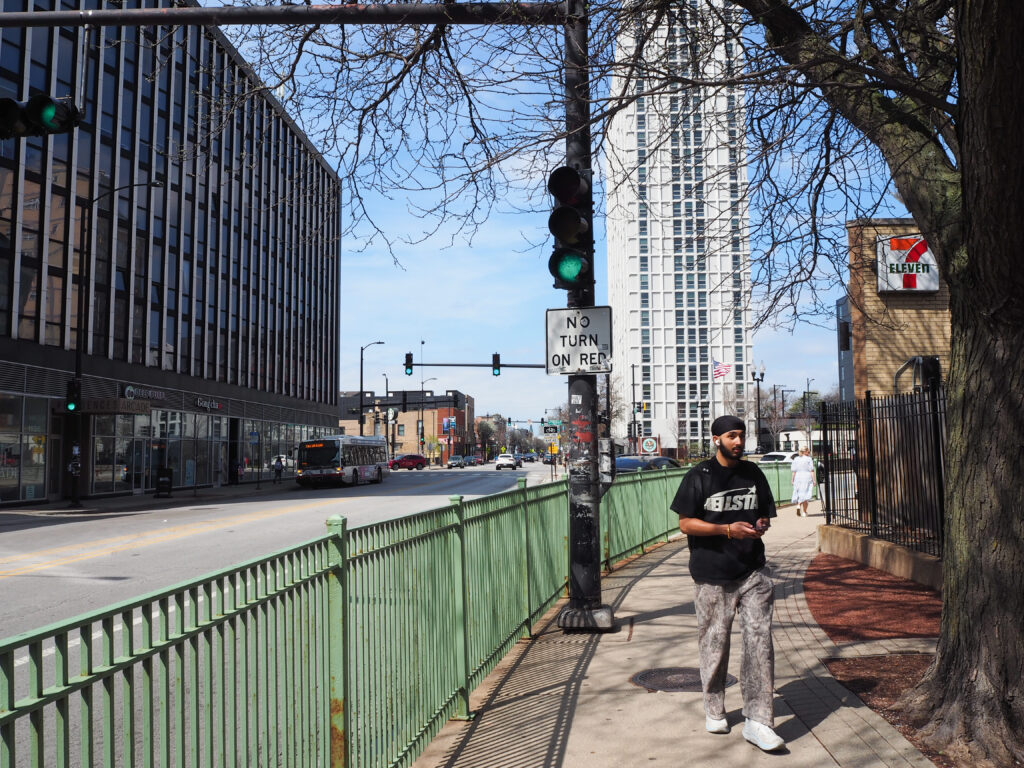
Earlier in the year, Pane said she had a close encounter with a car that came “flying” around the corner toward the north branch crosswalk from the overpass light, and since that event she’s been extra cautious.
Pane said she wishes the city would pay more attention to the area and the dangers of it, especially since so many students use it every day and there’s so much car traffic.
Finerty said he thinks the city should pay more attention to the intersection.
“I feel like I never see actual police cars on campus,” Finerty said. “I only see Loyola cops. And for a city that has traffic cameras that are going to charge me $100 or $40 for going, like, five over, it’s kind of ridiculous that they can’t monitor a school campus street where there’s a bunch of young people walking around and there’s more foot traffic than other areas.”